Classical · Site
Abhayagiri
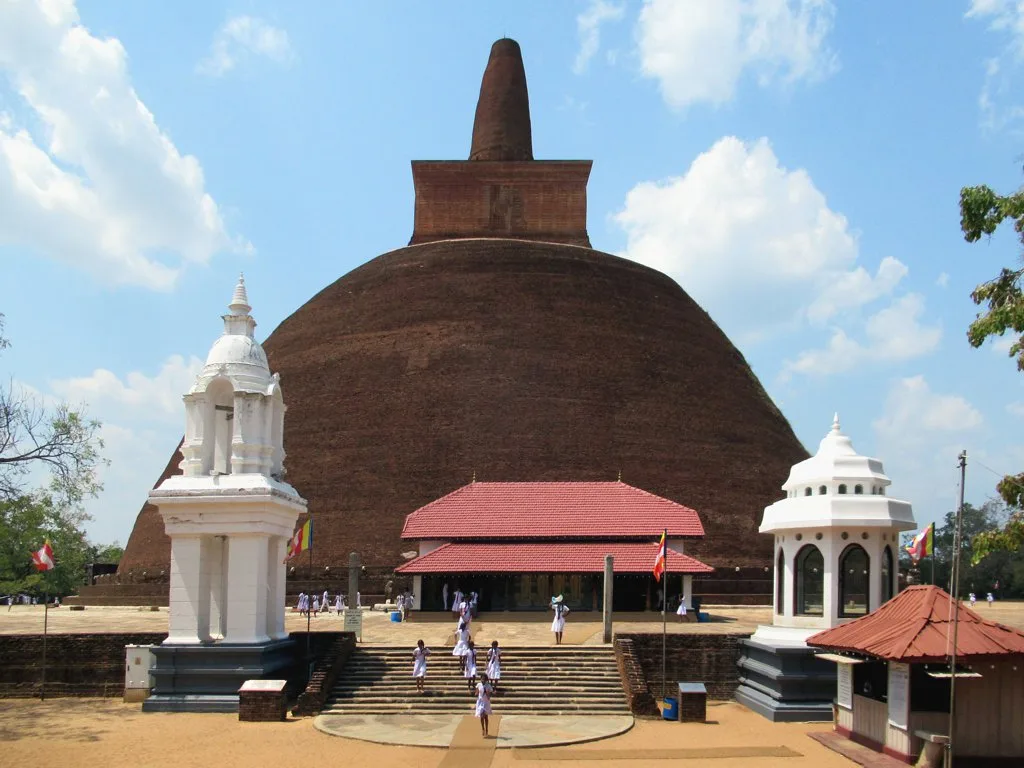
To the north of the old city rises the second of the giant dagobas, the mound of Abhayagiri, and behind it lay one of the great monasteries of the Buddhist world. It was founded in the first century before Christ by King Vattagamani Abhaya, and its name joins the king’s own, Abhaya, to that of a Jain named Giri whose hermitage had stood on the spot; it became the seat of the Abhayagiri fraternity, the more open and speculative of the city’s three great chapters, hospitable to Mahayana currents and to ideas from abroad in a way the orthodox Mahavihara was not. Its fame reached far. When the Chinese monk Faxian came to the island at the beginning of the fifth century he stayed at Abhayagiri and counted its community in the thousands, and for a long period the Tooth Relic of the Buddha was kept and shown here.
.jpg)
The dagoba is built to the same colossal ambition as the Ruwanwelisaya, its dome the paddy-heap shape the old builders reckoned the soundest for a brick mass of that size, and it once rose some hundred and twenty-three metres, on a circumference of three hundred and forty-four, laid out with a precision that still impresses: its axes set within a degree and a half of true, its spire only twenty-three millimetres off the dead centre of its base. The relic it was raised to hold is said to have been enshrined within a figurine of a bull worked in gold. Much brick lies lost from its full height, and what stands today follows the form to which Parakramabahu I rebuilt it, restored again in this century. A British tunnel driven into it in 1887 found only minor deposits; whatever treasure it held had been taken long before.
The lasting art of Abhayagiri is in its precinct as much as its mound. The seated Samadhi Buddha, among the noblest images the island ever cut, sat within this monastery, and here too are the works that show the classical genius for the threshold and the water’s edge: the Nagaraja guardstone at the Ratnaprasada, where the cobra-hooded serpent-king stands watch with his pot of abundance, the exquisite moonstone of the so-called Queen’s Pavilion, and the Kuttam Pokuna or Twin Ponds, a pair of stepped bathing tanks fed through a carved makara mouth, plain in line and faultless in proportion. In these the monastery’s real character shows, a learning and a refinement that turned even a bathing pool and a doorstep into occasions for the highest art.
Sources
- The Mahavamsa and the Culavamsa; Faxian, A Record of Buddhistic Kingdoms.
- Paranavitana, Senarath. The Stupa in Ceylon (Memoirs of the Archaeological Survey of Ceylon, Vol. V). 1946.
- Bandaranayake, Senake. Sinhalese Monastic Architecture: The Viharas of Anuradhapura. Leiden: Brill. 1974.
- UNESCO World Heritage Centre. ‘Sacred City of Anuradhapura’ (inscribed 1982). https://whc.unesco.org/en/list/200/
- Ponnamperuma, Senani. The Story of Anuradhapura.
How to cite this profile
Malaka Talwatte, “Abhayagiri,” Malaka Talwatte: Sri Lankan Art and Ceylon Antiquaria, https://malakatalwatte.pages.dev/artists/abhayagiri/.
Quote and cite freely with attribution; please do not republish a whole essay, or a photograph, without permission.