For collectors
How to collect the island's art, and be sure of what you hold.
The questions a collector brings to someone who has spent a lifetime with the work, answered plainly and grouped by topic.
Value and authenticity
How can you tell if a Sri Lankan painting is valuable?
Value gathers where several things line up at once, and no single one settles it. The first is the hand: a work by a '43 Group painter, a George Keyt or an Ivan Peries, sits in a different world from an unattributed canvas, and where a piece falls within that artist's own work matters too, an ambitious oil against a slight study.
The second is provenance, a documented line of ownership and a place in exhibitions and the literature. The third is condition, which in this climate is never simply given. The fourth, and the one that most often decides it, is authenticity: whether the work is genuinely by the hand it carries. The most celebrated names are also the most imitated, precisely because those names carry the most, so the nearer a painting sits to the top of the market, the more its worth rests on an eye that knows the difference.
That judgement is not made from a photograph or a signature alone. It is made by someone who has spent a lifetime with the work, and it is the first thing worth establishing before anything else follows.
How do you know a painting is genuinely by a '43 Group artist?
By the same evidence that decides value: the hand, the documented history, and the judgement of someone who knows the artist's work closely. A signature settles little on its own; the celebrated names are exactly the ones worth imitating, so authentication rests on the picture itself read against the artist's known work, on provenance, and on a place in the literature or a known collection. This is a judgement to establish before a purchase, not after.
How is a work by George Keyt valued?
By the same measures as any painting: the work read against the artist's known hand, its provenance, its condition, and where it sits in his output. Keyt is the most sought-after of the Sri Lankan moderns, his work held at the Victoria and Albert Museum in London and the National Gallery of Modern Art in New Delhi, and reaching the highest prices of any Sri Lankan painter at international auction. That standing is exactly why authentication and provenance matter most with his name.
What is a certificate of authenticity worth?
As much as the person who signed it. A certificate from a recognised authority on the artist, or from the artist's estate, carries weight; one from an unknown party, or the seller alone, carries little. Treat it as a starting point for your own checks, not a substitute for them.
What happens if a work turns out not to be what it was sold as?
Abroad, a serious misdescription can be grounds to return a work under consumer or contract law, often within a stated period. In Sri Lanka little formal recourse exists locally, which is the strongest argument for buying from people who stand behind what they sell, and for doing the checks before you pay rather than after. For any specific case, confirm the position with counsel.
Provenance and attribution
What is provenance, and why does it matter?
Provenance is the recorded history of a work's ownership, from the artist's hand to the present holder. A line of named owners is evidence that a work is what it is said to be; it establishes clear title, and it carries the exhibition and publication history that scholarship rests on. Gaps are common in older material and are not damning in themselves, but they should be described rather than smoothed over.
How do you test a provenance claim?
You follow it back and look for the joins. Named collections, dated sale records, exhibition labels and catalogue references can each be checked against the published record; a claim that rests only on the seller's word, with nothing to corroborate it, is worth less than one that can be traced. A seller who has done the work will show you the evidence rather than ask you to take it on trust.
What do 'signed', 'attributed to', 'studio of' and 'after' mean?
They are graded terms for how firm the attribution is. A plain name or signature is the strongest; 'attributed to' means the balance of opinion favours the artist but stops short of certainty; 'studio of' points to the artist's workshop rather than their own hand; 'after' means a later copy of a known composition. The wording is doing careful work, and it is worth reading closely.
Why does a catalogue raisonné matter?
A catalogue raisonné is the complete, scholarly record of an artist's known work. A piece that appears in one carries a strong presumption in its favour; a piece that should appear and does not invites a question. For most Sri Lankan artists no such catalogue yet exists, which is precisely why provenance and documentation carry so much weight here.
Condition and care in the tropics
Which condition problems matter most in a tropical climate?
Humidity governs, and most of the rest follows from it. Sustained damp brings mould and foxing, swells and cockles the support, and creates the conditions insects prefer. A clean sheet bought in a temperate country can fox after a few years in Colombo, because foxing is latent in the paper and triggered by moisture. Condition here is not a fixed state; it is something you maintain.
Does restoration reduce value?
Sympathetic, well-documented conservation that stabilises a work generally protects its value; heavy or hidden restoration that disguises loss reduces it. The market's distinction is between conservation, which is reversible and declared, and repainting, which is neither. Keep the record of any treatment, and of who carried it out.
What can be done in a house without climate control?
A great deal, short of a museum. Keep works out of direct sun and off external walls, run a dehumidifier through the wettest months, and frame under an acid-free mount with a spacer so the sheet never touches the glass. Stability matters more than any single reading on a meter: a steady, moderately dry room is kinder than one that swings.
Buying and the market
How do you start collecting Sri Lankan art?
Look a great deal longer than you buy. See work in person wherever it is publicly held, read the standard literature, and settle on a direction, one artist, one period or one subject, before spending. Provenance and authenticity matter most where value is highest, so with any significant work the soundest first step is an informed opinion from someone who has spent a lifetime with it, on what it is and whether it is worth acquiring. Many collectors begin with a single antiquarian map or book, lower in price and rich in history, before the first painting follows.
Is a cheap reproduction worth buying?
A printed reproduction can be a pleasure to live with, and there is no harm in hanging one you love. It helps, though, to be clear about what it is. A mass-produced copy, of the kind sold cheaply online, has decorative value but no lasting worth: it holds no value over time, carries no history, and is not a thing to pass on.
A genuine work is another matter. An original painting, or a real period print with a record behind it, is made to outlast you, to be handed to the next generation, and to be worth more for the years it has kept. If you mean to spend, spend on the real thing. That is where the value, and the pleasure that lasts, actually lie.
Where can you acquire Sri Lankan art?
The historic work is held in the island's public collections and, internationally, in museums such as the Victoria and Albert Museum and the National Gallery of Modern Art in New Delhi. A selection of works from The Talwatte Collection can be acquired by arrangement: it is a private collection shown by appointment rather than a gallery, so acquisition is by enquiry, not off a wall. A work comes with Malaka Talwatte's knowledge of it and a documented provenance, which is the difference that lasts.
How do auction estimates and reserves work?
An estimate is the auction house's opinion of the likely hammer range; the reserve is the confidential minimum below which the work will not sell, and it sits at or below the low estimate. Estimates are a guide, not a valuation, and they are set to encourage bidding as much as to predict it.
What is buyer's premium?
It is the percentage the auction house adds to the hammer price, paid by the buyer on top of the winning bid. It is substantial, often a quarter or more of the hammer, and it is easy to forget in the moment. Read the terms before the sale and budget for it.
Ceylon prints, maps and books
Is an old map or print of Ceylon valuable, and how do you identify it?
It can be, and identifying it is the first step to knowing. Look for the process (relief, intaglio or lithograph, explained below), the maker and date, whether the colour is original, and whether the sheet is complete and sound. A named cartographer or artist, an early impression and original hand-colouring all lift a sheet; a later reprint or a cut-down copy sits well below it. Much of the antiquarian record of Ceylon is over a century old, which is worth knowing before it moves.
A guide to prints: relief, intaglio, lithograph, hand-colouring
Before photography, an image of Ceylon reached the world only as a print. Three families cover almost everything you will meet.
Relief prints, the woodcut and wood engraving, take ink on a raised surface, as with a stamp; the oldest method, long used to illustrate books.
Intaglio prints, the engraving, etching, mezzotint and aquatint, are printed from lines cut or bitten into a plate, so they often show a plate mark pressed into the sheet. From the 1820s and 1830s harder steel replaced copper, allowing longer runs and finer lines, which is why so many mid-century Ceylon books are steel engravings; aquatint, which gives tone from powdered resin, carried most of the early hand-coloured views.
Lithographs are drawn on stone or zinc with a greasy crayon and bear no plate mark, which is the quickest way to tell one from an intaglio print; lithography largely superseded aquatint from the 1840s.
Hand-colouring is the distinction every print collector should hold: a print coloured by hand after printing, against one printed in colours from the plate. Hand-colouring was done by teams working to an approved pattern, so no two impressions of a view are tinted quite alike. This draws on R. K. de Silva's Early Prints of Ceylon (1985), the standard guide.
What do 'plate', 'impression' and 'state' mean?
A plate is the engraved or lithographic surface a print is taken from; an impression is a single print pulled from it, and early impressions are crisper than late ones where the lines have worn. A state is a stage in the life of the plate: an engraver may rework it, and each change makes a new state, with earlier states often the rarer. For maps, the states record the island's changing coastline of knowledge as each survey corrected the one before.
What makes one antiquarian book of Ceylon worth more than another?
Completeness first: a book with all its plates, maps and text present is worth far more than a broken copy. Then the impression quality of the plates, the presence or absence of later colouring, the binding, and the provenance. Two copies of one title, one complete and clean and one lacking plates, are not the same object at all.
Owning and moving works
Can you legally export an antique painting, map or book from Sri Lanka?
Not freely. Sri Lanka restricts the export of cultural property, and an item over a hundred years old may need a licence and the approval of the Department of Archaeology before it can leave the country. Many antiquarian maps, books and prints of Ceylon cross that line. The rules are specific and they change, so treat this as a matter to settle with a lawyer and the authorities before you commit, not after.
Is this a decorative reproduction or a real work?
A decorative reproduction is a printed copy made to hang on a wall; an original is the artist's own work, or a genuine period print, with a record behind it. The difference is not always visible across a room, but it is decisive in what you own. Ask what the object actually is, in plain terms, and what documents come with it. A real work has an answer.
Collecting the '43 Group
What was the '43 Group, and who were its members?
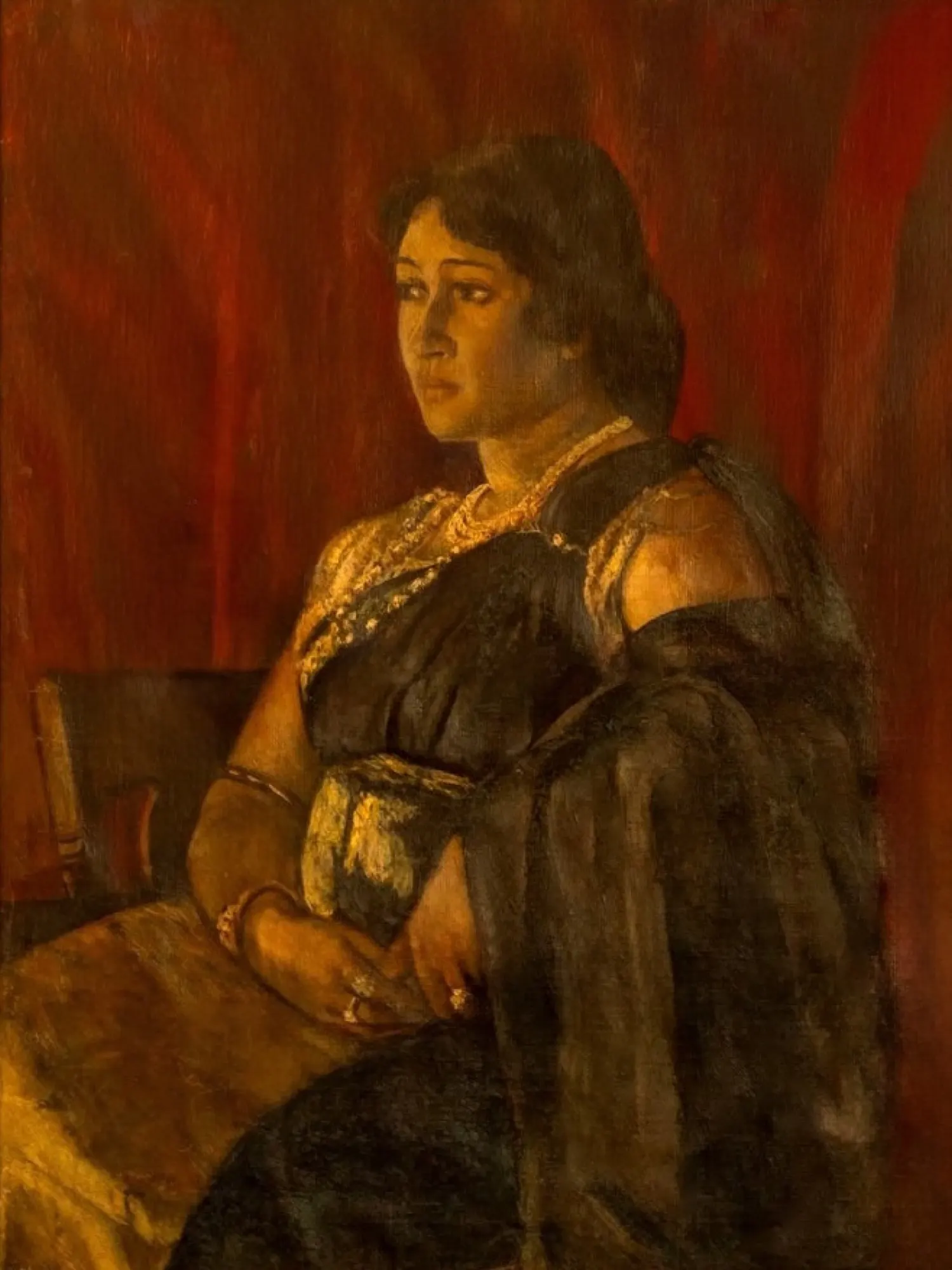
The '43 Group was the circle of painters who met in Colombo in August 1943, broke from the academic Ceylon Society of Arts, and resolved that the island would have a modern art of its own, formed on its own terms rather than borrowed from London or Paris. It gathered around the photographer and critic Lionel Wendt; its painters included George Keyt, its best-known figure, alongside Ivan Peries, Justin Deraniyagala, Harry Pieris, George Claessen, Geoffrey Beling, Richard Gabriel, Aubrey Collette and L. T. P. Manjusri. By 1955 the Group hung at the Venice Biennale, and it remains the foundation of modern Sri Lankan art.
Why is the '43 Group the most collected Sri Lankan art?
Because it is the pivot of the island's modern art, and its supply is fixed. Every member has died, no new work will be made, and the public holdings are settled, so what remains in private hands is a closed and slowly shrinking pool. Historical importance and finite supply together are what concentrate collector attention here. It is a fact about the field, not a reason to hurry.
What should you check before buying a '43 Group work?
Provenance first, and it is close to everything: a named estate, a documented collection, an exhibition history. A work with a clear line is one you can buy, and one day sell, with confidence; a work without one warrants caution, however attractive.
Then documentation. A certificate from a credible authority, a place in the literature, or a history in a known collection. The market for these painters is thin and largely undocumented, so the evidence that does exist matters more, not less, and the most celebrated names are the ones most worth imitating.
How has the '43 Group market moved?
The Sri Lankan modern market is still young, and prices have risen more slowly than the Indian modernism of the same years. George Keyt reaches the highest prices of any Sri Lankan painter at international auction; the rest of the Group trades more quietly. Value here rewards patience and knowledge more than speed.
About Sri Lankan art
What is Sri Lankan art?
Sri Lankan art is the whole record of the island in image: from the fifth-century rock paintings of Sigiriya and the shrine walls of Anuradhapura and Polonnaruwa, through the temple painting of the Kandyan kingdom and the foreign draughtsmen who recorded colonial Ceylon, to the modern art the island made its own in 1943 and the work of the artists at work today. It is among the oldest painting traditions in South Asia.
Who are the most important Sri Lankan artists?
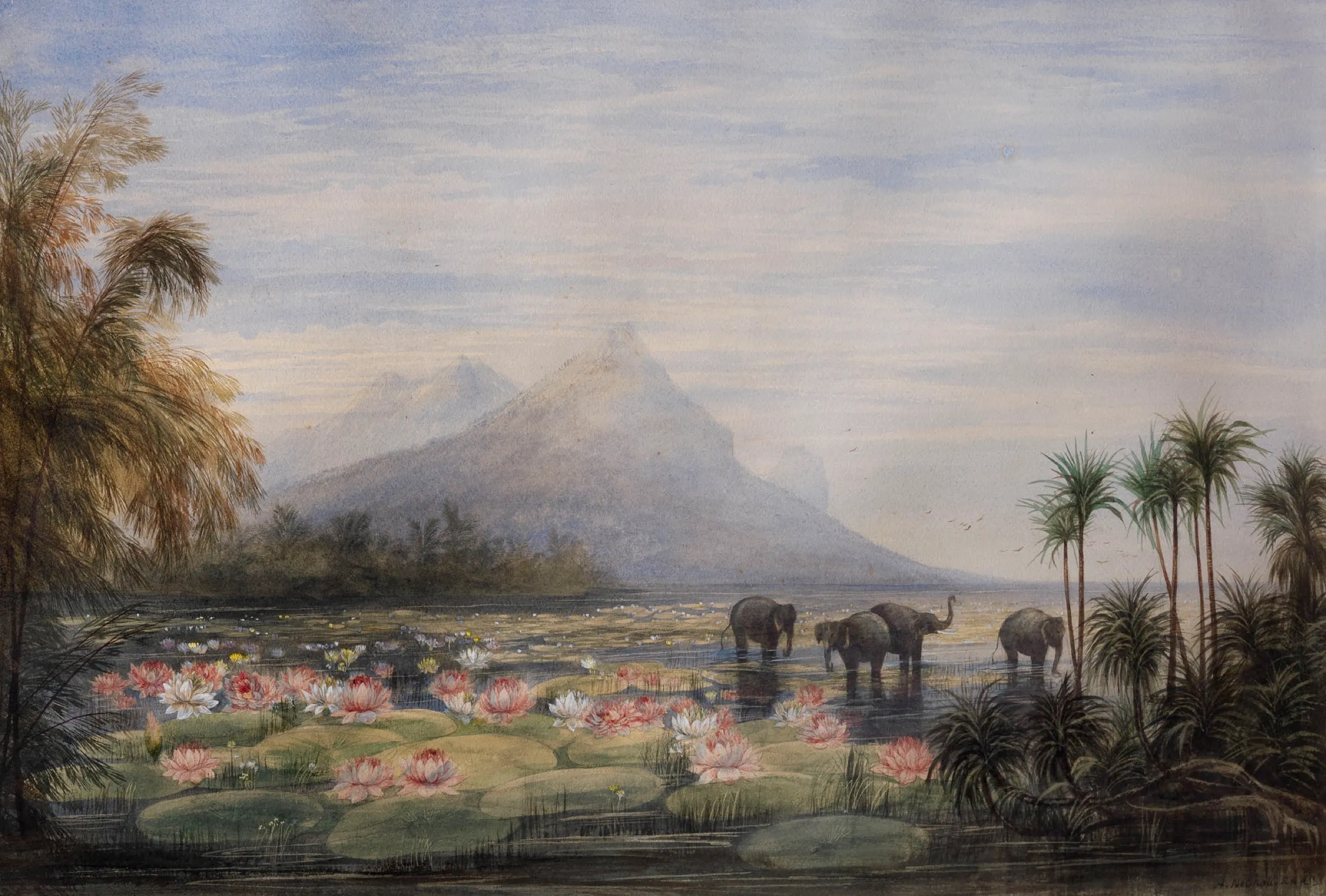
The island's modern art turns on the '43 Group, the circle that broke from the colonial salon in 1943. Its best-known figure is George Keyt, who set the line of Matisse and the structure of Cubism against the temple sculpture of South Asia; around him stood Ivan Peries, painter of the southern shoreline, Justin Deraniyagala, the boldest of its expressionists, and Lionel Wendt, who convened them. Before them come the painters who first recorded the island for the wider world, Andrew Nicholl among them.
Among living artists, Senaka Senanayake has painted for seven decades, from a child prodigy shown abroad to the luminous rainforest canvases of his maturity; and a contemporary generation has carried the island's art onto the international stage, among them Jagath Weerasinghe, Anoli Perera, Pala Pothupitiye and Priyantha Udagedara. Each has a page here.
What is the history of Sri Lankan painting?
The island's painting runs in seven ages. The oldest survives on rock and temple wall, from Sigiriya in the fifth century to the shrines of Anuradhapura and Polonnaruwa, its makers unnamed. The Kandyan kingdom, the island's last, gave the first painters the record keeps by name. Under the Dutch and the British, foreign draughtsmen recorded Ceylon for a world that would otherwise never have seen it. As that old tradition passed, lowland temple painters carried it towards the modern. In 1943 the '43 Group broke from the colonial salon and made a modern art of the island's own; a later generation brought abstraction; and a living generation carries the work on.
Who are the leading contemporary Sri Lankan artists?
Among living artists, Senaka Senanayake has painted for seven decades, known now for his luminous rainforest and lotus canvases. A politically engaged generation came up through the island's long civil war, much of it around the Theertha Collective and the movement known as the '90s Trend. Of those who have carried the island's contemporary art onto the international stage, Jagath Weerasinghe, Anoli Perera, Pala Pothupitiye and Priyantha Udagedara are among the leading figures, working across painting, installation and performance.