Contemporary · Artist
Anoli Perera
A dress stands in the middle of the room with no one inside it, sewn from paper, thread, cloth and lace, empty where a body should be. Anoli Perera makes garments that no woman can wear, and the emptiness is the point: the dress holds what a woman in society is asked to become and to hide, the shape expected of her with the person left out. That question, the space between what a woman is and what she is made to perform, is the thread she has followed for thirty years, and from the 1990s onward it placed her among the first artists on the island to set a woman’s position at the centre of contemporary practice.
She arrived at that question from the far side of the university. Born in Colombo in 1962, she took her first degree at the University of Colombo in political science, economics and sociology, and followed it with a graduate diploma in international affairs; the art training came later and elsewhere, in programmes at Santa Barbara and Princeton between 1988 and 1992. The route left its mark on the work. She reads society the way a social scientist might, through consumer culture, advertising, myth, history and the household, then makes her argument in cloth, object and image rather than in prose.
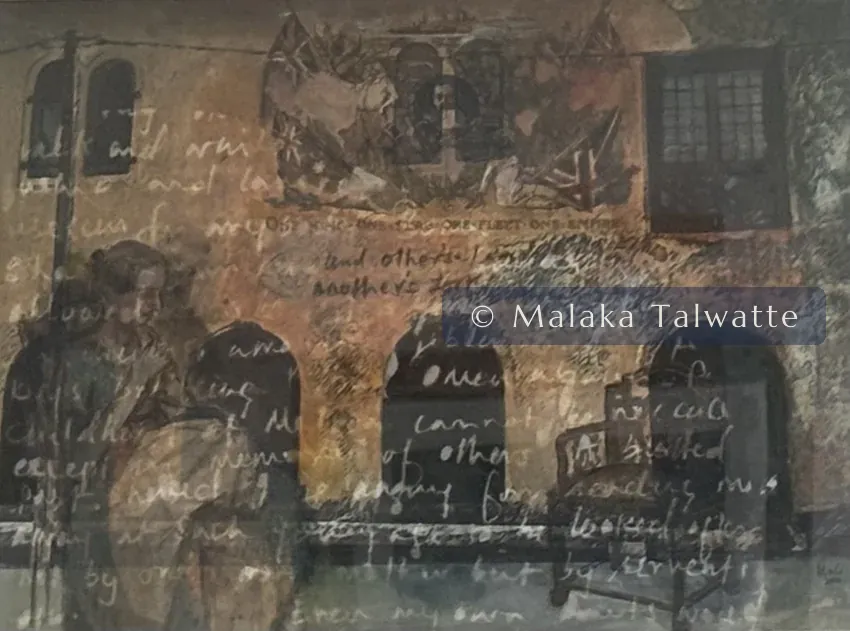
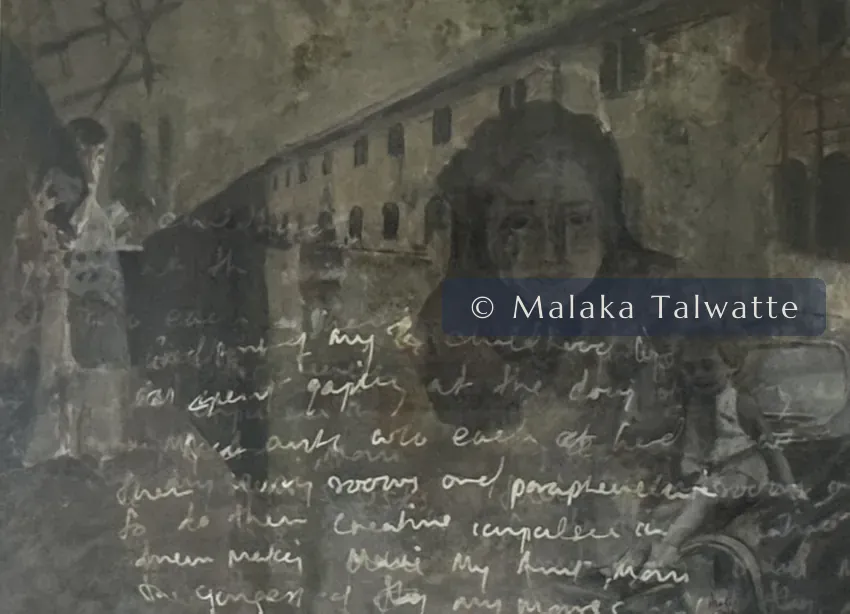
The empty dress is one answer among many. Her practice moves across painting, sculpture, installation, photography and photo-performance, held together by a habit of accumulation, fragments of text, found objects, raw materials and painted surfaces layered until the surface itself becomes an argument. In recent years clothes, thread, lace and paper have become her chief materials, and the making, the stitching and binding, is part of the meaning. Her recurring subject is the position of women, caught between the labour of the home and a gaze that turns them at once into something to be desired and something to be sold to, and set always against a manufactured ideal of beauty they are asked to match.
She has built institutions as well as objects. In 2000 she was among the founders of the Theertha International Artists’ Collective in Colombo, the body that gathered much of the ’90s Trend generation, and she has served it since through workshops, programming and international collaborations, and through her own writing on Sri Lankan art. Having worked for years between Colombo and New Delhi, a movement that widened the reach of her practice across South Asia, she now lives once more in Sri Lanka.
Her standing outside Sri Lanka rests on named work. In 2002 she held a residency at the Fukuoka Asian Art Museum in Japan and a visiting-artist residency at the University of Wollongong in Australia. She has shown at the Colombo Art Biennale and the India Art Fair, and held solo exhibitions including ‘The City, Janus-Faced’ at Shrine Empire in New Delhi, the gallery that has shown her repeatedly, and ‘Comfort Zones’ at the Kashi Art Café in Kochi. Her installation ‘Elastic Dress’ featured in ‘Don’t Measure Me’ at the Historisk Museum in Oslo, and her work has been presented by the Ishara Art Foundation in Dubai.
Come back to the dress standing empty in the room. For all the theory behind it, the work stays close to the hand that made it: a garment of stitched paper, a surface built up thread by thread, a form bound in lace. Anoli keeps returning to the quiet labour women have long done, and gives it room in a gallery where it has seldom been allowed any.
Sources
- Wikipedia. ‘Anoli Perera.’ https://en.wikipedia.org/wiki/Anoli_Perera
How to cite this profile
Malaka Talwatte, “Anoli Perera,” Malaka Talwatte: Sri Lankan Art and Ceylon Antiquaria, https://malakatalwatte.pages.dev/artists/anoli-perera/.
Quote and cite freely with attribution; please do not republish a whole essay, or a photograph, without permission.