Classical · Site
Anuradhapura
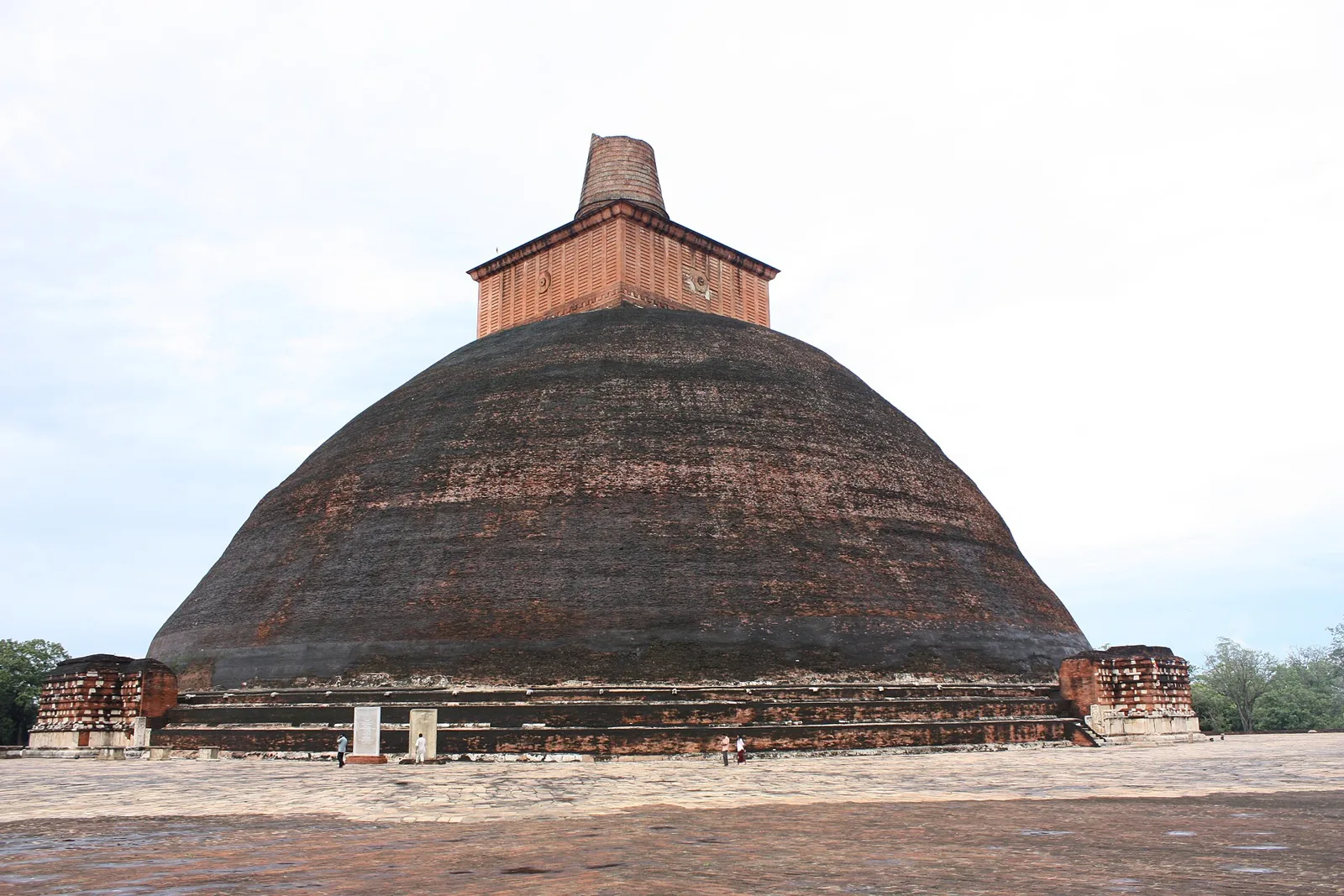
For close to fourteen hundred years the seat of Sinhalese kingship stood on the northern plain at Anuradhapura, established as a capital, the chronicles hold, by King Pandukabhaya in the fourth century before Christ; at its height the city spread across some forty square kilometres, one of the largest and most resplendent capitals of the ancient world. Its measure is easiest to take in brick. The great dagoba of Ruwanwelisaya, raised in the second century before Christ, and the still larger Jetavana and Abhayagiri that followed, were among the biggest built structures anywhere on earth, exceeded in their day only by the two great pyramids of Giza. To stand before them is to see the ambition of the classical island whole.
.jpg)
The city grew around a faith. Buddhism reached Ceylon in the third century before Christ, when the missionary Mahinda, son of the Mauryan emperor Asoka, converted King Devanampiya Tissa, and from that moment the making of merit and the making of monuments ran together. A sapling of the very tree under which the Buddha gained enlightenment was planted here, the Sri Maha Bodhi, and around it rose the first stupa, Thuparama, then the great relic-mounds, the monasteries, the bathing tanks and the image-halls of a sacred landscape that kings enlarged for a thousand years. Three monastic fraternities, the Mahavihara, the Abhayagiri and the Jetavana, held the city between them, at times in learned rivalry, and their precincts still divide the ruins today.
The art of Anuradhapura is above all an art of the stupa. The Sinhalese builders raised the solid hemisphere, the paddy-heap and the bell, to a colossal scale on foundations of stamped stone and clay, cased them in millions of bricks and a gleaming lime skin, and crowned them with the square Hatharaskotuwa and its tapering spire, a form the island refined over centuries and lent, in the ring of pillars at Thuparama, the beginnings of the circular relic-house or vatadage. Around the stupas the classical sculptor worked the same restraint into stone: the seated Samadhi Buddha in its deep meditative calm, serene and abstracted in the manner the island drew from Gupta India and made its own, the guardian Nagaraja at the threshold, and the carved semicircle of the moonstone underfoot, where the whole path from desire to release is set down in concentric bands. The finest bronzes of the age, the Tara now in the British Museum among them, carry that gravity into metal. Much of this stone was never meant to be seen bare. The classical image was plastered, painted and often gilded, and only rare survivals, a trace of pigment under the Samadhi Buddha’s shoulder, the stucco still clinging to the colossal figures at Buduruwagala, hint at the colour the grey ruins have lost.
The record of who made it is thin, and this is part of the story. The builders left few inscriptions of their construction, and but for the monastic chronicles, the Dipavamsa, the Mahavamsa and the Culavamsa, the names behind the greatest of these works would be lost entirely. Those chronicles are indispensable and partial at once, freely mingling fact with legend in the telling, so that the history of the city has to be read with a careful eye, its wonders weighed against its miracles. What stands beyond doubt is the scale of the achievement and the length of the devotion.
The end came from the south of India. After centuries of pressure and interrupted rule, the Chola conquest of the early eleventh century broke the kingdom, the capital was abandoned for Polonnaruwa, and the jungle closed over the monuments for the better part of a thousand years. Travellers and colonial officers came upon the ruins piece by piece, from Robert Knox in the seventeenth century to the British surveyors of the nineteenth, and the long work of clearing, study and restoration began that continues still. The Sacred City of Anuradhapura was inscribed on the UNESCO World Heritage list in 1982, and the Sri Maha Bodhi, tended without a break since its planting, remains the oldest historically documented tree in the world.
Sources
- The Mahavamsa, the Dipavamsa and the Culavamsa.
- Paranavitana, Senarath. The Stupa in Ceylon (Memoirs of the Archaeological Survey of Ceylon, Vol. V). 1946.
- Bandaranayake, Senake. Sinhalese Monastic Architecture: The Viharas of Anuradhapura. Leiden: Brill. 1974.
- Coomaraswamy, Ananda K. Medieval Sinhalese Art. 1908.
- UNESCO World Heritage Centre. ‘Sacred City of Anuradhapura’ (inscribed 1982). https://whc.unesco.org/en/list/200/
- Ponnamperuma, Senani. The Story of Anuradhapura.
How to cite this profile
Malaka Talwatte, “Anuradhapura,” Malaka Talwatte: Sri Lankan Art and Ceylon Antiquaria, https://malakatalwatte.pages.dev/artists/anuradhapura/.
Quote and cite freely with attribution; please do not republish a whole essay, or a photograph, without permission.