Pre-modern · Artist
Arent Jansen
Arent Jansen, a draughtsman and painter in the Company’s service with the rank of ensign, was in Ceylon in the early 1730s, when Governor van Domburg commissioned him to record the island’s noteworthy sites. Among them stood the rock temple of Mulgirigala, which the Dutch called Adam’s Hill, in the belief that Adam and Eve lay buried on the rock. Jansen built a hut at the foot of the rock, climbed it, was shown its painted chambers by the priests, and took soot-and-paper rubbings of the inscriptions, which he afterwards redrew in miniature, a patient method that speaks to the care of the man.
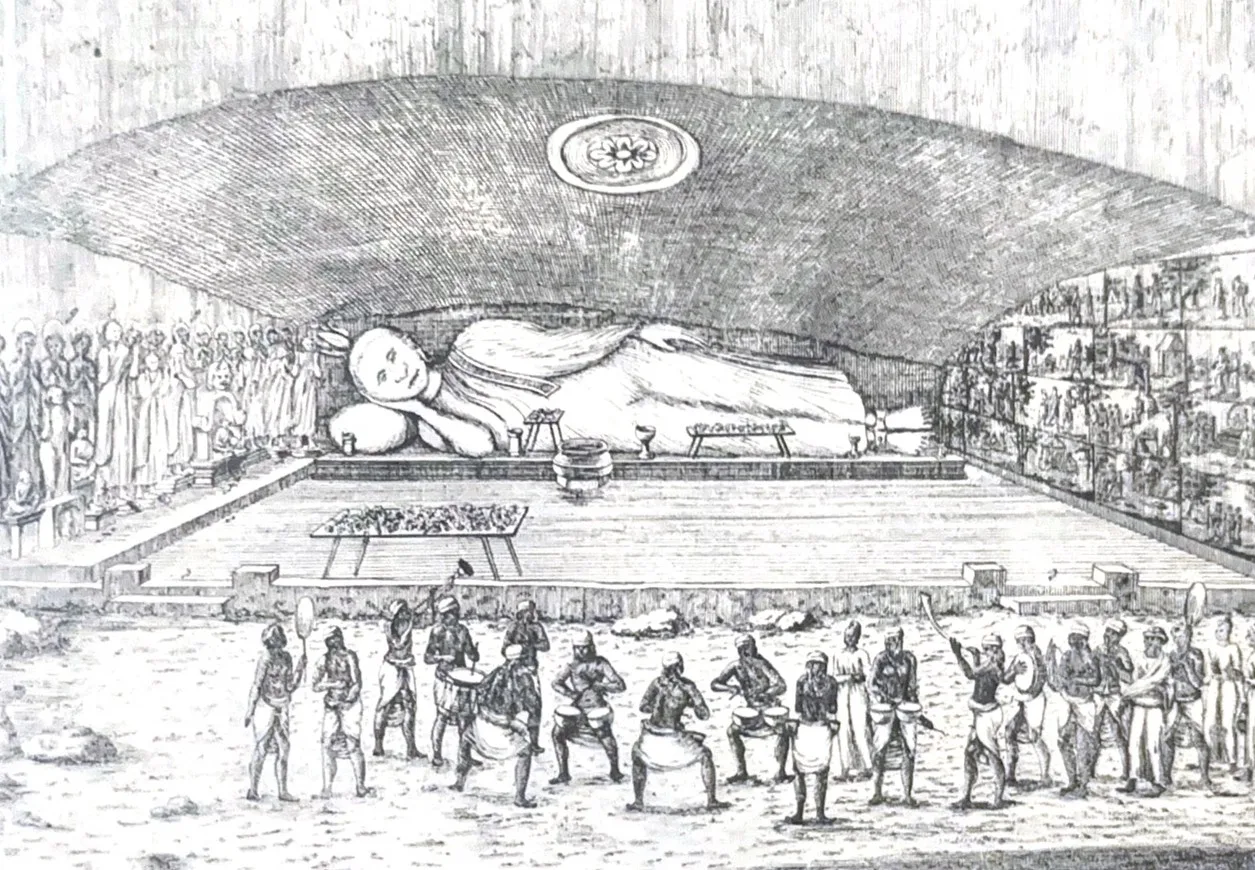
Many of his sketches passed to his friend J. W. Heydt, who had them engraved for his own book of 1744 with due acknowledgement, so that Jansen’s careful record of Mulgirigala survives at one remove. Heydt praised his accuracy, calling him an honest and experienced man of thirty years in the East. His work, preserved chiefly through another’s pages, remains a valuable early witness to the rock temple and its chambers.
What sets Jansen’s Mulgirigala apart is its subject. The Dutch record is overwhelmingly one of coasts and forts, the things a maritime power needed to see, and here instead is the painted interior of a Buddhist shrine, its reclining Buddha and its wall paintings given with the dancers and drummers before them. His patient method, the built hut, the soot-and-paper rubbings, the redrawing in miniature, is closer to the antiquarian’s than the topographer’s, an early effort to record a sacred site of the interior as it actually stood. Through Heydt’s plates it became one of the first considered European images of a Ceylon temple seen from within.
Sources
- de Silva, R.K., and W.G.M. Beumer. Illustrations and Views of Dutch Ceylon 1602–1796. E.J. Brill / Serendib Publications. 1988.
- Heydt, Johann Wolfgang. Allerneuester Geographisch- und Topographischer Schau-Platz von Africa und Ost-Indien. 1744.
How to cite this profile
Malaka Talwatte, “Arent Jansen,” Malaka Talwatte: Sri Lankan Art and Ceylon Antiquaria, https://malakatalwatte.pages.dev/artists/arent-jansen/.
Quote and cite freely with attribution; please do not republish a whole essay, or a photograph, without permission.