Classical · Sculpture
The Aukana Buddha
Twelve metres of granite stand at Aukana in the shape of a Buddha, cut almost free of the rock that holds it and finished with a delicacy the scale does nothing to coarsen. The right hand is raised to the shoulder, the palm turned out in the asisa mudra, the Sinhalese gesture of blessing; the left grips the robe at the shoulder; and the robe itself is the marvel of the work, drawn so close to the body that the figure reads through it, its pleats combed into fine parallel folds that fall the whole height of the image and gather in a bell at the feet. The tension between the colossal size and the fineness of that carved cloth is the whole art of it.
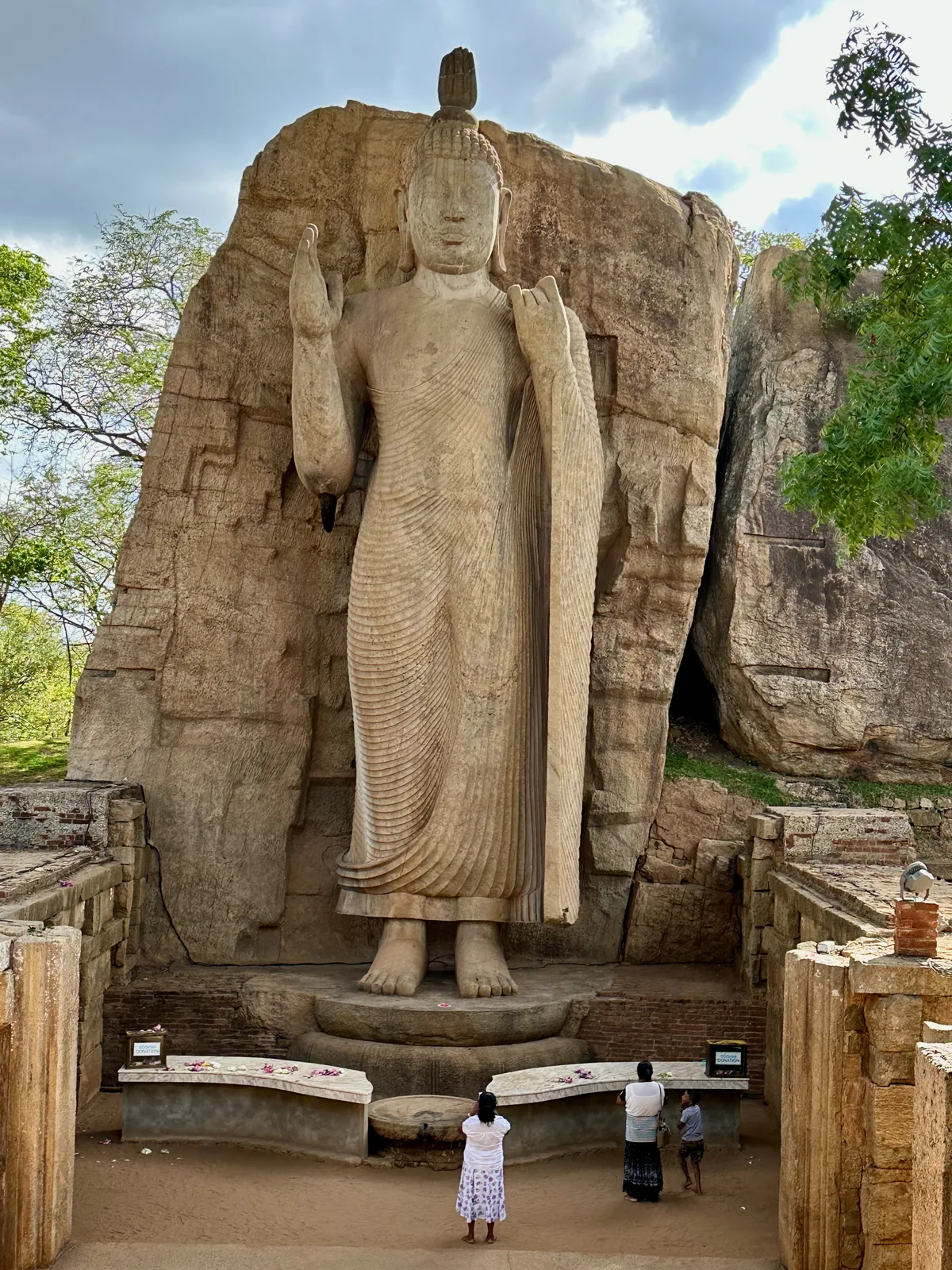
The image was cut in place from a single face of living granite, freed from the parent rock save for a narrow band left at the back to steady it, and raised on a lotus plinth; the foundations of a brick image-house survive around it, so the Buddha now open to the sky once stood enshrined. The drapery, close and clinging with a raised fold at the ankle, belongs to the Amaravati tradition of southern India, and the wide-shouldered, columnar body to the Gupta; from that inheritance the Sinhalese carver made the erect, frontal, deeply calm figure reckoned the finest of the island’s colossal standing Buddhas. Visitors are still told that the proportions are so exact that a drop of rain from the tip of the nose falls between the feet; the claim is not to be tested, though the story catches the precision the carving plainly has.
When it was made is not settled. Tradition gives it to the fifth century and to King Dhatusena, who built the great Kala Wewa reservoir below it; a donative inscription found at the shrine in 1951 is of the eighth century, and Diran Dohanian, reading the robe and the pose, argued for the eighth as well. The two dates lie three hundred years apart and the question stays open, though the inscription strictly dates the shrine and the gift rather than the carving itself.
The bare granite is, once more, a stripped state. By the practice of its age a stone Buddha of this rank would have been given a skin of lime plaster and painted, and the evidence for it stands on the coloured stucco that still clings to the colossal figures at Buduruwagala; the blank stone we now admire for its austerity was meant to be seen in colour, though nothing of that colour survives on the Aukana figure today.
A rougher, unfinished twin stands across the country at Sasseruwa, and folk memory makes the two a contest between a master and his pupil, the master’s Aukana finished first and the pupil’s abandoned. The tale is loved and chronologically impossible, the two images being centuries apart. Of the master who did finish Aukana nothing is known, as nothing is known of any of them, and the figure keeps its blessing hand raised over the tank country with not a name to its making.
Sources
- Dohanian, Diran K. The Mahayana Buddhist Sculpture of Ceylon. New York: Garland. 1977.
- von Schroeder, Ulrich. Buddhist Sculptures of Sri Lanka. Hong Kong: Visual Dharma. 1990.
- Paranavitana, Senarath. Art of the Ancient Sinhalese. Colombo: Lake House. 1971.
- Archaeological Survey of Ceylon, Annual Report 1952.
How to cite this profile
Malaka Talwatte, “The Aukana Buddha,” Malaka Talwatte: Sri Lankan Art and Ceylon Antiquaria, https://malakatalwatte.pages.dev/artists/aukana/.
Quote and cite freely with attribution; please do not republish a whole essay, or a photograph, without permission.