Classical · Sculpture
Buduruwagala
On the white-plastered figure at the centre of the left-hand group at Buduruwagala the paint has held, a wash of red still burning behind the head where every other surface has weathered to bare rock, and it is the surest thing the island keeps to tell us how these great stone images once looked. Seven colossal figures are carved into a single outcrop near Wellawaya: a standing Buddha at the middle, close to fifteen metres and the tallest on the island, and to either side a group of three, bodhisattvas and their attendants modelled with a swaying, hip-shot grace against the Buddha’s erect calm.
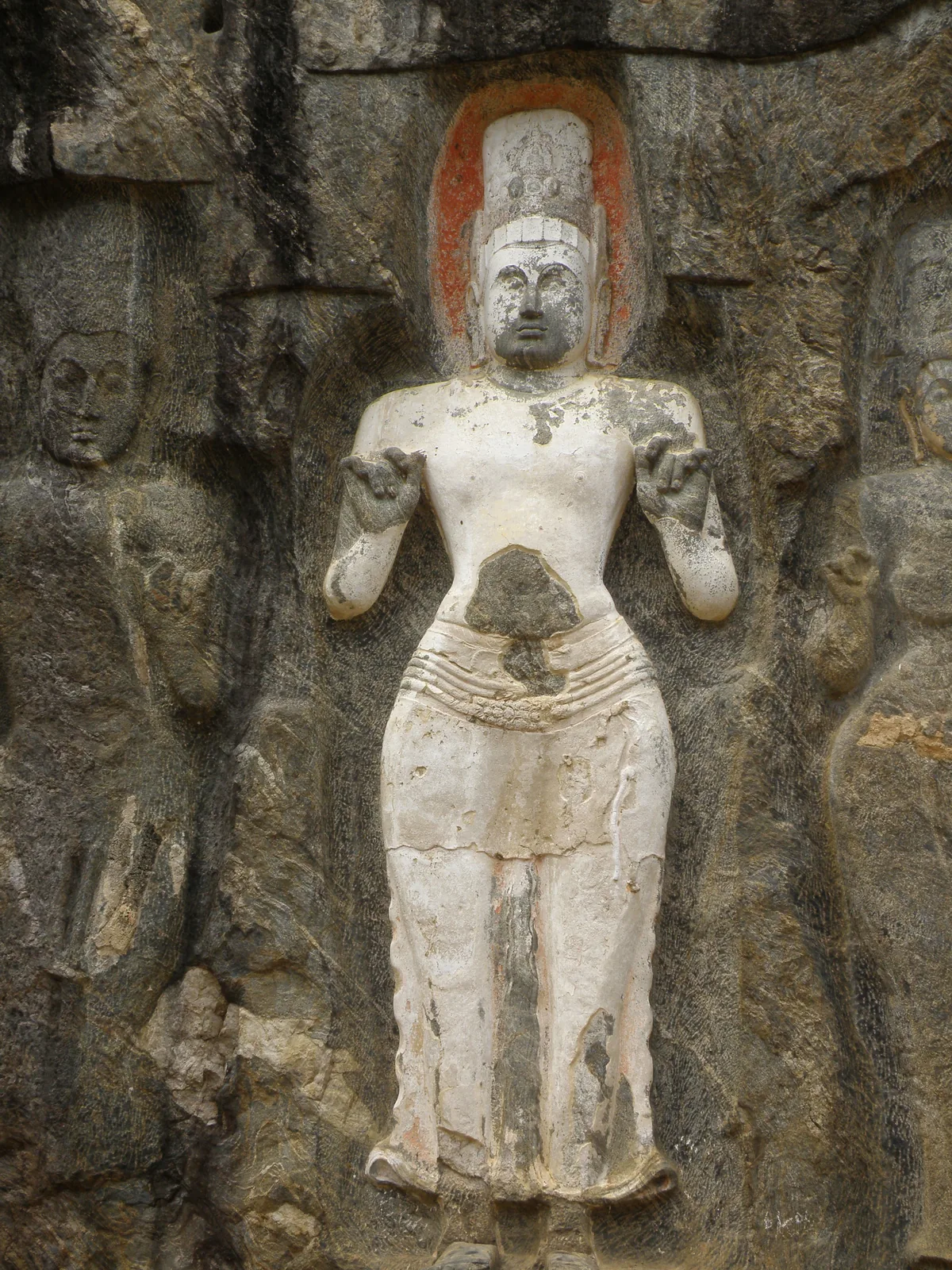
The figure that keeps its colour is the bodhisattva Avalokitesvara, the lord of compassion, a small seated Buddha set in his crown; beside him stands a female figure taken for Tara, the only colossal woman in Sinhalese stone, in the thrice-bent tribhanga pose, and a third read as the prince Sudhana. The group to the right carries a figure holding the vajra, the thunderbolt, the mark of Vajrapani, and it is that attribute above all that makes Buduruwagala the fullest statement in Sinhalese stone of the Mahayana, and of its Tantric current, the strand of Buddhism that set the great compassionate bodhisattvas and their consorts beside the Buddha. The reading is one of several ever offered: H.C.P. Bell, a century ago, saw the same figures as characters of the Vessantara story and Hindu gods, and the outermost figures are argued over still.
What sets Buduruwagala apart is that it still shows its skin. The Buddha’s robe keeps traces of the stucco that once sheathed it and a long streak of orange where it was painted; the Avalokitesvara keeps much of its white finish and the red aureole above the head. These are the survivals that let us say, of Aukana and the Gal Vihara Buddhas and all the bare grey images beside them, that they were never grey: the stone was plastered and painted, and here alone a little of that colour has outlasted the centuries in the open.
The date is as open as the reading. Paranavitana placed the group in the fifth century, Dohanian in the seventh, others in the ninth or the tenth; the popular consensus now settles around the ninth to tenth, and the early end rests on Paranavitana alone. Its makers are unknown, and even the site’s ancient name is lost; it is thought to have been a forest hermitage, and the seven figures kept their long argument and their last colour in the scrub of the Uva lowlands with no record of who cut them.
Sources
- von Schroeder, Ulrich. Buddhist Sculptures of Sri Lanka. Hong Kong: Visual Dharma. 1990.
- Dohanian, Diran K. The Mahayana Buddhist Sculpture of Ceylon. New York: Garland. 1977.
- Paranavitana, Senarath. Art of the Ancient Sinhalese. Colombo: Lake House. 1971.
- Bell, H.C.P. Archaeological Survey of Ceylon: Annual Reports.
How to cite this profile
Malaka Talwatte, “Buduruwagala,” Malaka Talwatte: Sri Lankan Art and Ceylon Antiquaria, https://malakatalwatte.pages.dev/artists/buduruwagala/.
Quote and cite freely with attribution; please do not republish a whole essay, or a photograph, without permission.