Modern · Artist
Charles Freegrove Winzer
First published as ‘Charles Freegrove Winzer: The Architect of Modern Art in Ceylon’ in The Ceylon Journal, Volume 03, No. 01, June 2026.
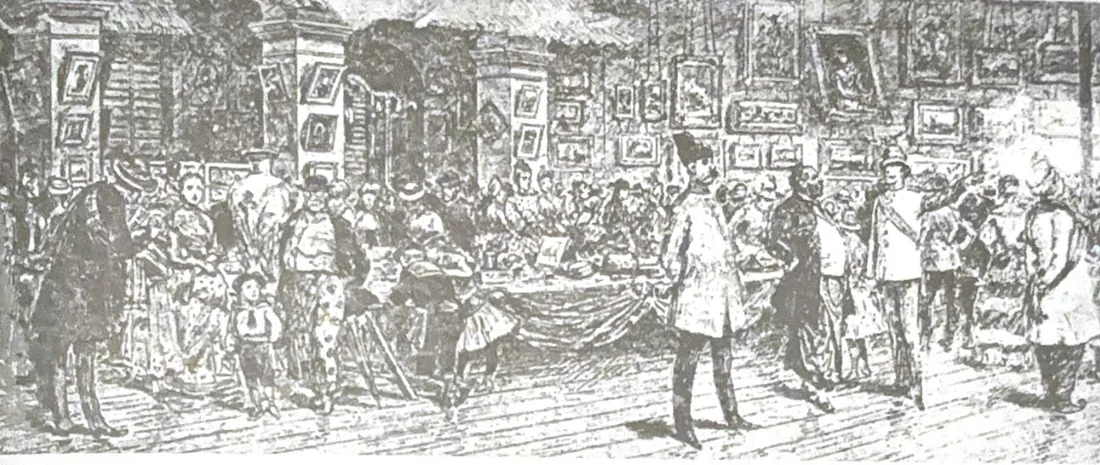
The dominance of the Ceylon Society of Arts
Art in Ceylon in the early twentieth century was governed, in both institutional and aesthetic terms, by the Ceylon Society of Arts (CSA). Founded as the Colombo Drawing Club by Sir Noel Walker and renamed in 1887, the CSA held its first major exhibition on the 7th of December 1892. By the 1900s it had aligned itself firmly with the conservative tradition of the Royal Academy in London, championing a Victorian realism that had little room for the international currents reshaping European painting.
The CSA’s most influential promoter was Mudaliyar A.C.G.S. Amarasekara, an academic portraitist and art teacher whose authority shaped the annual exhibition, a fashionable social event timed to coincide with August Race Week. The critic L.C. Van Geyzel memorably characterised the cultural climate of Colombo as ‘if not quite a cultural desert, at best a genteel wilderness.’ The city had no public art gallery. Modernist developments in European art, Post-Impressionism, Fauvism, Cubism, were effectively absent in official exhibition spaces.
Some individual artists had encountered reproductions of French modern art, among them a young George Keyt, who is thought to have obtained lithographic copies through Hugh Modder, possibly the first person in Ceylon to circulate high-quality reproductions of modern European works. But without institutional support, and in the face of the powerful lobby centred on Amarasekara, there was no viable platform from which to challenge the CSA’s orthodoxy.
Winzer’s arrival and the founding of the Ceylon Art Club
Into this environment came Charles Freegrove Winzer. Appointed Inspector of Art by the colonial government in 1921, an Education Department role supporting the subject in schools, he brought with him not only formal training in Paris but direct personal acquaintance with the leading modernists of the age. In 1928 he founded the Ceylon Art Club, providing it with rooms in a working-class district of Colombo. The Club held annual exhibitions explicitly positioned as a counter to what Winzer called the capital’s CSA ‘artistic standard of picture postcards and plagiarism of Royal Academy catalogues.’
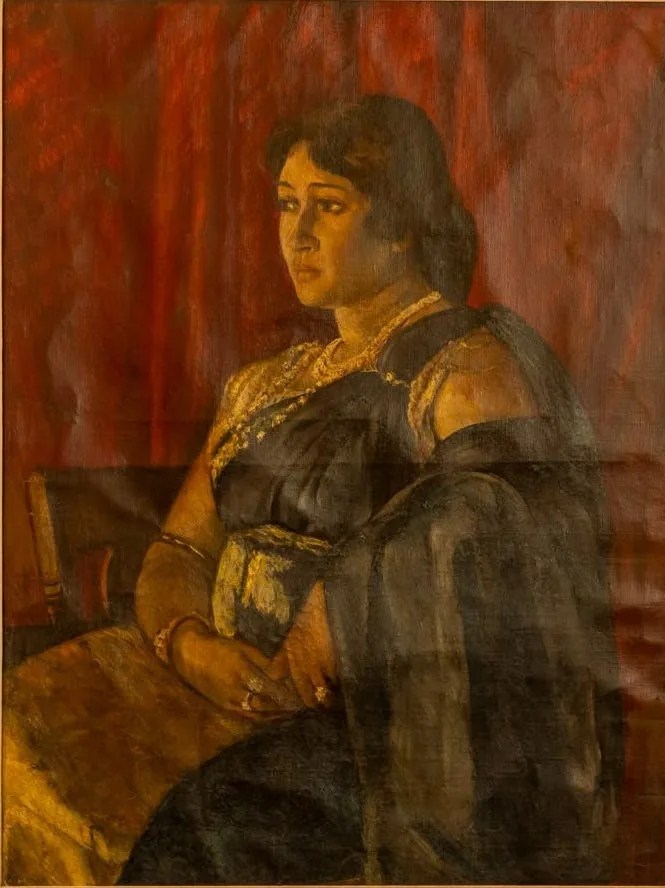
Winzer’s critique was not simply aesthetic: it was cultural. He argued that a genuinely modern art for Ceylon could not be built by imitating Western academicism, nor by mechanically transplanting Parisian modernism. It had to emerge from a synthesis, modern in form and sensibility but rooted in the island’s own ancient traditions. In his final address to the Art Club in 1931, he articulated the challenge with characteristic directness:
Our materials are different, our conditions are different, the demands of the public are different and the public must be trained and enlightened by us sufficiently, not only to appreciate our work but also that of the past… The eternal qualities of art as shown at Anuradhapura and Polonnaruwa should be studied, adapted to our life, and a continuity with them achieved. I may add that this continuity is closer to the decorative conceptions of modern art than to the realistic, true-to-life prettiness and cheap harmonies of academic achievement.
Keyt, Beling, and the Art Club circle
The Art Club’s most enduring contribution was the space it provided for a younger generation of artists working outside the CSA’s orbit. Among those Winzer took under his wing were George Keyt and Geoffrey Beling, both of whom would later become founding members of the ’43 Group. Lionel Wendt, lawyer, photographer and cultural impresario, is believed to have facilitated the introduction, though his absence in London between 1919 and 1924 meant that the initial period of mentorship was Winzer’s alone.
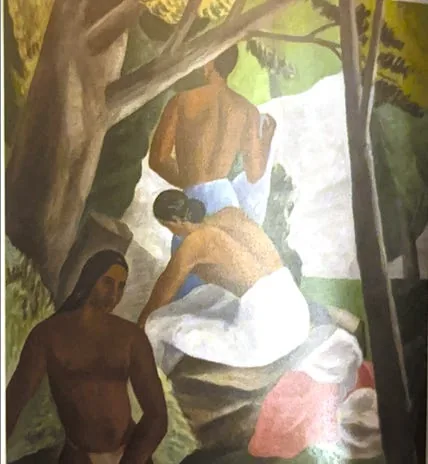
Martin Russell, in his biography of Keyt, documents the direct imprint of Winzer’s aesthetic programme on the younger artist’s early paintings of 1927 to 1929. Works from this period reveal what Russell identifies as ‘the assimilation of Winzer’s conception of the gracefulness of Sigiriya with the use of the calligraphic line’, a synthesis that attempted to graft European naturalism onto the forms and postures of ancient Ceylonese art. Russell notes a comparable influence on Beling’s work of the same period, observing that the two painters’ output was not only stylistically similar to each other but closely aligned with the themes and approaches Winzer advocated.
The exhibitions and the critical controversy
The Art Club exhibitions of the late 1920s and early 1930s were flashpoints for a wider debate about the direction of art in Ceylon. The 1929 show included works by Winzer, Keyt, Beling, Daraniyagala, George de Niese and J. D. A. Perera, with an opening address by the pro-modern Dr. Paul Pieris. The local press was dismissive: one reviewer reduced Keyt’s Kandy landscapes to the observation that they were ‘largely occupied by trees in the foreground.’
The January 1930 joint exhibition of Keyt and Beling at the Ferguson Memorial Hall proved more incendiary. Winzer, writing from Nepal, contributed a pointed foreword attacking the prevailing ‘artistic standard’ of the CSA. Mudaliyar Amarasekara responded in the Ceylon Daily News, invoking a certain Dr Hyslop on ‘cases of genius akin to madness’ and characterising modern art’s defenders as ‘impostors or degenerates.’ The counter-riposte came from Lionel Wendt, whose witty and scathing letter silenced Amarasekara publicly. Wendt also translated for the Times of Ceylon a review of the exhibition by Pablo Neruda, then a Chilean diplomat stationed in Colombo, who wrote admiringly of Keyt’s work. It was the first time a sustained and public opposition to the CSA’s aesthetic monopoly had been mounted in Ceylon.
The May 1930 Art Club exhibition was notable for another reason: it included what appears to have been the first exhibited painting of a female nude by a Sri Lankan artist. The work was Keyt’s Govindamma, depicting a South Indian dancer.
The rupture and Winzer’s departure
The Art Club’s final years were marked by internal friction as well as external hostility. At the May 1931 exhibition, critical comment reached what Russell describes as a level of ‘almost too fatuous for quotation’, and divisions within the Club were deepening. Winzer held his farewell exhibition in January 1932. Within months of his departure, the Art Club collapsed following a dispute at its annual show, during which Daraniyagala removed his works from an unfair hanging, and Wendt, emerging from behind a screen, removed those of Keyt and Beling in solidarity. The Club had served its purpose: it had given the artists the courage to pursue a new path.
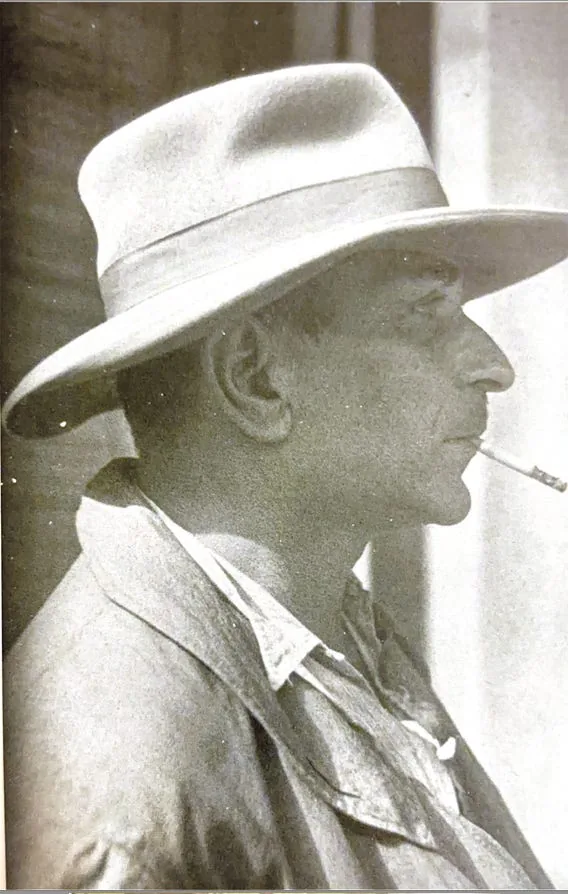
Origins and early career
Charles (Henry D.) Freegrove Winzer was born in Warsaw, probably around 1886, the third child of Julius Charles Winzer, a British merchant and pro-consul, partner in a major wholesale business in the Kingdom of Poland, and his wife Leonie Mary Lesser. The family’s cosmopolitan character was established early: his paternal grandfather, Julius Ernst Winzer (1830 to 1899), was a German musician born in Bremen who became bandmaster of a British regiment before settling in Staffordshire as a musical-instrument dealer and china merchant.
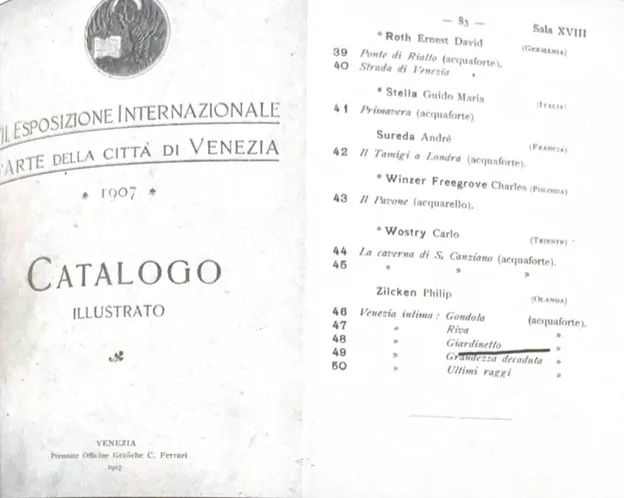
Educated in Warsaw and England, Winzer trained as an artist in Paris, where he exhibited at the Salon d’Automne from 1909. His emergence was precocious: in 1907, aged approximately twenty-one, he represented Poland at the Venice Biennale, an exhibition where fellow participants included John Singer Sargent, Frank Brangwyn and Auguste Rodin. His entry, a watercolour titled Il Pavone (The Peacock), announced an artist already operating at an international level.
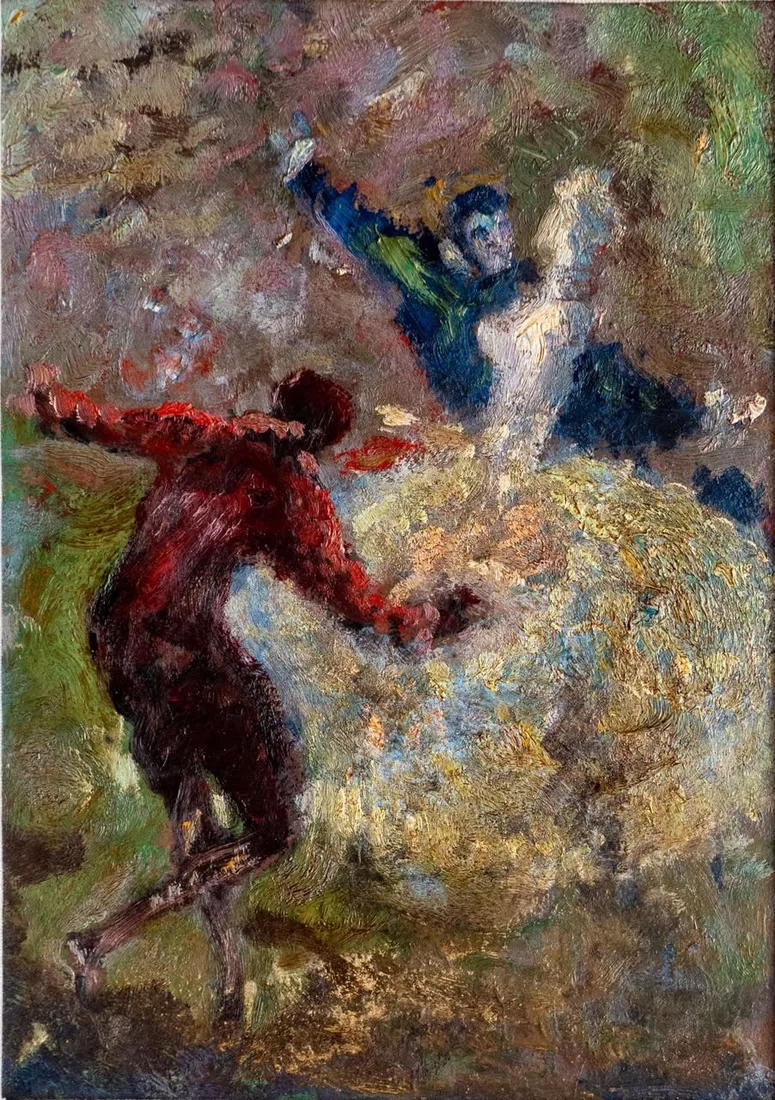
His Paris years brought him into the circle of the central figures of European modernism. He knew Picasso and Modigliani as contemporaries and became a close friend of Henri Matisse. In March 1911 he shared an exhibition at 3 Rue du Colonel Combes, Paris, with Modigliani, the Portuguese artist Amadeo de Sousa Cardoso and Rodolphe Balint. He also showed sketches alongside the Camden Town Group at the Carfax Gallery, London, in 1912, and had a solo exhibition at the Ashnur Gallery, Paris, in 1914.
The First World War and internment at Ruhleben
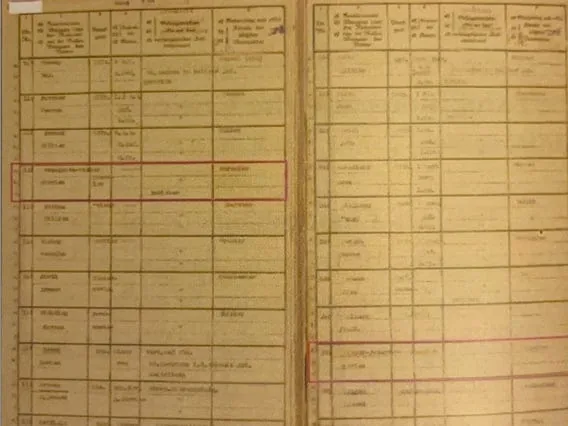
The outbreak of war in 1914 interrupted a career that had been building steadily. Winzer’s sister Alice had married his German artist friend Baron Götz von Seckendorff in early 1914; her husband was killed at Cambrai in August, one of the war’s first casualties. Winzer, working for the French and Belgian Red Cross, attempted to visit the widowed Alice in Germany. Despite holding valid papers, he was stopped at the Swiss frontier and interned at the Ruhleben camp near Berlin for the remainder of the war.
The long and, as he considered it, improper detention appears to have damaged his mental health. He participated in the first two Ruhleben camp exhibitions and produced lithographic illustrations for the camp magazine; the Australian War Memorial holds a number of these works. His engagement seems to have diminished from 1916. After repatriation he illustrated a collection of poems by James Elroy Flecker and provided drawings for R.F. Johnson’s Chinese Drama (both 1921). The French poet Paul Claudel wrote a sonnet to accompany a showing of Winzer’s work at the Galerie Vildrac in Paris in May 1919, a recognition, if a belated one, of his standing in European cultural life.
Ceylon, Nepal, and final years
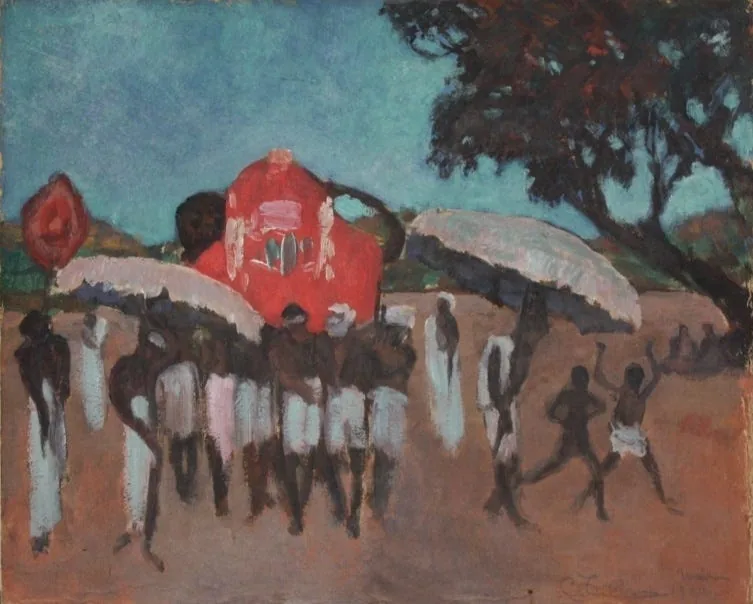
His appointment as Inspector of Art in Ceylon in 1921 coincided with his sister Alice’s remarriage in Italy to Count Camillo Borgia. He held the Ceylon post until 1931, during which time he also painted in mainland India and, apparently in 1928 to 1929, in Nepal, then a closed state to foreigners, which he accessed through a personal connection with its ruling prince. His sole Asian work recorded on Art UK, Music for Ganesha (1929), depicts a Nepalese temple figure group and was presented to the National Museum of Wales in July 1930 by his friend and patron Evan Morgan, 2nd Viscount Tredegar.
After leaving Ceylon, Winzer appears to have settled in Venice, though he continued to exhibit in London, at the Warren Gallery on Maddox Street, where his patrons included the French Princess Murat and the socialite Violet Trefusis (née Keppel). His lithographs were held by the British Museum and the Museum of Western Art in Moscow. He died on 19 February 1940, at the Warneford Hospital in Oxford, an institution for the treatment of mental illness. Whether he had come to England for personal reasons or to escape the war’s approach to Italy, which did not formally enter the conflict until June 1940, remains unclear.
The memorial exhibition and critical reception
The Winzer Memorial Exhibition, held at the National Gallery of Ceylon in March 1941, was an eloquent indicator of his standing. It was organised, with some irony, by the Ceylon Society of Arts, the institution Winzer had spent a decade opposing, whose adaptation to changing taste was itself a measure of his influence. Lionel Wendt played a central role in assembling both the works and the catalogue. The then Governor of Ceylon, Sir Andrew Caldecott, opened the exhibition and was greeted by the President of the CSA, Mr. G.A. Wille, and its Secretary Dr. G. P. Malalasekera, signifying the great importance given to this memorial exhibition.
The response to the exhibition was unreserved. The Ceylon Daily News wrote that ‘anywhere in the world he would be considered an important artist; for Ceylon he has the added attraction of being one of the very few artists who have portrayed this country and its people with accuracy and understanding.’ Wendt’s tribute in the Observer Pictorial of 1940 was among the most generous assessments of any artist writing in Ceylon at the time:
His love for this country and its peoples is everywhere apparent in his work. No one before him, and, after him, no one yet has translated into paint and pencil the colour harmonies peculiar to Ceylon, and the grace of posture and movement natural to the Sinhalese and the Tamil.
Wendt also drew attention to Winzer’s contribution to art education, noting that he had transformed the teaching of art in schools by focusing not on imitation but on preserving each child’s own capacity for creative expression. His influence, conveyed through visits to schools across the country, was acknowledged after his death by the establishment of an art circle named in his honour in Jaffna.
Winzer and the ’43 Group
The most significant measure of Winzer’s legacy is the ’43 Group, which emerged three years after his death. The Group brought together Keyt, Wendt, Beling, Daraniyagala and others, and is widely regarded as the foundational moment of Sri Lankan modernism. Martin Peries, in his thesis ’The ‘43 Group and its Legacy in Sri Lanka’, draws directly on the scholarship of Bandaranayake and Dharmasiri to establish the connection:
Winzer’s view on the state of art in Sri Lanka and his opposition to the British academic style prevalent at that time gave expression to the ’43 Group’s impetus, stressing the need to preserve local culture. He promoted the idea that Sri Lankan artists should look to, and study, their own traditional arts for inspiration in creating their modernist styles of art.
It should also be noted that Daraniyagala, who pursued his studies at the Slade School of Art in London on the advice of Augustus John, is known to have been acquainted with Winzer, a connection whose full significance has yet to be explored.
The colonial contradiction: Neruda’s account
Any honest assessment of Winzer’s role in Ceylon must also reckon with its darker dimension. While serving as Inspector of Art, Winzer was also appointed Acting Archaeology Commissioner, a role that brought him into direct participation in the colonial appropriation of Sri Lanka’s material heritage.
The most vivid account of this aspect of his work comes from Pablo Neruda, who served as Chilean consul in Colombo in the early 1930s and moved in the same circle as Winzer, Wendt and Keyt. In his memoirs, first brought to scholarly attention in Sri Lanka by Ismeth Raheem in a 2024 article in the Sunday Times, Neruda describes accompanying Winzer on an official expedition:
Excavations had brought to light two magnificent cities the jungle had swallowed up: Anuradhapura and Polonnaruwa … Naturally, everything the excavations had brought to light was carefully packed and went on its way to the British Museum, London … My friend Winzer was pretty good at his work. He went to remote monasteries and, to the enormous satisfaction of the Buddhist monks, he loaded the official van with marvelous stone sculptures, thousands of years old, that would end up in England’s museums. The look of contentment on the saffron-garbed monks was something to see, when Winzer would leave them painted celluloid Buddha images made in Japan as replacement for their own antiques … My friend Winzer was an excellent product of the Empire, an elegant short-changer.
The passage is devastating in its precision. The same man who urged Ceylonese artists to draw sustenance from the ‘eternal qualities of art as shown at Anuradhapura and Polonnaruwa’ was simultaneously overseeing the removal of those very works to institutions in Britain. Winzer’s vision of cultural continuity was, in this respect, fatally compromised by his position within the colonial apparatus.
This contradiction does not negate his contribution to modern art in Ceylon. But it does require that his legacy be understood in its full complexity, as the work of a gifted, cosmopolitan and genuinely sympathetic figure who was also, to borrow Neruda’s phrase, an ‘elegant product of the Empire.’ The question of restitution, of what was taken from Sri Lanka and placed in foreign museums without the consent of its people, remains live, and any celebration of Winzer must hold space for that reckoning.
Without Winzer’s mentorship, it is possible that modern art in Ceylon would have developed along purely imitative lines, reproducing Western styles without the distinctive cultural grounding that gives Sri Lankan modernism its particular character. The ’43 Group, which emerged three years after his death, was in a real sense the fruition of seeds he had planted.
At the same time, Winzer’s story reminds us that the history of art cannot be clearly separated from the history of power. The same colonial system that gave him the platform to foster an indigenous modern art also made him an instrument of cultural extraction. To remember Winzer fully is to hold both of these truths at once.
Bibliography
- Archer, W.G. (1959) India and Modern Art.
- Art UK (n.d.) ‘Winzer, Charles Freegrove (1886–1940)’. Accessed 11 May 2026.
- Bandaranayake, S. and Dharmasiri, A. (2009) Sri Lankan Painting in the 20th Century. Colombo: National Trust of Sri Lanka.
- British Museum (n.d.) ‘Winzer’, British Museum Collection. Accessed 11 May 2026.
- Claudel (n.d.) ‘Winzer’, Claudel Image Archive. Accessed 11 May 2026.
- Daraniyagala, R. (2011) Justin Daraniyagala: Oil Paintings. Published by Arjun Daraniyagala.
- De Fonseka (n.d.) ‘Winzer Art of the De Fonseka Family’, De Fonseka Family Website. Accessed 11 May 2026.
- De Soysa, R. (2016) The ’43 Group – Origins, Aims, Activities and Legacy. Presentation to the National Trust of Sri Lanka, 29 September.
- De Stefani, A. (2015) ‘Modigliani alla Cité Falguière’. Academia.edu, p. 257. Accessed 11 May 2026.
- Dharmasiri, A. (1988) Modern Art in Sri Lanka: The Anton Wickramasinghe Collection.
- Esposizione Internazionale d’Arte della Città di Venezia: Catalogo Illustrato (1907). Venice.
- Freiman, J. (n.d.) ‘Remembering Ruhleben: A Reimagined Harvard Law School Library Digital Exhibit’. Accessed 11 May 2026.
- Goonetilleke, H.A.I. (1989) George Keyt: A Life in Art. Colombo.
- Holroyd, M. (2010) Augustus John: The New Biography.
- Neruda, P. (2001) Memoirs. Translated by H. St. Martin. New York: Farrar, Straus and Giroux.
- Ondaatje, C. (n.d.) Email correspondence with the author regarding Winzer’s portrait of Henrietta de Fonseka.
- Pieris, M. (2020) The ’43 Group and its Legacy in Sri Lanka. PhD thesis. University of Newcastle.
- Raheem, I. (2024) ‘When Winds of Modernism Blew into 1920s’ Ceylon’, The Sunday Times, 23 June. Accessed 11 May 2026.
- Roberts, M. (2021) ‘The 43 Group in Ceylon – The Story’, Thuppahi’s Blog. Accessed 11 May 2026.
- Russell, M. (1950) ‘George Keyt: Introduction and Biographical Notes’.
- Weeraratne, N. (1993) 43 Group – A Chronicle of Fifty Years in the Art of Sri Lanka. Melbourne: Lantana.
- ‘What Ceylon Art Owes to Winzer’ (1941) Ceylon Daily News, 26 March, p. 5.
- Wendt, L. (1940) ‘Winzer’, Ceylon Observer Pictorial.
How to cite this profile
Source noteExtracted verbatim from Malaka Talwatte, 'Charles Freegrove Winzer: The Architect of Modern Art in Ceylon', The Ceylon Journal, Volume 03, No. 01, June 2026. Where this page reproduces a previously published essay, cite that original in preference to this page.
Malaka Talwatte, “Charles Freegrove Winzer,” Malaka Talwatte: Sri Lankan Art and Ceylon Antiquaria, https://malakatalwatte.pages.dev/artists/charles-freegrove-winzer/.
Quote and cite freely with attribution; please do not republish a whole essay, or a photograph, without permission.