Start typing to search the essays, the artists and the collection.
Pre-modern · Artist
Captain Charles O'Brien
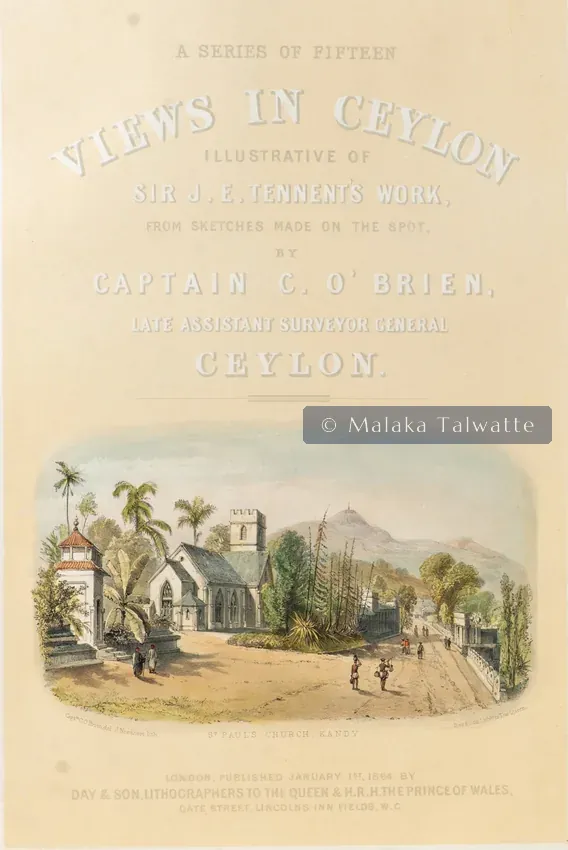
Where Nicholl illustrated Tennent’s text from within, Captain Charles O’Brien (d. 1866) supplemented it from outside. As Assistant Surveyor General of Ceylon he possessed the same extensive access to the interior that Tennent had enjoyed as Colonial Secretary; and upon the appearance of the book in 1859, and its considerable success, O’Brien recognised that its descriptions of the hill country, the coffee districts and the remote interior had outrun the illustrations Tennent had been able to provide. In 1864 he published A Series of Fifteen Views of Ceylon Illustrative of Sir J.E. Tennent’s Work, with lithographs by Jonathan Needham, a suite of landscape views conceived expressly as a visual companion to Tennent’s book. The title declares the relation: O’Brien’s art was placed in the service of Tennent’s scholarship, and the work of the two men together constitutes the most comprehensive visual and literary record of mid-Victorian Ceylon.
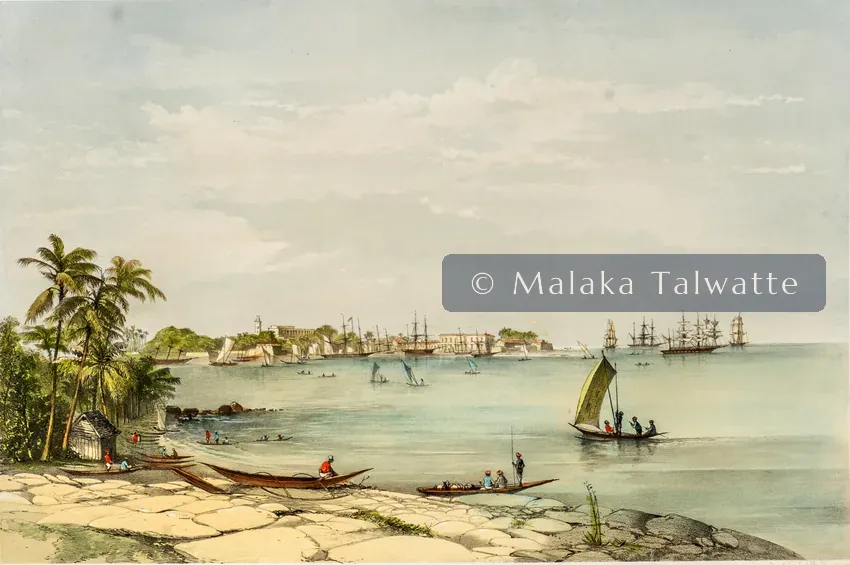
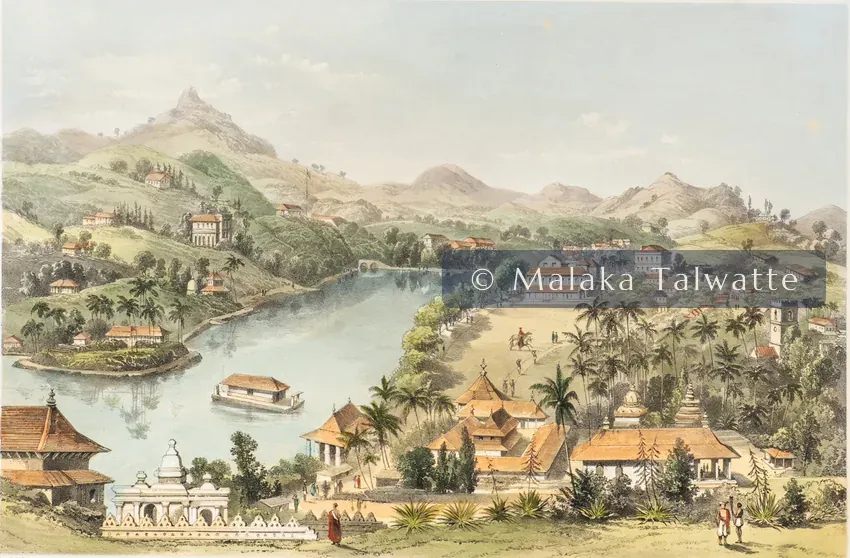
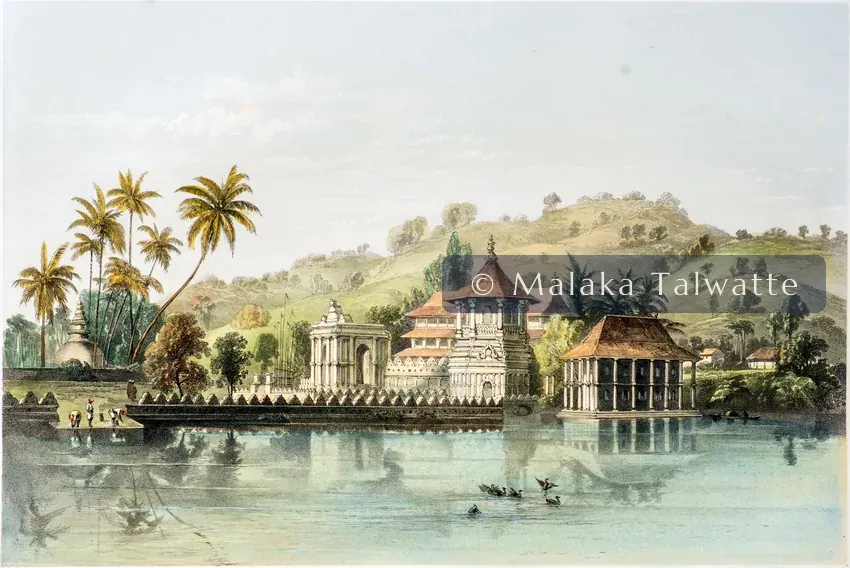
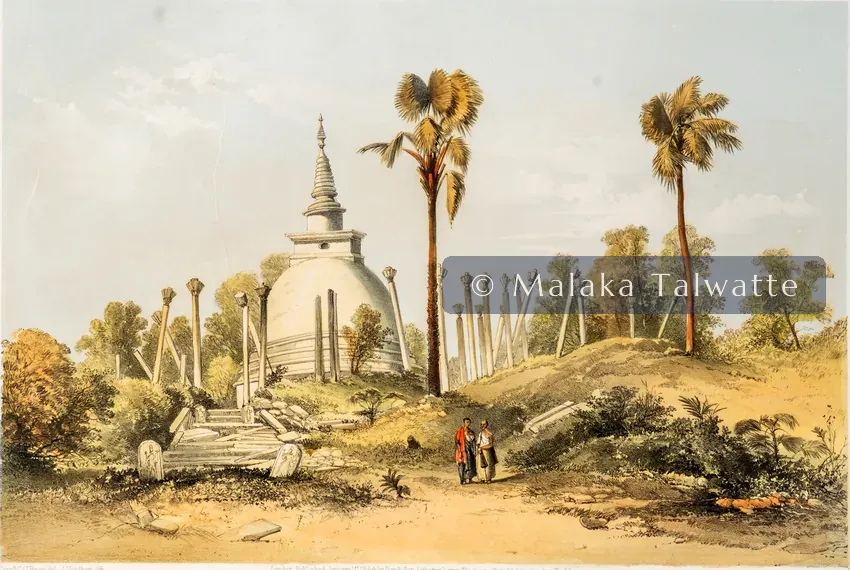
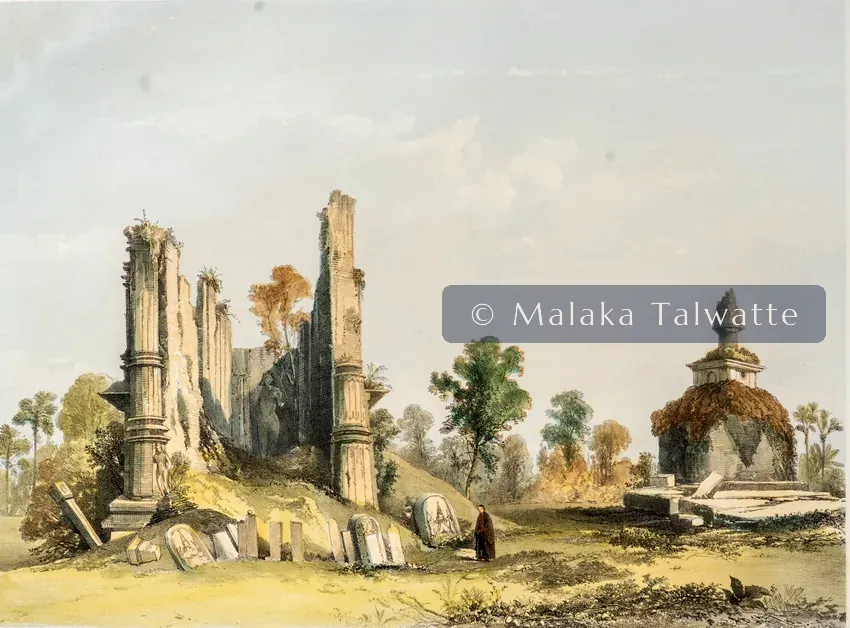
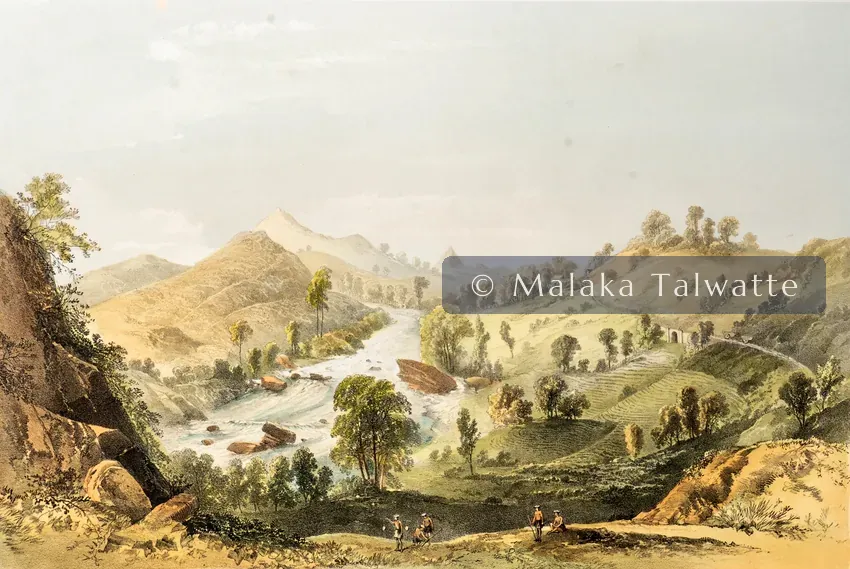
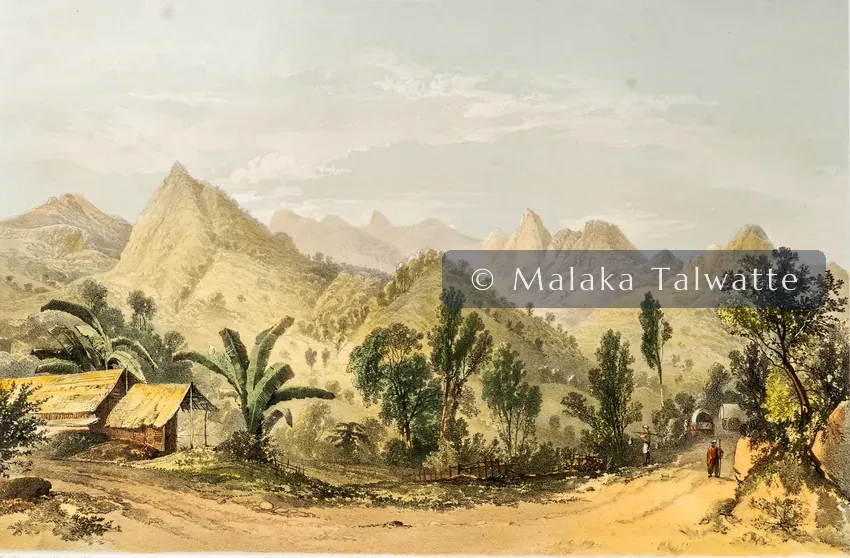
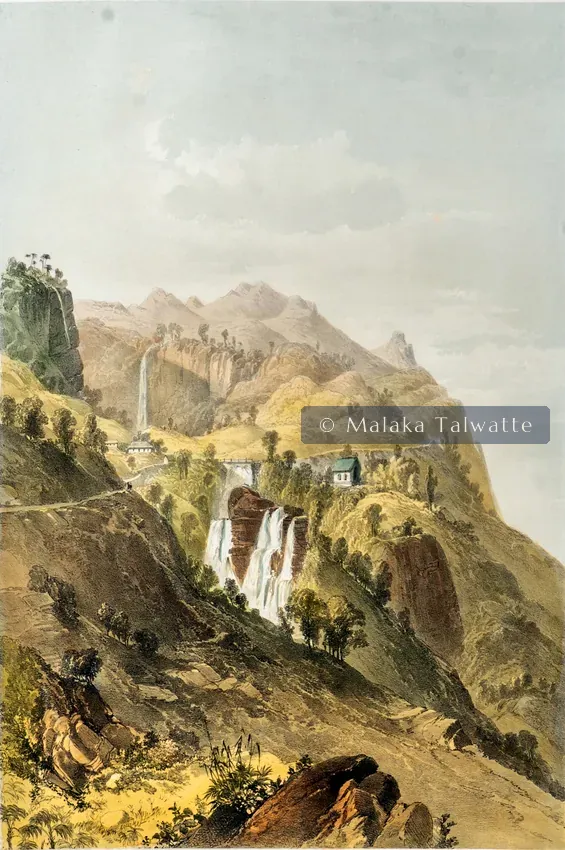
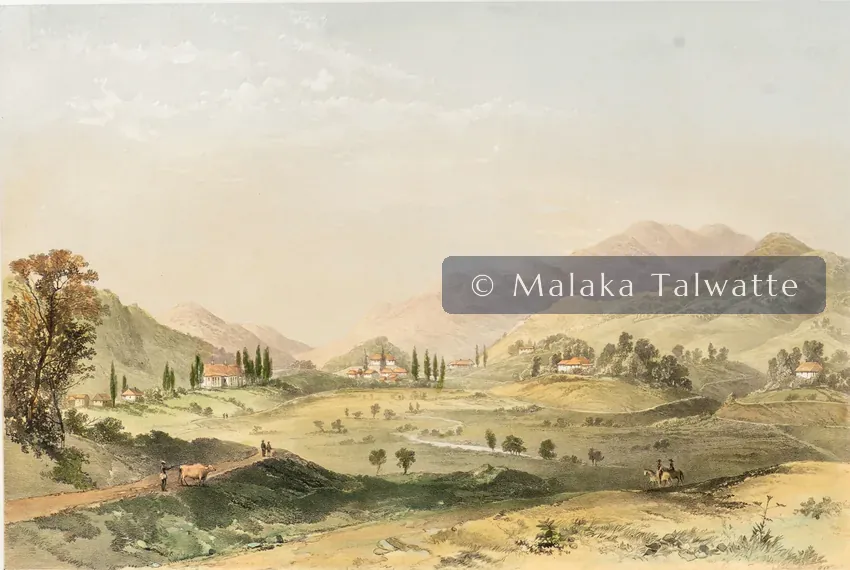
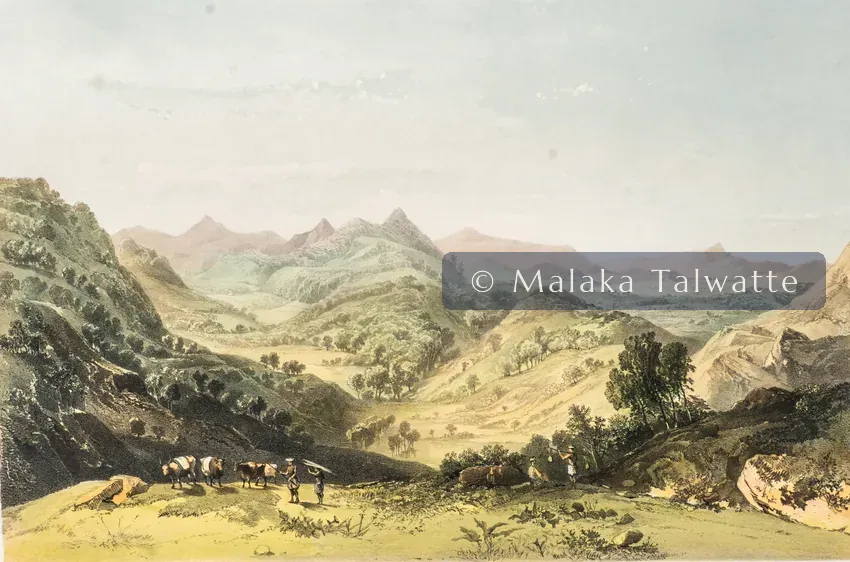
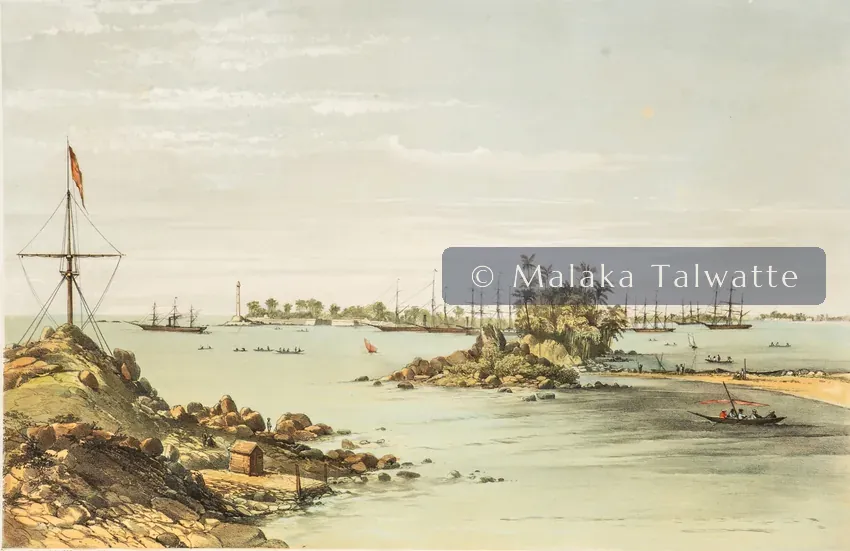
Captain Charles O'Brien, St. Paul's Church, Kandy, 1864. Hand coloured lithograph, 55 × 38 cm, private collection. This view appears to be orientated looking north, with the entrance to the Natha devale shown on the left and that to the Dalada Maligawa (Temple of the Tooth) on the right. In the centre is Udawattakelle with the eastern redoubt and its flagstaff. At the west end is a monument to officers of the Ceylon Rifle Regiment who served in the Crimean War, and in the south transept there is a window erected by the Ceylon Mounted Infantry in memory of their comrades who fell in South Africa. Regular Anglican services are now conducted both in Sinhalese and English. (De Silva, Rajpal Kumar. 1985. Early Prints of Ceylon (Sri Lanka) 1800-1900.)Captain Charles O'Brien, Colombo, 1864. Hand coloured lithograph, 38 × 55 cm, private collection. Colombo, the capital of the island and seat of government, has an interest as being the port from which nearly all the coffee and cocoa-nut oil is shipped for Europe. The view represents the Fort, with the Custom House, the Roadstead, in which are seen the large ships lading for Europe, and the "Inner Harbour," in which are the coasting vessels and native craft. The view is taken from the suburb of Mootwall, the resort of the fishing-boats; those formed of a single tree, with a washboard, supported by an "outrigger" of light wood, attached to the canoe by two tough but light sticks, have immense speed, and are, I believe, peculiar to Ceylon. (De Silva, Rajpal Kumar. 1985. Early Prints of Ceylon (Sri Lanka) 1800-1900.)Captain Charles O'Brien, Kandy, 1864. Hand coloured lithograph, 38 × 55 cm, private collection. Our view is taken from the hill, a little below Lady Horton's Walk, looking down on the lake, the Malagawa Temple, the Audience Hall, above which, surmounted by lofty cocoa-nuts, appear the tombs of the kings of Kandy. In the immediate foreground, is a terrace which leads to that part of the Palace now the residence of the principal civil officer of the province. On the opposite side from the town are the monasteries of the priests, and, above them, the residence of the principal civilians and merchants. Near the centre is a redoubt, called "Castle Hill," with a barrack for a company of Malay soldiers, below which are the barracks of the Ceylon Rifle Regiment. The most prominent building on the Esplanade is a very respectable hotel; the large two-story building is the Oriental Bank; and to the extreme right is the parade-ground and barracks of the European regiment. A part of the tower of St. Paul's Church is seen. (De Silva, Rajpal Kumar. 1985. Early Prints of Ceylon (Sri Lanka) 1800-1900.)Captain Charles O'Brien, The Malagawa Temple, Kandy, 1864. Hand coloured lithograph, 38 × 55 cm, private collection. Our view is taken from an island in the lake. On the left is a dagoba, the tomb of one of the kings of Kandy. On the hills behind the Temple winds the beautiful road called “Lady Horton's Walk." The building projecting into the lake, to the right of the Temple, is a modern structure, used as a library and assembly rooms. (De Silva, Rajpal Kumar. 1985. Early Prints of Ceylon (Sri Lanka) 1800-1900.)Captain Charles O'Brien, Thuparamaya Dagoba, 1864. Hand coloured lithograph, 38 × 55 cm, private collection. "Near the intersection of the two great streets of the city stands the ‘Thuparama,' the most venerated of all the dagobas in Ceylon, having been constructed by King Devenipiatissa, three centuries before the Christian era, to enshrine the collar-bone of Buddha. Its outline is peculiar, being flattened at the top, and so hollowed at the sides as to give it the configuration of a bell. Its height is about seventy feet from the ground: and the terrace on which it is placed is surrounded by rows of monolithic pillars, each twenty-six feet high, with richly-decorated capitals." -SIR J. EMERSON TENNENT'S Ceylon, &C., Vol. I1., page 622. (De Silva, Rajpal Kumar. 1985. Early Prints of Ceylon (Sri Lanka) 1800-1900.)Captain Charles O'Brien, Ruins at Pallanarrua, 1864. Hand coloured lithograph, 38 × 55 cm, private collection. "Still advancing along the main street, we come next to an immense edifice of brick, in the highest style of ornamented Southern India architecture. This is the Jayta-wana-Rama, a temple of great dimensions, built by Parakrama Bahu I after the model, it is said, of one erected by Buddha himself at Kapili-vastu, the place of his birth. The exterior is profusely decorated with architectural devices in chunam. The style seems to belong to the Saracenic period; and the grand entrance to the temple, at the eastern end, is flanked by two polygonal turrets, which forcibly recall the outline of the Kotub Minar at Delhi” SIR J. EMERSON TENNENT'S Ceylon, &C., Vol. II., page 592. (De Silva, Rajpal Kumar. 1985. Early Prints of Ceylon (Sri Lanka) 1800-1900.)Captain Charles O'Brien, Adam's Peak from the Yatteantotte Road, 1864. Hand coloured lithograph, 38 × 55 cm, private collection. Adam's Peak, whether, to our delight, we recognise it rising above its peers on the distant horizon, or, as in the ascent from Ratnapoora, "the majestic cone is discerned towering in unsurpassed sublimity," forms the most striking object in every view from which it is visible. Here it soars over a range of wild and almost inaccessible country, singularly in keeping with its cone-like form. The river Calany is seen glittering in its fall, as it leaps its barrier, and, plunging into the gorge, foams along a rocky course till it reaches the village of Yatteantotte, when it becomes navigable for boats laden with rice from Colombo. The numerous coffee estates in Ambogammoa are connected with Yatteantotte by a splendid cart-road, of twenty-six miles, from the top of the pass. (De Silva, Rajpal Kumar. 1985. Early Prints of Ceylon (Sri Lanka) 1800-1900.)Captain Charles O'Brien, Adam's Peak from the Ambogammoa Road, at Pusbage, 1864. Hand coloured lithograph, 38 × 55 cm, private collection. The lake of Kandy is artificial, formed by damming up a small stream; and the extensive "tanks," which may almost be called lakes, are confined to the low country. On the road from Gampola to Ambogammoa, the Mahavilla Ganga, which passes under a suspension bridge at the former town, here again bursts upon us, foaming down over a rocky bed, whilst "the Peak," in which it has its source, cuts distinctly against the clear morning sky. On the right bank of the river, at this spot, is a flourishing coffee-plantation, called "Mahavilla," the property of Captain Graham, the talented architect of the bridge of Gampola. On the slope below the road are the terraced rice-fields. (De Silva, Rajpal Kumar. 1985. Early Prints of Ceylon (Sri Lanka) 1800-1900.)
The full title carries the purpose without ornament: A Series of Fifteen Views of Ceylon Illustrative of Sir J.E. Tennent’s Work, from Sketches Made on the Spot by Capt. C. O’Brien, late Assistant Surveyor General, Ceylon, issued in London in 1864. The phrase ‘from sketches made on the spot’ marks the difference between O’Brien and the studio artists who worked from other men’s drawings: his images began in the field, from a surveyor’s first-hand sight of the ground. The drawings were carried onto stone by Jonathan Needham (fl. 1850–1874), a professional lithographer of the period, and the fifteen plates range across precisely the country Tennent’s chapters had described, among them the town and lake of Kandy, the coffee estate at Peacock Hill with Gampola in the distance, and the upland station of Nuwara Eliya, given on the plate in the older spelling ‘Nuera Ellia’. The subjects answer the text directly, carrying the reader into the hill country, the coffee districts and the interior that the prose had reached before any illustration could follow. The plates survive in the collection of the British Library, where they are catalogued individually rather than as a bound set, and where O’Brien is recorded as Charles D.C. O’Brien.
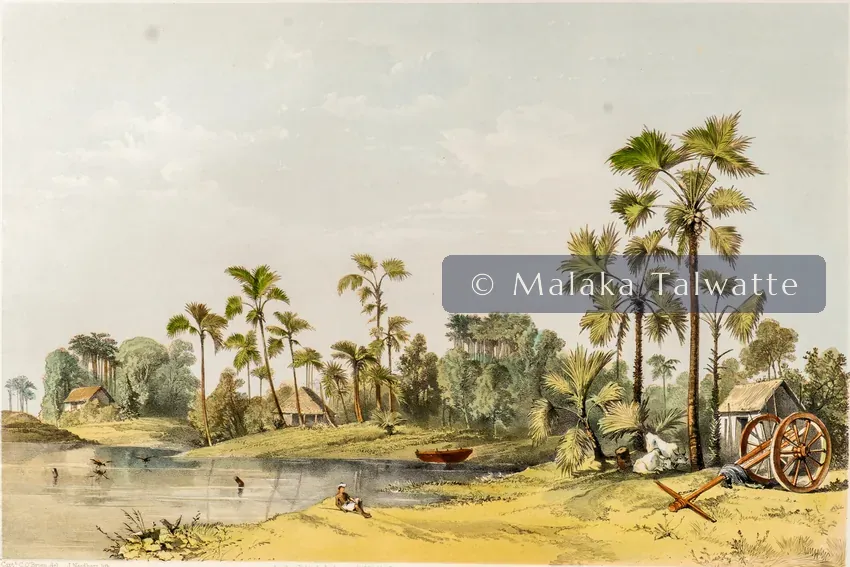
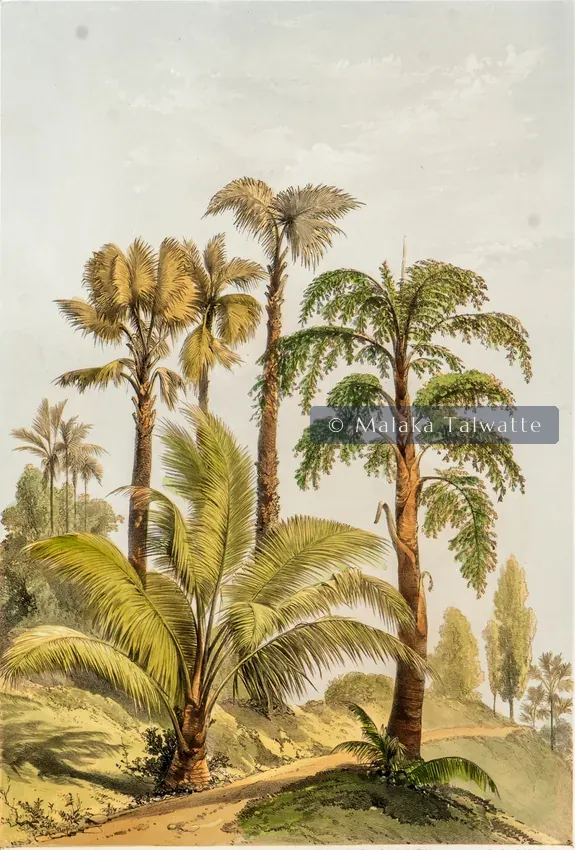
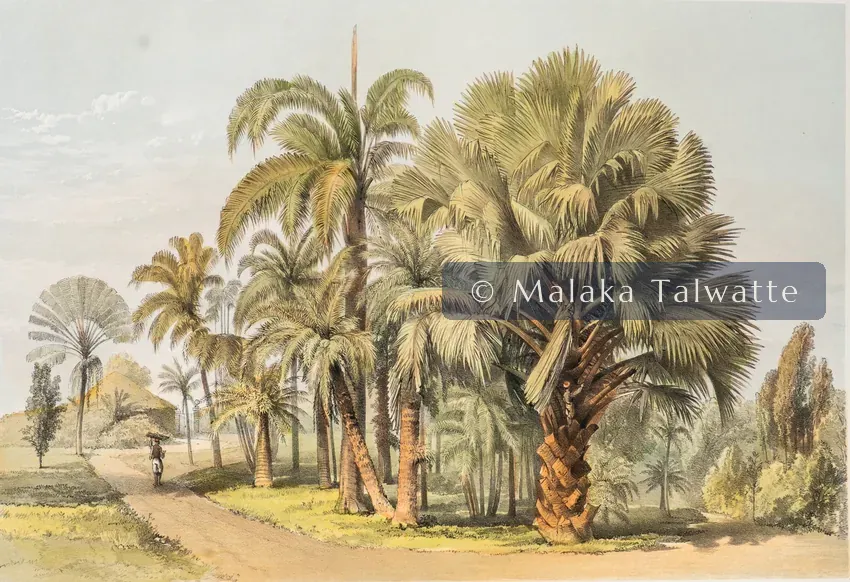
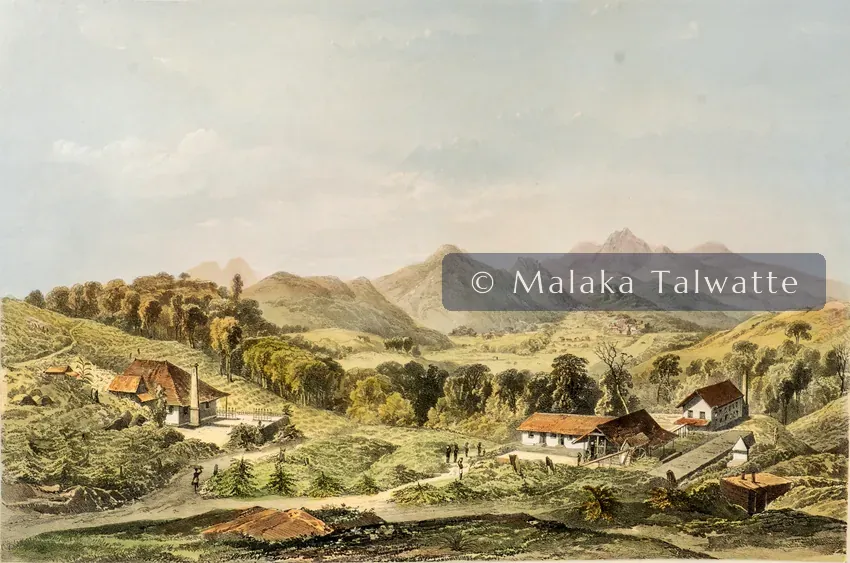
Captain Charles O'Brien, Ferry on the Road from Manaar to Colombo, 1864. Hand coloured lithograph, 38 × 55 cm, private collection. Though the scenery on the coast-road along the western shore, from Manaar to Colombo, is Some-what tame, from the absence of mountains, and monotonous from the constantly recurring Palmyra "topes," or groves, still there are many spots of quiet beauty, particularly on the banks of the rivers. The Palmyras in the view before us are exact portraits, but they have been despoiled of much of their majestic beauty by the custom which prevails amongst the natives of lopping off each leaf as it comes to maturity, as substitutes for thatch with which to cover their huts, convert into fans, and for many other uses. (De Silva, Rajpal Kumar. 1985. Early Prints of Ceylon (Sri Lanka) 1800-1900.)Captain Charles O'Brien, The Talipat in Flower, 1864. Hand coloured lithograph, 38 × 55 cm, private collection. "The most majestic and wonderful of the palm tribe is the talpat, or talipat (Corupho umbraculifera), the stem of which sometimes attains the height of one hundred feet, and each of its enormous fan-like leaves, when laid upon the ground, will form a semicircle of sixteen feet in diameter, and cover an area of nearly two hundred superficial feet. The tree flowers but once and dies; and the natives assert that the bursting of the spadix is accompanied by a loud explosion." -SIR J. EMERSON TENNENT'S Ceylon, &c., Vol. I., page 109. (De Silva, Rajpal Kumar. 1985. Early Prints of Ceylon (Sri Lanka) 1800-1900.)Captain Charles O'Brien, Paradinia Garden, 1864. Hand coloured lithograph, 38 × 55 cm, private collection. "The entrance to Paradinia Garden* is through a noble avenue of India-rubber trees (Ficus elastica), and the first object that arrests the admiration of a stranger on entering is a group of palms, which is, I apprehend, unsurpassed both in variety and grandeur. It includes nearly all those indigenous to the island-the towering talipat, the palmyra, the slender areca, and the kitrol, with its formidable thorny congener, the Caryota horrida, and numerous others less remarkable”. - SIR J. EMERSON TENNENT'S Ceylon,&c., Vol. I, page 208. (De Silva, Rajpal Kumar. 1985. Early Prints of Ceylon (Sri Lanka) 1800-1900.)Captain Charles O'Brien, Coffee Estate, 1864. Hand coloured lithograph, 38 × 55 cm, private collection. Our view is taken in the "Peacock Hill" estate, the property of Messrs. Baring Brothers, near Pusilawa. On the left is the superintendent's bungalow; through the coffee are seen the stumps of the larger trees of the felled forest. In front of the store are the drying grounds, on which the "parchment" coffee is spread. The coolies are seen carrying their loads up the steps of the "pulping-house," in which is the machinery turned by a water-wheel; a little removed is the "Clarihew" stove. In the right foreground is a dam, by which the water of a small stream may accumulate at night to work the machinery during the day. Over a belt of the standing forest is seen the town of Gampola, with the "Mahavilla Ganga" flowing past it, which is here spanned by a splendid suspension bridge. (De Silva, Rajpal Kumar. 1985. Early Prints of Ceylon (Sri Lanka) 1800-1900.)Captain Charles O'Brien, Rangbodde Falls, 1864. Hand colored lithograph, 38 × 55 cm, private collection. "Still ascending towards Nuera Ellia, the road from Pusilawa winds through the valley skirting the bases of the hills, till it reaches an apparently insurmountable barrier of mountains in the glen of Rangbodde. Here the acclivities that bound the ravine are overcome by a series of terraced windings, cut out of the almost precipitous hill; and so narrow is the gorge that the road enters between two cataracts that descend on either side of the pass."-SIR J. EMERSON TENNENT'S Ceylon, &c., page 257, 5th edit. A small church has been erected on a bold projection of the rock overhanging the cataract. There is a hamlet, or bazaar, and a "Rest-House'" for the accommodation of travellers. Some of the finest coffee in the island is produced at Rangbodde. Our sketch is taken from "Wavendon" estate, the valuable property of J. Lewis Gordon, Esq. (De Silva, Rajpal Kumar. 1985. Early Prints of Ceylon (Sri Lanka) 1800-1900.)Captain Charles O'Brien, Nuera Ellia, 1864. Hand coloured lithograph, 38 × 55 cm, private collection. Our view is taken from the road round the plain, that part of it leading to Badulla. We face the pass which leads into it from Rangbodde and Kandy. On the extreme left are the small but neat cottages occupied by visitors from Colombo, during the fine months from January to May. Next is a large and commodious house, built by Sir Edward Barnes, on the first establishment of the Sanitarium. A little further on, where a few low trees mark the top of a knoll, is the burial- ground of Europeans. Over the bazaar, in the centre, is the Club House, and other accommodation for visitors and public officers. There is a very pretty church, concealed by the woods above "Rosebank,” the residence of our late lamented Governor, Sir Henry Ward; passing which the road winds up to the "Barrack Plains," and on the extreme right is the Parsonage. Over Rosebank are the rises of Peduru-talla-galla. (De Silva, Rajpal Kumar. 1985. Early Prints of Ceylon (Sri Lanka) 1800-1900.)Captain Charles O'Brien, Oovah Country and Happotella, 1864. Hand coloured lithograph, 38 × 55 cm, private collection. "Badulla, the capital of the principality, lies in a valley, on one side of which rises the mountain of Namoone-koole, whose summit is nearly 7000 feet high." -SIR J. EMERSON TENNENTS Ceylon, &c., Vol. I., pages 265, 266. The view is taken from one of the minor roads leading from the coffee district of Oodoo Pusilawa to Alampettia and Badulla. At the extremity of the valley, to the left, rises the mountain of Namoone-koole; the distant range to the right is Happotella, and we overlook the plains of Fort McDowall and the main road from Nuera Ellia to Badula. (De Silva, Rajpal Kumar. 1985. Early Prints of Ceylon (Sri Lanka) 1800-1900.)Captain Charles O'Brien, Galle, 1864. Hand coloured lithograph, 38 × 55 cm, private collection. "No traveller fresh from Europe will ever part with the impression left by the first gaze upon tropical scenery, as it is developed in the bay and the wooded hills that encircle it; for although Galle is surpassed, both in grandeur and beauty, by places afterwards seen in the island, still the feeling of admiration and wonder called forth by its loveliness remains vivid and unimpaired" -SIR J. EMERSON TENNENTS Ceylon, &c., Vol. I., page 99. Galle is now the resort of the Peninsular and Oriental Company's steamers, bi-monthly from England and Calcutta. These are met by their steamers from China, Australia, and Bombay which together with numerous ships laden with coal for their use, give the harbour a lively appearance, adding much to its natural beauty. (De Silva, Rajpal Kumar. 1985. Early Prints of Ceylon (Sri Lanka) 1800-1900.)
Sources
Talwatte, Malaka. ‘19th Century Views of Ceylon by British Artists’.
O’Brien, Captain Charles. A Series of Fifteen Views of Ceylon Illustrative of Sir J.E. Tennent’s Work. 1864.
Tennent, Sir J. Emerson. Ceylon. 1859.
De Silva, Rajpal Kumar. Early Prints of Ceylon (Sri Lanka) 1800-1900. London: Serendib Publications, 1985.
British Library.
How to cite this profile
Source noteExtracted verbatim from Malaka Talwatte, '19th Century Views of Ceylon by British Artists'. Where this page reproduces a previously published essay, cite that original in preference to this page.
Malaka Talwatte, “Captain Charles O'Brien,” Malaka Talwatte: Sri Lankan Art and Ceylon Antiquaria, https://malakatalwatte.pages.dev/artists/charles-obrien/.
Quote and cite freely with attribution; please do not republish a whole essay, or a photograph, without permission.