Pre-modern · Artist
Cornelis Jansz Vennip
Cornelis Jansz Vennip, a steersman of Enkhuizen, kept the log of the fleet of three ships that Joris van Spilbergen led out of Veere on 5 May 1601 to open a Dutch trade with Ceylon. He travelled inland with Spilbergen to the court of Kandy and set down all that he saw, and he is thought to have drawn the towns the expedition visited as well as the admiral’s audience with King Vimala Dharma Suriya. Vimala Dharma Suriya received the Dutch in hope of an ally against the Portuguese, who then held the ports of the coast that Kandy could not take. He is believed the earliest European to have drawn Ceylon from direct observation, and the sketch behind the earliest Dutch map of the island may be his. He died at sea on 15 June 1603, before the voyage was done.
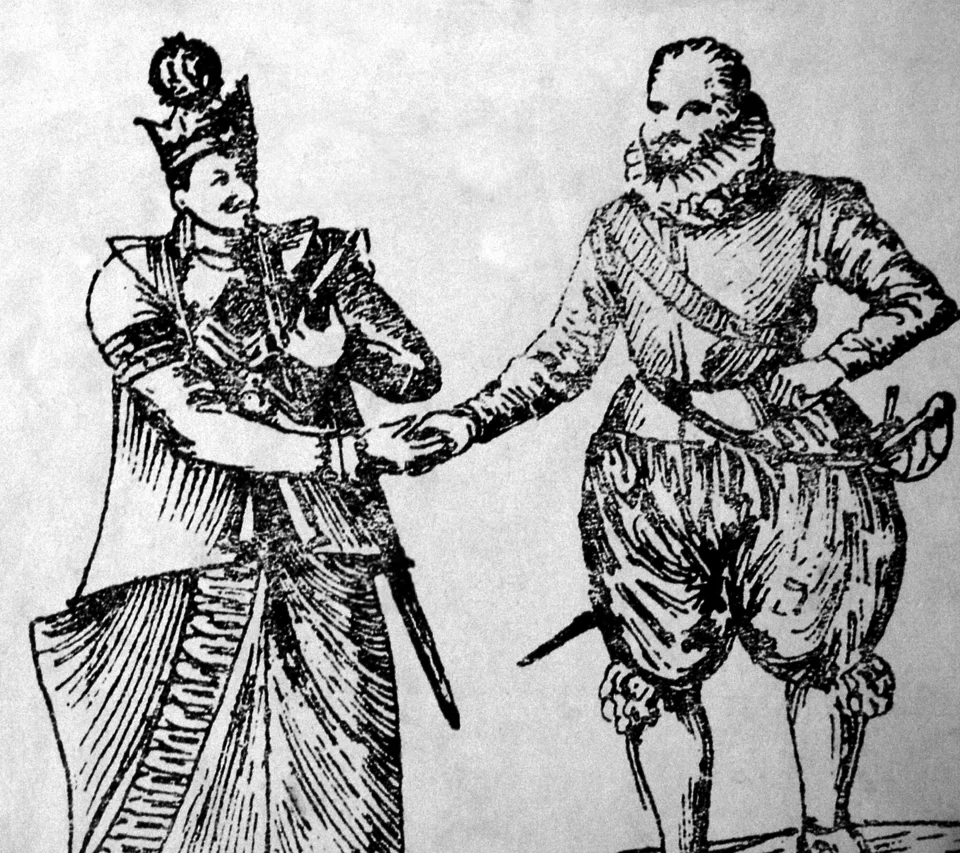
His original drawings do not survive. They are thought, all the same, to lie behind the fourteen plates that Floris Balthasar engraved for Spilbergen’s ‘Historiael Journael’, printed at Delft in 1605, so that what Vennip saw of Ceylon passed into print through another hand.
Those fourteen plates are among the first printed European images of Ceylon drawn from life, and they carry a weight beyond their age from what they show. Among a map and a set of town plans stands the scene that opens the whole Dutch record of the island, the admiral received by Vimala Dharma Suriya, two courts meeting on paper for the first time. The cutting was done in Delft by Floris Balthasar, a mapmaker and engraver of standing, and the Protestant temper of the venture shows in the sheets, which dwell on the veneration of images in the Buddhist court with the wary eye of a Reformed people who named such things idolatry. What began as a steersman’s working sketch became, in the print house, the founding picture of Ceylon as the Dutch would come to see it, a diplomatic encounter and a survey at once, set down before a single fort had changed hands.
Sources
- de Silva, R.K., and W.G.M. Beumer. Illustrations and Views of Dutch Ceylon 1602–1796. E.J. Brill / Serendib Publications, 1988.
- van Spilbergen, Joris. ’t Historiael Journael. Delft: Floris Balthasar, 1605.
How to cite this profile
Malaka Talwatte, “Cornelis Jansz Vennip,” Malaka Talwatte: Sri Lankan Art and Ceylon Antiquaria, https://malakatalwatte.pages.dev/artists/cornelis-jansz-vennip/.
Quote and cite freely with attribution; please do not republish a whole essay, or a photograph, without permission.