Classical · Site
The Council Chamber
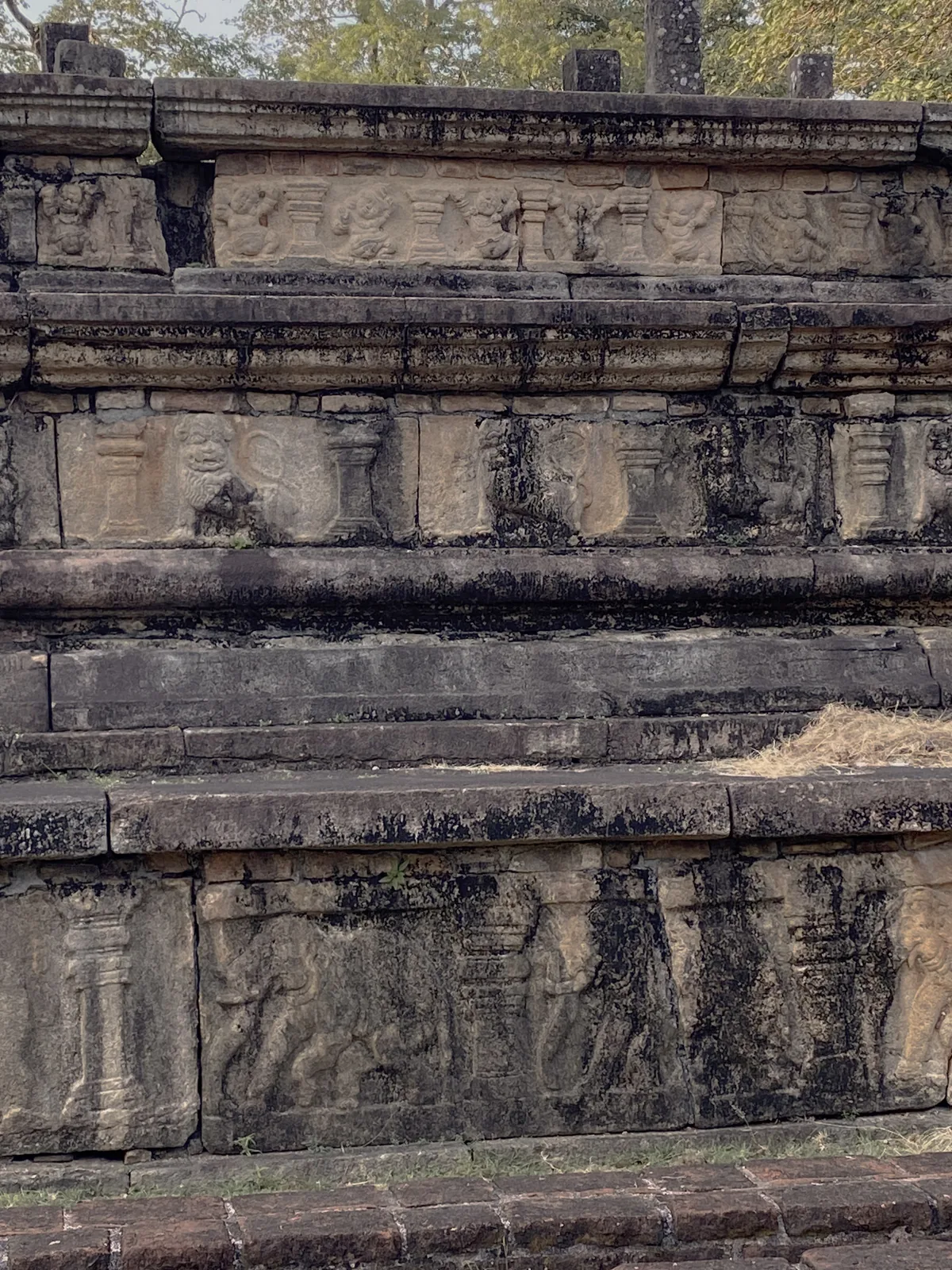
Along the base of the audience hall that Parakramabahu I raised beside his palace at Polonnaruwa runs a procession of elephants, and the carver gave each of them its own attitude, so that no two along the whole course are alike. The building, the king’s council chamber, is a raised oblong platform climbed by a stair and set once with rows of stone pillars that carried a timber roof; the roof and the upper walls are gone, but the carved plinth that lifted the hall above the ground has kept its three bands of figures almost whole.
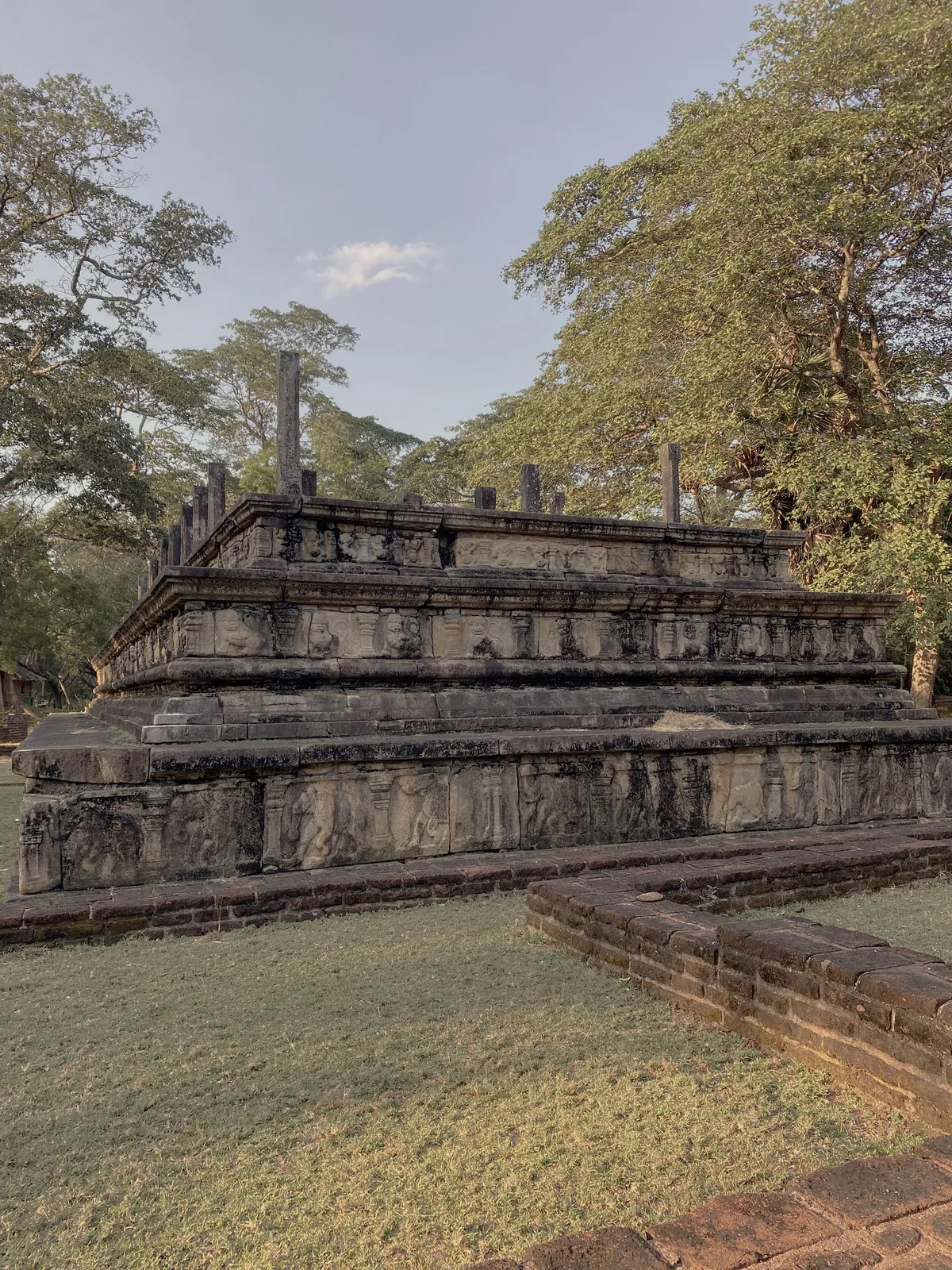
The lowest band is the elephants, then a band of lions, then a band of dwarfs, the ganas, caught in a lively play of music and movement. It is the elephants that are looked at. Where a decorative course of this kind would usually repeat one figure round a building, here the animals are individually observed, each in a different posture and gait, a naturalism unusual in so formal a place and the reason the frieze is counted among the finest secular carving of the age. A stair flanked by stone lions climbs to the platform, and a lion stood at the head of the hall, the seat and the emblem of the king, the sinha whose name the Sinhalese people carry.
A second council chamber stands nearby, built by Nissanka Malla a few years later, and the two are often confused. That later hall is known for something different, the short inscriptions cut on its pillars that fix the seating order of the court, the king on his lion throne, the heir apparent, the commander, the chief scribe and the head of the merchants’ guild each set in his appointed place. The varied elephants belong to the earlier hall, Parakramabahu’s, and it is the carving there by which the secular art of the age is measured.
The friezes are cut in the hard grey stone of the region, in low relief along the moulded courses of the plinth. No trace of colour is recorded on them, and they are seen as worked stone. Of the carvers nothing is known, as nothing is known of any of them, and the wonder of the hall is that an anonymous mason, set to the routine task of a decorative basement course, chose to look at a hundred elephants and cut each as a thing seen rather than a thing repeated.
Sources
- Paranavitana, Senarath. Art of the Ancient Sinhalese. Colombo: Lake House, 1971.
- Bandaranayake, Senake. Sinhalese Monastic Architecture. Leiden: Brill, 1974.
- Epigraphia Zeylanica. Vol. IV. Edited by S. Paranavitana.
- UNESCO World Heritage Centre. ‘Ancient City of Polonnaruwa’ (inscribed 1982).
How to cite this profile
Malaka Talwatte, “The Council Chamber,” Malaka Talwatte: Sri Lankan Art and Ceylon Antiquaria, https://malakatalwatte.pages.dev/artists/council-chamber/.
Quote and cite freely with attribution; please do not republish a whole essay, or a photograph, without permission.