Kandyan · Site
Dambulla
The rock temple of Dambulla holds the largest single expanse of temple painting in the country, and it carries a lesson at its heart: the caves are ancient, the paintings on them are not. The five caves were cut and dedicated as a monastery in the first century before Christ, in the reign of Valagamba, who is said to have taken refuge here during the years an invasion from South India drove him from his Anuradhapura throne, and to have consecrated the site in gratitude on his return, yet the murals that cover their ceilings and walls today are overwhelmingly the work of the Kandyan revival, repainted in the eighteenth century under Kirti Sri Rajasinha, whose restoration added new murals, overpainted older ones, had the statues gilded and painted, and raised the long colonnaded verandah that now runs along the cave mouths behind their moulded, white-plastered facade.
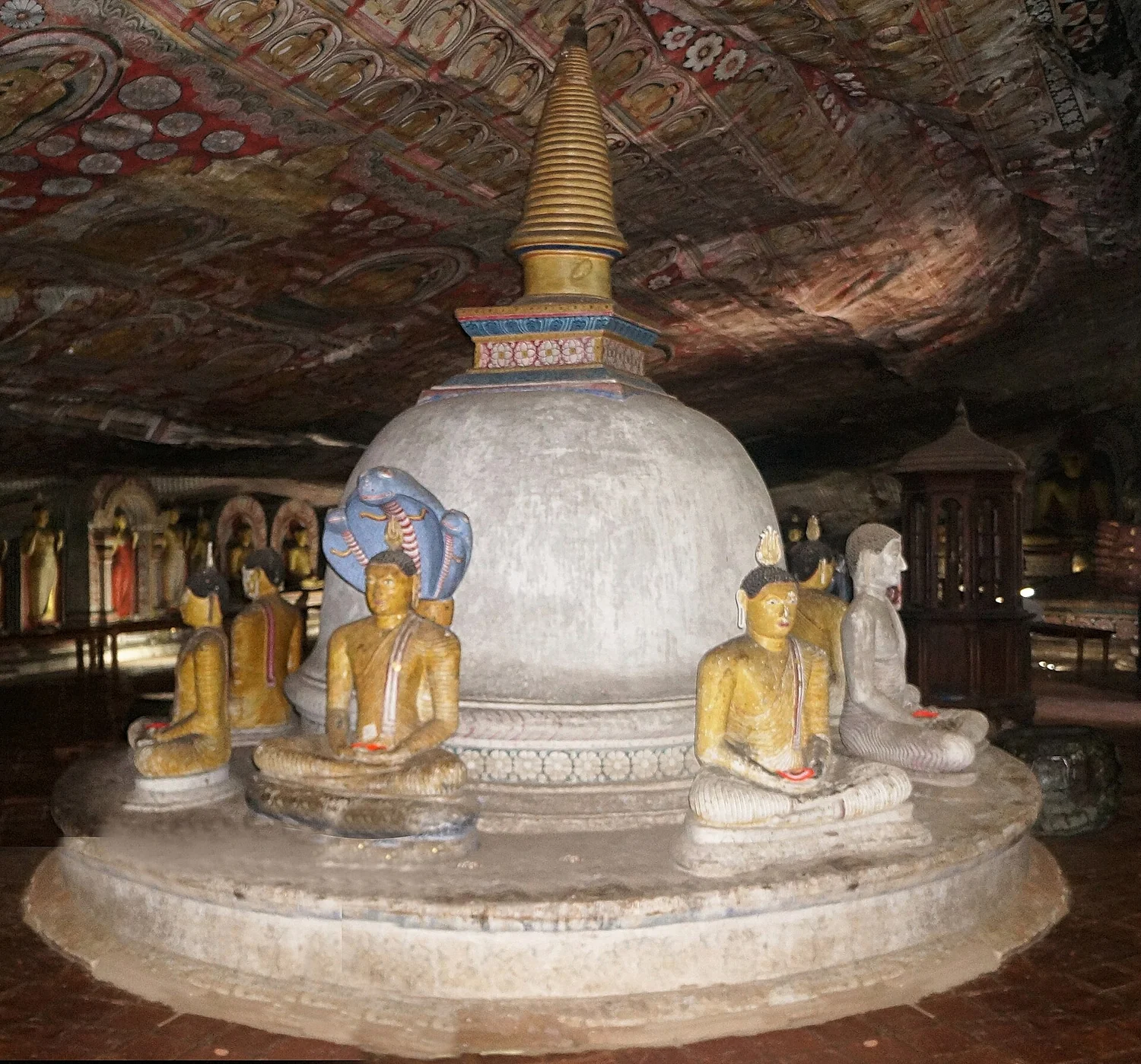
Cave 2, the Maharaja Vihara, named for two much earlier kings, Vattagamini Abhaya and Nissanka Malla, holds the temple’s grandest single space: a great gilded reclining Buddha and a long row of gilded standing Buddhas set beneath a densely painted rock ceiling, its ambulatory carrying the standard narrative sequence of a Kandyan image house, the Buddhacarita and Jataka cycles, the Seven Weeks after the Enlightenment, the prophecy of the twenty-four former Buddhas, and the forty-five rain retreats of the Buddha’s ministry. Cave 3, the Maha Aluth Viharaya, the ‘great new temple,’ next door to it, holds the standing portrait statue of Kirti Sri Rajasinha himself, an identification not seriously disputed, set in worshipping posture before the images his own restoration commissioned. The entrance to Cave 1 alone carries a painted doorframe bordered in dense red-and-gold scrollwork and roundels, announcing in miniature the ornamental discipline that fills the caves beyond.
The eighteenth-century work is credited chiefly to Kirti Sri Rajasinha’s own painters, and some accounts place the Nilagama school, the same lineage that supplied the foreman of Degaldoruwa, among the workshops responsible, with Devaragampola Silvattenne Unnanse himself named in a handful of sources as a leading hand in the renovation, though no source pins his part to a particular cave with certainty. Across some two thousand square metres the murals carry the life of the Buddha, ranks of deities and guardian figures, and the geometric and floral infill, checkerboard ceiling panels among them, that Kandyan painters used to leave no surface bare, all laid in the earth reds, yellows and blacks of the hill-country palette.
To read Dambulla as classical, on the strength of its ancient caves, is the common mistake. Its painted surface belongs with the Kandyan masters, the work of named eighteenth-century hands repainting a monastery already two thousand years old when they climbed the scaffolding, and it is among the Kandyan school that it is placed here.
Sources
- Coomaraswamy, Ananda K. Mediaeval Sinhalese Art. 1908. https://archive.org/details/mediaevalsinhale0000coom
- Bandaranayake, Senake. The Rock and Wall Paintings of Sri Lanka. Colombo, 1986.
- de Zoysa, Asoka, and Vajira Nalinda Jayathilaka. Buddhist Image Houses. Colombo: Samkathana Research Team, 2015.
- Manjusri, L.T.P. Design Elements from Sri Lankan Temple Paintings. Colombo: The Archaeological Society of Sri Lanka, 1977.
- UNESCO World Heritage Centre. ‘Rangiri Dambulla Cave Temple’ (inscribed 1991). https://whc.unesco.org/en/list/561/
How to cite this profile
Malaka Talwatte, “Dambulla,” Malaka Talwatte: Sri Lankan Art and Ceylon Antiquaria, https://malakatalwatte.pages.dev/artists/dambulla/.
Quote and cite freely with attribution; please do not republish a whole essay, or a photograph, without permission.