Modern · Artist
David Paynter
In the meditation chapel of Trinity College, Kandy, the biblical figures David Paynter painted onto the walls wear the faces and carry the bodies of the island he was raised on. The Good Samaritan, Christ washing his disciples’ feet, the Crucifixion: he set the scenes of a European faith among Ceylonese models, and gave Christ and the biblical figures the island’s own trees and rocks to stand among, in the full academic manner of the schools where he had trained, and made in the process something the island had not seen before. To understand how a painter arrived at that fusion, you go back to a mission house in the hills and to a boy who could draw.
A mission house in the hills
He was born on 5 March 1900 at Almora, in northern India, to a British father and a Sinhalese mother; the family moved to Ceylon in 1904, where his parents opened a Christian mission at Nuwara Eliya. The household was an unusual one. His father, Arthur Stephen Paynter, came of a brewery family of Bicester in Oxfordshire and had thrown that inheritance over for the Salvation Army; his mother, Anagi Weerasooriya, was of a southern Ceylonese family and a sister of the noted Salvationist Arnolis Weerasooriya. By the family record the father ended his days as a Christian mendicant, moving about in the saffron robe and with the begging bowl of a sadhu, disowned by his English relations for the marriage. The devotional temper of that home stayed with the son, though he wore it lightly, and it gave him his lifelong subject before it gave him a brush.
He was schooled first at Breeks Memorial School, in the South Indian hills, and then at Trinity College, Kandy, where his exercise books filled with drawings and his masters filed the verdicts of a distracted talent: fair, must work harder; intelligent, but lazy; very good, sometimes. During the First World War, still a schoolboy of sixteen and seventeen, he tried three times to enlist, riding down to Colombo from the family home to present himself, until an army commander sent him back on the evidence of his own birth certificate. The turn came at nineteen, on the shore of the Nuwara Eliya lake, when he fell into conversation with an Englishwoman, a Miss Mason, whom he found painting the water. Six months of trial under her coaxing brought a natural authority out of him, and with it the decision to become a painter.
London and Italy: the making of a draughtsman
That decision was vindicated almost at once. In open competition with students already schooled in the European academies, and with little formal training of his own, he won a five-year scholarship to the Royal Academy Schools in London. Four years in, at twenty-three, he took the Academy’s Gold Medal, awarded only in alternate years, and with it the Edward Stott Travelling Scholarship, which carried him for two years to Italy and to the frescoes that shaped his sense of what wall painting could do.
What London gave him, above everything, was the discipline of the schools: sustained study from the antique and the life model, tonal control, the construction of a picture as a designed and load-bearing thing. A reviewer of his Academy work, Horace Shipp, praised the draughtsmanship and the ‘carefully graded tone values’ as the virtues of the schools they were; another London notice admired how soundly his pictures were built, their design carrying the interlocked logic of music and the balanced load of an engineered span. That grounding never left him, and he came to defend it as the necessary root of any painter’s freedom, his own included.
The discipline of drawing
Drawing was the spine of everything Paynter made, and it is in his drawings, more than in the finished pictures, that the reach of his hand can be seen. He held throughout his life that draughtsmanship is the basis of painting, and in the studio he built the human form for his pupils in a succession of parallel hatchings laid along the turn of the form, drawing volume out of line. His surviving sheets are almost all preliminary studies of the body or of nature, and because they were means of enquiry rather than ends they are the more revealing: not simply accurate, but reasoned penetrations of how a thing is made, the structure under the surface set down as if it were being explained. The large squared-up studies for the Trinity murals and for the later Transfiguration, gridded and numbered for transfer to the wall, show the old studio method of proportion carried through with an ease that few of his generation could match.
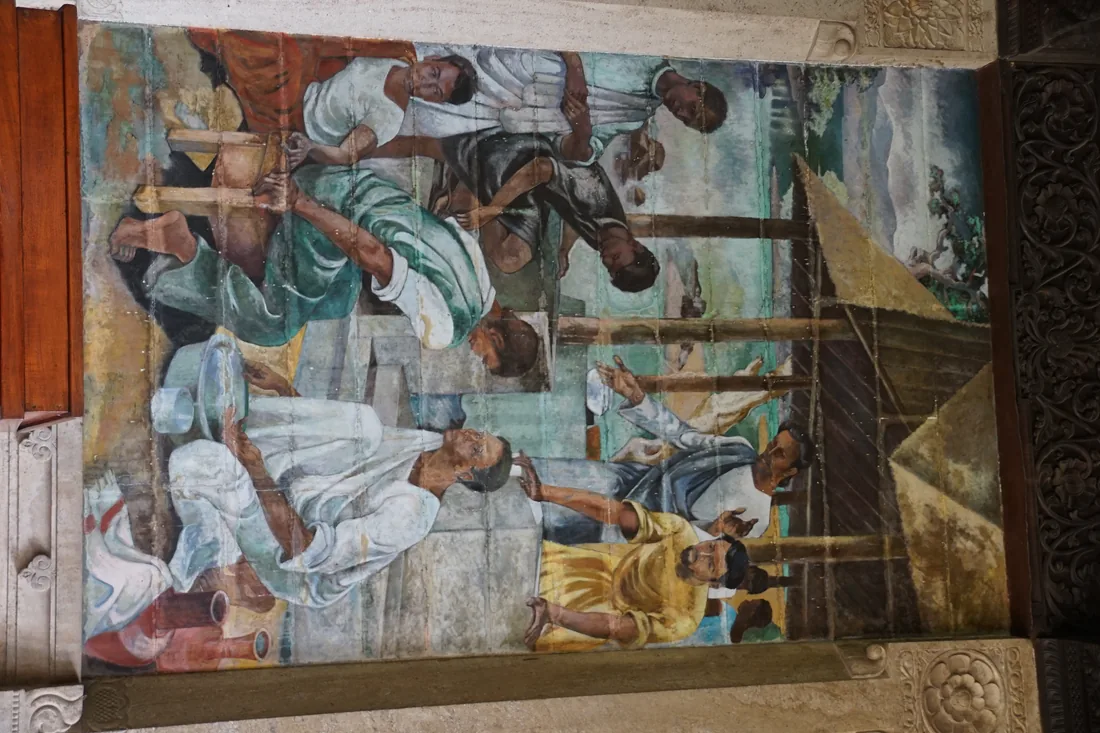
The pencil studies for the wall-painting of Christ washing the disciples’ feet, made in 1928 for a first version he would repaint on the same wall in 1965, after the earlier one was lost when the chapel roof was renewed, are among the clearest evidence of the method: the whole composition tried and retried in the figures alone, sheet after sheet, before a colour touched the wall. His authority as a teacher of drawing was recognised by the painters who followed him. The landscapist George Beven learned the drawing of the human figure from Paynter, and among his pupils at the Colombo school were Ivan Peries and Aubrey Collette, who would go on to help found the very movement that set itself against him. To place him in the wider world, as he liked to place himself, the parallel he reached for was Picasso, who had absorbed the whole apparatus of the schools in boyhood, and whose mastery of it, far from imprisoning him, freed the invention that came after.
The male nude
It was to the male nude that Paynter turned when he wanted to say what drawing was for. Male beauty was among the abiding subjects of his art, in nudes and semi-nudes both, and he treated it as a spiritual rather than a merely decorative matter. The classical nude, refined and ideal, held less for him than the virile grace of the peasant and the labourer, the fisherman hauling a net or the boy at rest, in whom he found a body that was working and alive. The figure, for him, was the sole complete vehicle of expression, and its beauty carried a meaning he took from the devotional world of his childhood, that man was made in the image of God. The lineage he worked in ran from the archaic and classical Greeks through Michelangelo, and it surfaces in his own pictures in works such as L’Après-Midi of 1934, now in the Brighton Art Gallery, and The Boy with Catapult of 1931, where the schooled study of anatomy is turned to a Ceylonese subject and a Ceylonese light.
The Royal Academy years
For seventeen years his work was hung, and hung on the line, at the Royal Academy in London: every year from 1923 to 1940. He arrived with force, for at the Autumn Exhibition of 1923 two pictures, The Entombment and The Styx, took the line, and the critic Wilfred Meynell wrote of the sincerity of the first in the Review of Reviews; the Triumphal Entry into Jerusalem of the same year, the picture that had carried the Academy Gold Medal, now hangs in the Colombo Art Gallery. His portrait of the actress Margaret Rawlings, shown in 1929, was singled out by more than one London writer as the finest in the exhibition. In 1931 his Boy with Catapult was praised, printed in the illustrated catalogue, and paid the backhanded compliment of a caricature in Punch.
The single-artist show came in 1936, at the Wertheim Galleries in London, and drew notice from the European art journals. His reach beyond Britain widened from there. He was invited into the great international surveys of the day, at the Carnegie Institute in Pittsburgh, in Rome, at the New York World’s Fair, and in New Delhi, where his Nepalese Mother and Daughter of 1947 was judged the best picture at the Inter-Asian exhibition. In 1951, for the Holy Year, his Madonna con Bambino was chosen for the exhibition of contemporary Christian art held at Rome under Pope Pius XII, a rare inclusion for a painter from the island. At home, near the end, he showed in 1968 in a three-man exhibition in Colombo alongside Karl Kasman and J. D. A. Perera.
Painting Ceylon into a European faith
He had returned to Ceylon in 1925 to begin the work that would occupy him, on and off, for the rest of his life: the murals of the Trinity College chapel, then still being built. What he did there was deliberate, and he explained it in his own words on Radio Ceylon. Radio Ceylon was among the oldest broadcasters in Asia, its transmissions begun under British rule in 1925. Having studied in Italy and France, he had found that the masters had painted their own countries and their own times: Piero della Francesca had set the biblical incidents at Arezzo, where he lived, and Benozzo Gozzoli had given his sacred pictures a Florentine world. So Paynter chose to paint, as he put it, more or less Ceylon landscapes and more or less Ceylonese types, the more readily because he disliked the recent European habit of showing Christ as a fair Englishman in Arab costume.
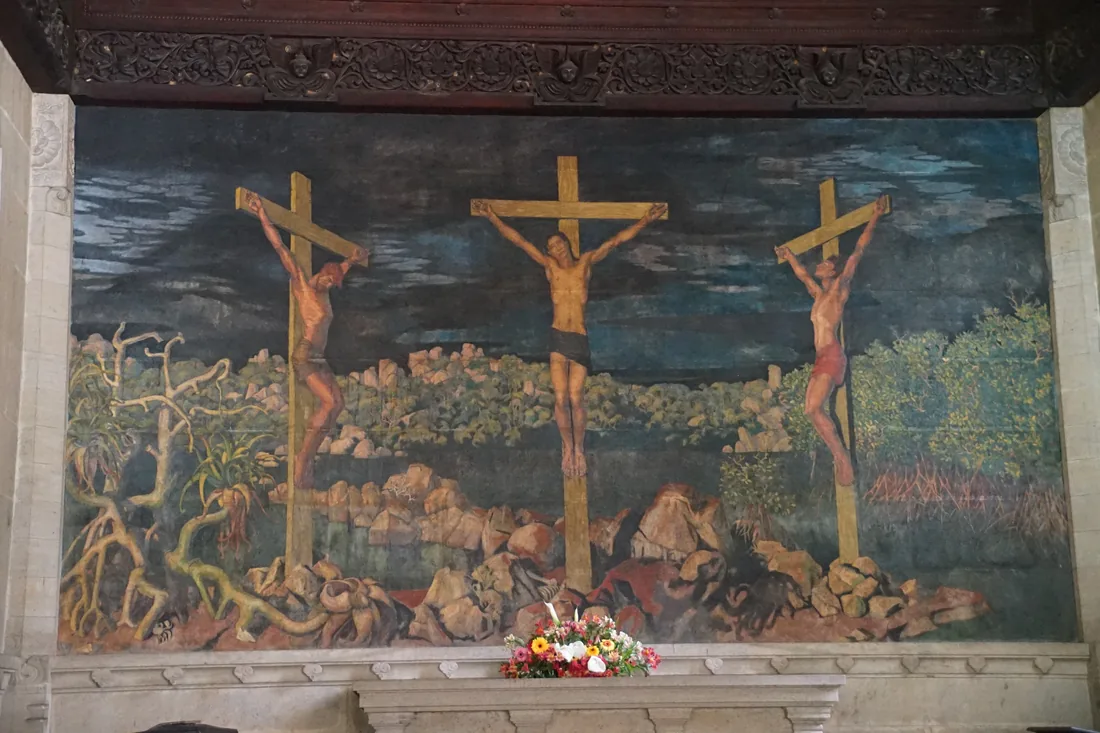
His first mural, ‘Are Ye Able…?’, went onto the wall of the meditation side-chapel from 1926; the vast Crucifixion followed, and over a decade the cycle grew to include Christ washing the disciples’ feet and, later, The Good Samaritan of 1958. The Christ of these walls is a dark-skinned, clean-shaven man of the country, and the settings are the island’s rock and tree and river, so that a European story is told in an unmistakably local voice. The scheme met resistance at first, for the boldness of setting the sacred among Ceylonese faces was new to eastern Christian art. Its logic he never abandoned: his last great commission, the Transfiguration for the Chapel of the Transfiguration at S. Thomas’ College, Mount Lavinia, completed in 1968, is a wall more than six metres high, and it repeats on the largest scale the argument he had begun in Kandy forty years before.
From the altarpiece to the tropical light
Paynter’s manner changed as his subjects did. The early religious pictures and the first wall-paintings are Renaissance in their bones, built on a designed and linear order, the figures drawn long in the way of Botticelli and the drapery falling in linear rhythms, the whole set in a measured and often high-toned space. After his return to the island the range opened out. He turned to the landscape and the working life around him, to fishermen and carters and harvesters, to the swineherd and the addict, and to portraiture, which became for a season the fashion of Colombo, so that governors and prime ministers and ordinary sitters alike came to be painted by him; in 1954 he was invited to India to paint the official portrait of its prime minister, Jawaharlal Nehru, and in 1955 he painted Sir John Kotelawala, the portrait now hanging in the Sri Lankan Parliament. With the new subjects came a new palette. He let colour run to the pure, vivid hues of the tropics, and used it descriptively and emotionally at once, as an expression of his own response rather than a report on the object; he preferred, tellingly, to speak of his surroundings rather than of nature. In the landscapes of his maturity the schooled finish loosens: Kumbuk Trees of 1950 is handled in a frankly impressionist way, its tactile surfaces dissolving, and Deadwood of 1954 carries the swirling, half-abstract movement of a painter no longer bound to the copied fact.
Influences, and how he turned them
The Italian masters he had absorbed in his two years abroad stayed with him as working tools rather than as objects of reverence. From Piero della Francesca he took the science of perspective and space, and from Andrea Mantegna the foreshortening and the overlapping of masses that let a figure recede convincingly into depth. Botticelli gave him line and the flow of drapery; Leonardo, the pursuit of an ideal form and the suppression of local colour under a total effect of light and shade; Michelangelo, the conviction that the human body is the one sufficient subject, man conceived as a godlike and unique creation. Yet he held that the academic principle was a framework to be adapted, never a dogma to be obeyed, and that blind adherence to it drains a picture of feeling. In his 1952 lecture on the fashions of painting he set out the balance he tried to keep: the mastery of the old craftsmen he called the fruit of genius, of tradition and of years of patient study, and he refused the modish notion that technique is a trick; and yet he judged the modern revolution necessary and vital, and thought no honest painter could ignore it. The cubists and the post-impressionists, he observed, had gone back for their strength to the great primitives, the early Flemish and Italian painters, rather than to the naturalism that came after. He kept his own admirations wide, reaching from Gauguin and Cézanne and Van Gogh, whom he had championed as far back as an unpublished essay of 1929, to the classical Sinhalese line of Sigiriya and the Hindagala cave, whose sure and sensuous line he studied and praised. His Self-Portrait with Lotuses of 1927 has been read against Gauguin, and it shows how naturally the European and the island sat together in him.
The India years, and the later life
At the height of an international career, in 1941, Paynter did an unexpected thing: he left the island. At his missionary brother’s asking he went to a colony in the Himalayan foothills, in the Terai jungle country of Kumaon, and for the better part of a decade he farmed and hunted and worked among the settlers, painting far less than before. He was back in Ceylon by 1949, and gave himself again to teaching and to portraiture, serving for a time as Principal of the Government College of Fine Arts at Heywood. He was appointed an Officer of the Order of the British Empire, and he was later numbered among the twenty-five distinguished citizens of Ceylon. The humanitarian strain of his upbringing ran through the rest of his life: during the malarial-dysentery epidemic of 1935 he stood in as a resident ‘doctor’ at the mission station at Waduwawa, he kept a home for orphans at Nuwara Eliya, and in 1962 he founded a collective farm, Salt Springs, on a hundred acres near Trincomalee. He was, by all accounts, a vivid presence, given to bright clothes and ancient cars and all-night bridge, devout in an unpreaching way; at Trinity he had been a man of the theatre besides, designing and producing plays and taking the stage himself. He was still drawing at the end; a small Study for a Composition of 1974 is recorded as his last picture.
The academy and the moderns
When the ’43 Group formed in 1943 to break with salon convention and turn towards modernism, it defined itself in part against the academic tradition Paynter embodied, a tradition two of its own, Ivan Peries and Aubrey Collette, had first learned in his classroom. That opposition has tended to fix him, in later tellings, as the establishment the moderns overthrew. The record argues for a fuller reading: he was among the first Ceylonese to hold a complete Western academic training and to win at the centre of the imperial art world on its own terms, and he spent his working life turning that training towards the faces, the light and the devotion of his own country.
He died of a heart attack on 7 June 1975 and was buried at Nuwara Eliya, in the hills where his family’s mission had stood. In the Trinity chapel the murals remain, their Ceylonese Samaritan and Ceylonese Christ still holding the argument he had made with his brush: that the craft of the academy, fully mastered, could be made to speak in an island’s own voice.
Sources
- Darling, Eve, and Albert Dharmasiri. David Paynter. Colombo, 1982.
- Wikipedia. ‘David Paynter (artist).’ https://en.wikipedia.org/wiki/David_Paynter_.
- Art UK. ‘Paynter, David, 1900–1975’. https://artuk.org/discover/artists/paynter-david-19001975
- Art Ceylon. ‘David Paynter.’ https://www.artceylon.com/artist40.html
- Kala (South Asian art archive). ‘David Paynter.’ https://kalasouthasia.com/david-paynter/
- Chapel of Trinity College Kandy. ‘Restoration of the David Paynter Murals.’ https://trinitycollege.lk/2020/08/28/restoration-of-the-david-paynter-murals-chapel-of-trinity-college-kandy/
- ‘The Mural’. Chapel of the Transfiguration, S. Thomas’ College, Mount Lavinia. https://www.stcmount.edu.lk/the-chapel/the-mural/
- Bandaranayake, Senake, and Albert Dharmasiri. Sri Lankan Painting in the 20th Century. Colombo: National Trust of Sri Lanka, 2009.
How to cite this profile
Malaka Talwatte, “David Paynter,” Malaka Talwatte: Sri Lankan Art and Ceylon Antiquaria, https://malakatalwatte.pages.dev/artists/david-paynter/.
Quote and cite freely with attribution; please do not republish a whole essay, or a photograph, without permission.