Kandyan · Artist
Devaragampola Silvattenne Unnanse
Devaragampola Silvattenne Unnanse is the finest painter the Kandyan kingdom produced, the man later writers credit with its most brilliant work. Devaragampola was his own name, taken from the village of his birth in the hill country; Silvat Unnanse is a title rather than a surname, marking a monk who had taken the lower monastic vows but had never gone forward to full ordination, upasampada. He painted under the patronage of Kirti Sri Rajasinha, the king whose reign from 1747 to 1782 revived both Buddhism and the temple arts of the hill country, and from around 1755 the king is said to have entrusted him with four temples in turn: Medawala, Degaldoruwa, Dambulla and Ridi Vihara.
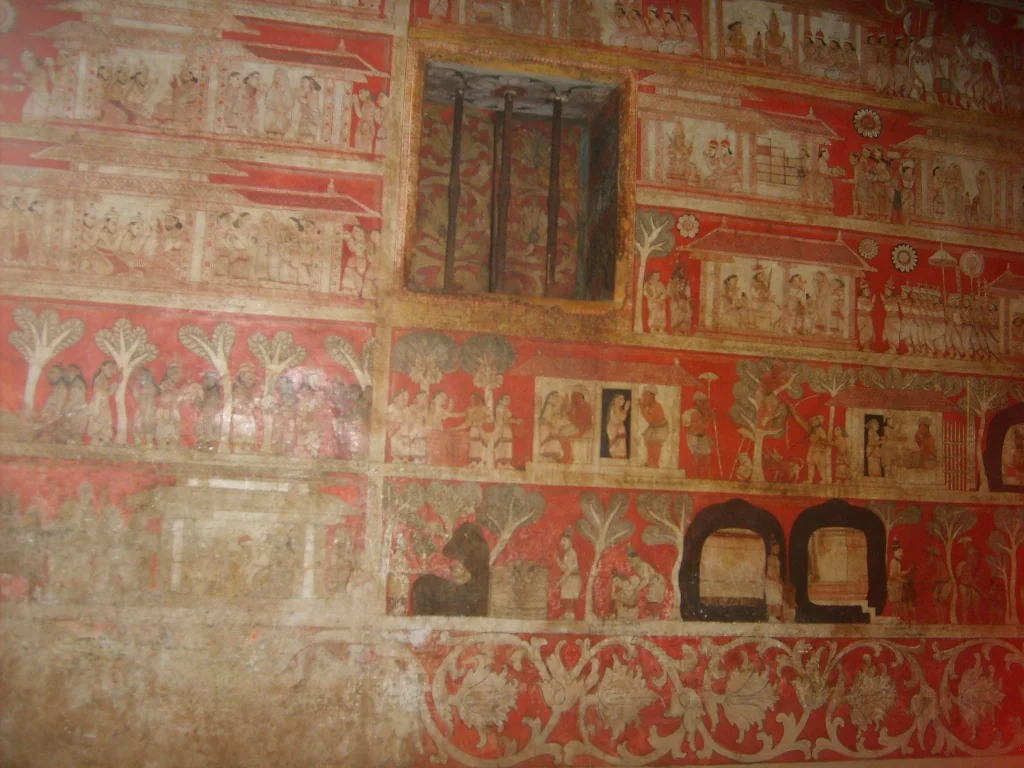
His masterpiece is the cave temple of Degaldoruwa, near Kandy, its walls finished around 1771 and its founding grant drawn up before 1786. Four Sittara painters worked there under the foreman Nilagama Patabenda, and Devaragampola Silvattenne Unnanse is named among them as the most celebrated of the four; another of them, Kosvatte Hitaranayide, painted the Sutasoma Jataka, and together the walls carry the Vessantara, Sattubhatta, Sutasoma and Mahaseelava Jatakas in one continuous scheme. Devendra Mulachari, the great builder-craftsman remembered for the Temple of the Tooth’s octagon and for Kandy’s lake, belonged to the same generation and is sometimes paired with Degaldoruwa in popular retelling, but the temple’s own foundation grant does not name him among its painters; that pairing looks like a later conflation of two celebrated men rather than a documented fact, and the earliest surviving account names Nilagama Patabenda as the workshop’s foreman instead.
His hand shows the craft at its most exact. In the Vessantara Jataka he paints the same elephant twice within one register, once ridden by the king and once being led away as a gift, so that the story unfolds as the eye moves along the wall rather than sitting still within a single frame, the continuous narration that was the Sittara’s chief narrative method. He also painted the earliest work at Ridi Vihara in Kurunegala, the rest of that temple’s murals completed later by painters of the same Nilagama generation, and he is remembered too as the chief artist of Kirti Sri Rajasinha’s renovation of Dambulla. A folk tale attached to that work is worth repeating, though not as history: high on the scaffolding in the dark of the cave, chewing betel through the long hours of work, he spat out a mouthful and called down for his boy to carry it away, only to find that the figure below was the king himself, come unannounced to watch how long the painter laboured. That a master could treat his sovereign so, and the story come down as tribute rather than affront, is the measure of the standing a court painter held.
The workshop and its reach
He worked within an institution as much as a tradition. The Kandyan court kept a royal department of arts and crafts, the Kottalbadda, under an officer called the Kottalbadda Nilame, and it was through that office that the patronage of Kirti Sri Rajasinha reached a painter, in grants of land, gifts of material and honorary titles conveyed by deed. Coomaraswamy, setting the practice down while it was still living memory, recorded how the Upcountry painter was trained: drilled first in proportion and in the grinding and mixing of colour, and set to the line exercises, the vaka-deka, the katuru mala and the tiringi talaya, by which the hand learned the forms before it was trusted near a wall. The reach of Devaragampola’s own workshop ran past the hill country: recent scholarship traces two Lowcountry monks, Vattawe and Katuvana, to his teaching, and holds that Katuvana founded one of the celebrated painting lineages of the southern coast, so that a line of descent runs from the central master to the makers of the Southern school.
Coomaraswamy called Degaldoruwa the best painting he had yet seen in Ceylon, and recorded that Devaragampola was still remembered, a century and more after his death, as the best painter of his day. His scenes are crowded, exact and alive to the manners of his own time, the Jataka stories set among the dress, gesture and ceremony of eighteenth-century Kandy. The Sittara tradition rose no higher than his walls.
Sources
- Coomaraswamy, Ananda K. Mediaeval Sinhalese Art. Broad Campden, 1908.
- Coomaraswamy, Ananda K. Notice in the Ceylon Observer, 17 February 1905.
- de Zoysa, Asoka, Vajira Nalinda Jayathilaka, and Ganga Rajinee Dissanayaka. Evolving Traditions of the Buddhist Image House, Part I. Samkathana Research Team, University of Kelaniya.
- Bandaranayake, Senake. The Rock and Wall Paintings of Sri Lanka. Colombo, 1986.
- The Degaldoruwa sannasa (foundation grant).
How to cite this profile
Malaka Talwatte, “Devaragampola Silvattenne Unnanse,” Malaka Talwatte: Sri Lankan Art and Ceylon Antiquaria, https://malakatalwatte.pages.dev/artists/devaragampola-silvattenne-unnanse/.
Quote and cite freely with attribution; please do not republish a whole essay, or a photograph, without permission.