Classical · Site
The early vatadages
The vatadage, the circular relic-house, is the island’s own contribution to the forms of Buddhist building: a ring of stone pillars raising a timber roof over a small stupa, so the relic stood sheltered within a round, columned room. Its ancestor is the ring of pillars about the Thuparama at Anuradhapura; its richest and latest form is the carved Vatadage at Polonnaruwa; and between them stand the early vatadages, where the form is seen at its purest, two of them best of all.
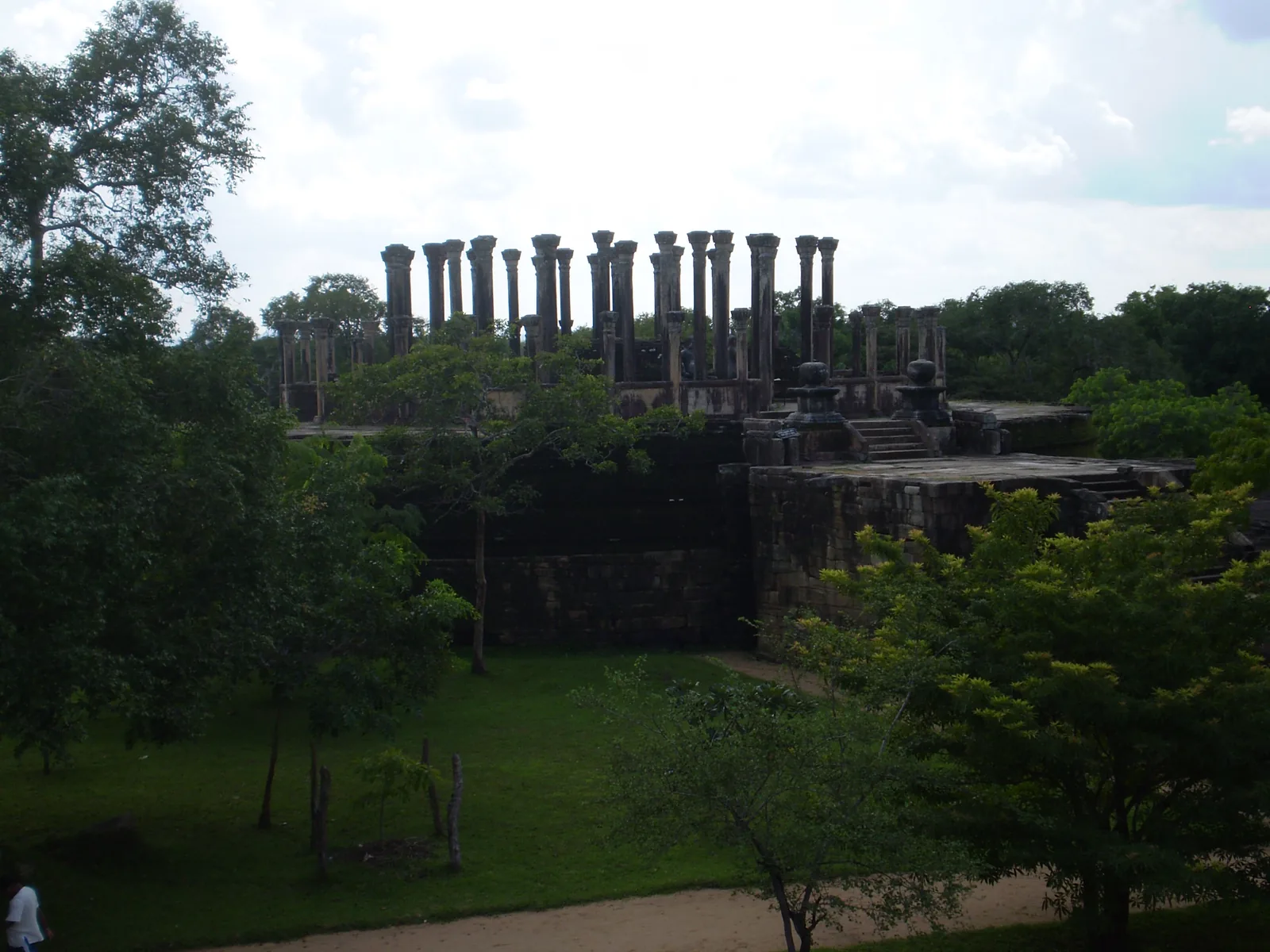
Medirigiriya
On a low rock in the forest north-east of Polonnaruwa stands the most complete vatadage the island keeps. Three concentric rings of stone columns rise about the central stupa, sixteen in the inner ring, twenty in the middle and thirty-two in the outer, stepped in height to the pitch of the vanished roof, and four seated Buddhas face out to the four directions. A long flight of cut-granite steps climbs the rock to the terrace. The art is in the geometry, the even circles of columns making a still round room open to the sky. The stupa at its heart is old, traced to the second century, but the relic-house is given to the seventh, to the age of Aggabodhi IV, a date the gold leaf inscribed in seventh or eighth century script, found here in 1947, supports. H.C.P. Bell, who recorded it in 1897, judged it one of the gems of the island’s architecture.
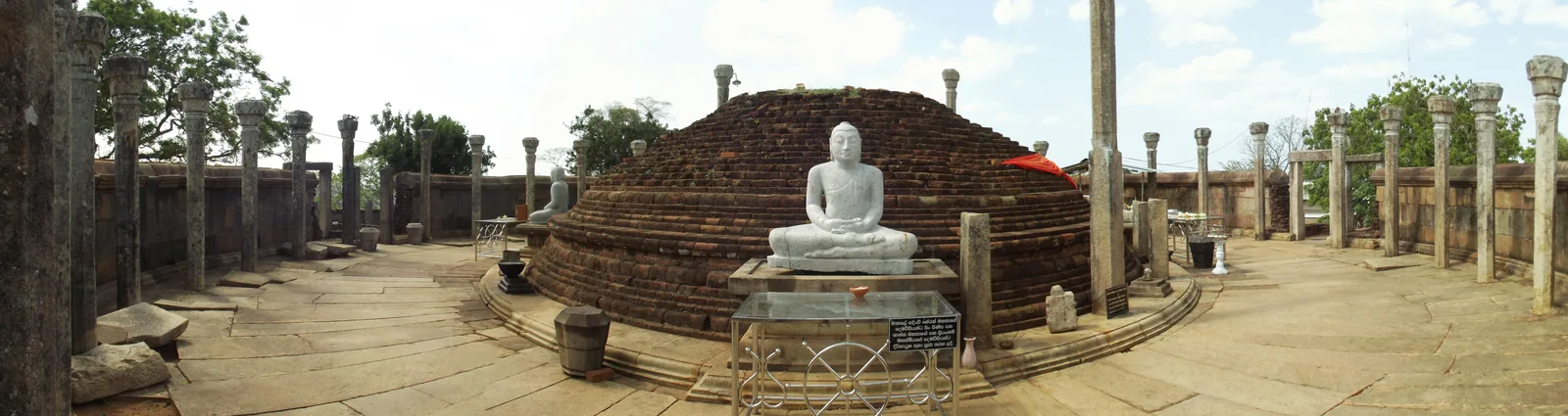
Tiriyaya
Far off on the east coast, on a hill above the sea near Trincomalee, stands the vatadage of Tiriyaya, the Girihandu Seya, its outer wall and its rings of pillars better kept than Polonnaruwa’s. Tradition makes it one of the first stupas of all, raised by the merchants Tapassu and Bhalluka, the Buddha’s first lay followers, over a hair of the Buddha they were given; Paranavitana warned that the legend is too fabled to take as history. What can be dated is the Sanskrit inscription cut on its rock, of the seventh or eighth century and in a Mahayana strain, which records that the Girikandi shrine was endowed by guilds of merchants, and the stupa was enlarged in the eighth century in the reign of Aggabodhi VI. Its pillars, its guardstones and its moonstone place it with the finest of the early vatadages, and it carries the form to the far edge of the island.
Who set the pillars in their circles is unknown, at Tiriyaya and Medirigiriya as everywhere. The vatadage was the island’s answer to a plain problem, how to roof a relic, and the early builders solved it in rings of plain stone that the later age at Polonnaruwa would cover in carving; the form is at its clearest here, before the ornament came.
Sources
- Paranavitana, Senarath. The Stupa in Ceylon (Memoirs of the Archaeological Survey of Ceylon, Vol. V), 1946; ‘Tiriyay Rock-Inscription’, Epigraphia Zeylanica, Vol. IV.
- Bandaranayake, Senake. Sinhalese Monastic Architecture. Leiden: Brill, 1974.
- Bell, H.C.P. Archaeological Survey of Ceylon: Annual Reports.
- Department of Archaeology, Sri Lanka.
How to cite this profile
Malaka Talwatte, “The early vatadages,” Malaka Talwatte: Sri Lankan Art and Ceylon Antiquaria, https://malakatalwatte.pages.dev/artists/early-vatadages/.
Quote and cite freely with attribution; please do not republish a whole essay, or a photograph, without permission.