Pre-modern · Artist
Edward Lear
Edward Lear (1812–1888), poet, painter and author of the Book of Nonsense, had come to Ceylon in the course of a fourteen-month journey through India undertaken at the invitation of the Viceroy, Lord Northbrook. In November 1874 one of the most celebrated figures of Victorian England landed at Colombo. He was sixty-two years of age, accompanied by his devoted Albanian attendant Giorgio Kokali, and had long anticipated the island, which he had, as he recorded in his journal, awaited ‘for so many years, the end of my landscape painting aspirations’.
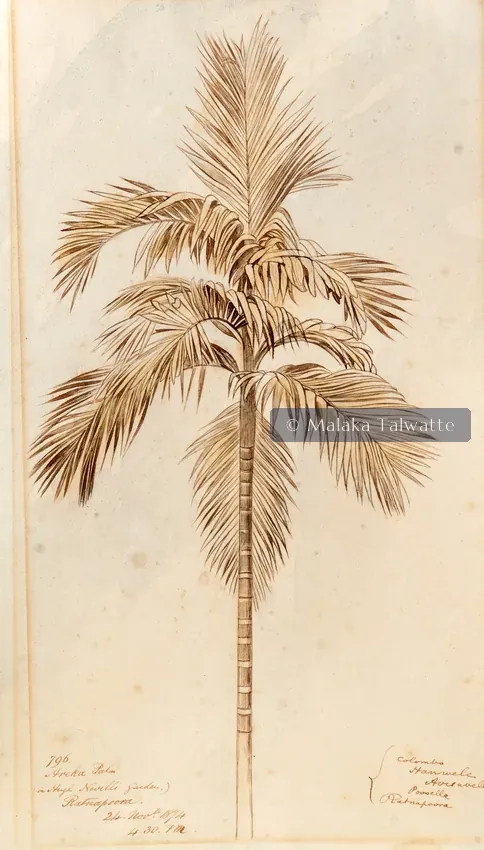
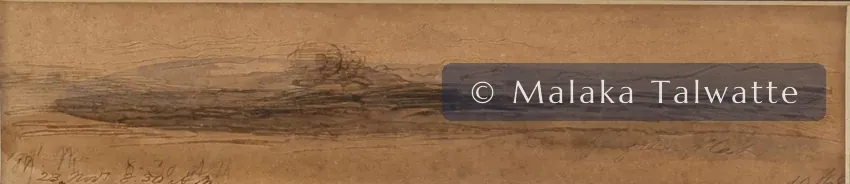
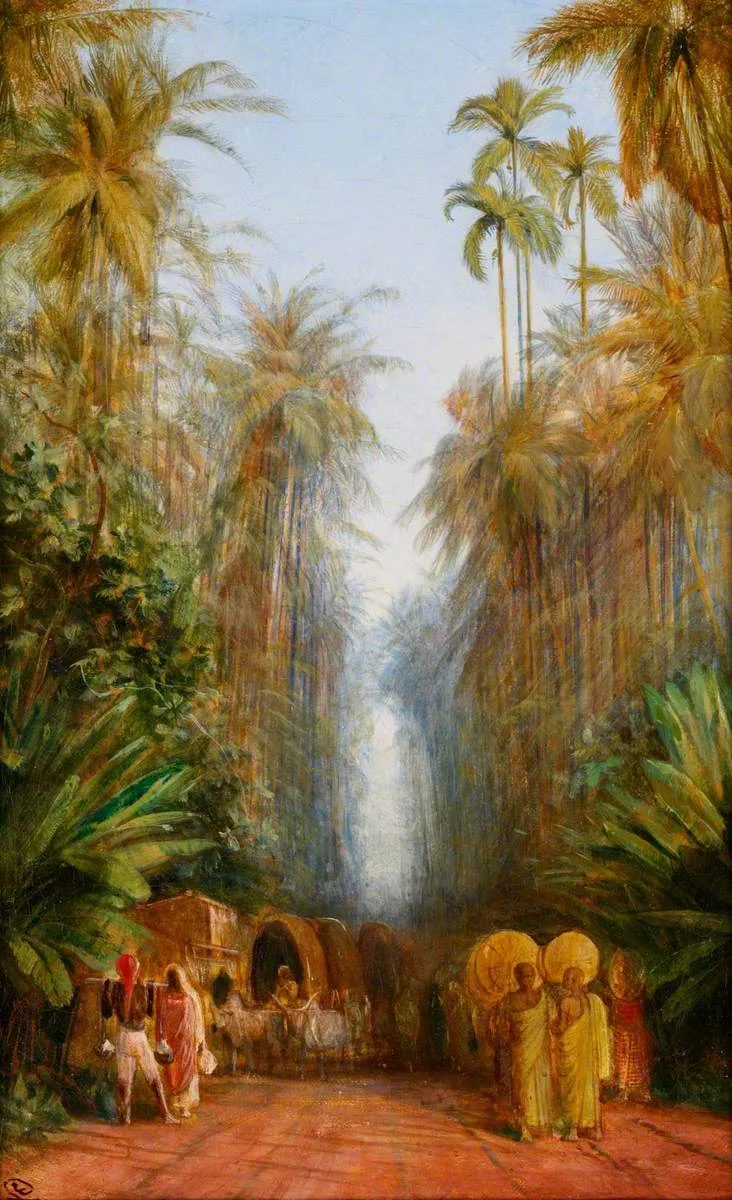
The event answered his expectation only in part. He found the island beautiful but the climate oppressive, the rains persistent, and his companion Giorgio gravely ill with dysentery; yet he sketched with his customary and compulsive industry, travelling by mail coach and one-horse trap to the south and to Ratnapura, and by railway from Colombo to Kandy and back, and producing in less than four weeks over seventy drawings and watercolours. Breadfruit and jak trees, coconut prospects, river scenes near Ratnapura with Adam’s Peak in the distance, animated roads near Galle, a landscape with two Buddhist monks: the drawings are vivid, immediate and technically assured, and bear the characteristic pencil annotations of colour and texture from which he was accustomed to elaborate finished watercolours in the studio.
At Ratnapura Lear was the guest of Hugh Nevill of the Ceylon Civil Service, the son of his late friend William Nevill; the visit was, he wrote, ‘a duty to the memory of dear William and Mary Nevill’. He can hardly have foreseen whom that duty would set him beside. The younger Nevill was one of the most serious British scholars of Ceylon culture then living: across thirty-two years on the island, through a succession of legal appointments from Colombo to Trincomalee to Batticaloa, he formed the greatest private collection of Sinhala palm-leaf manuscripts in existence, 2,227 of them, now preserved in the British Library, and the largest archive of Sinhala manuscripts anywhere beyond Sri Lanka; he edited The Taprobanian: A Dravidian Journal of Oriental Studies in and around Ceylon from 1885 to 1888. That a simple act of remembrance should have lodged England’s greatest nonsense poet beneath the roof of so formidable a scholar, at a remote hill station in the interior, is among the more singular footnotes of the island’s colonial history.
Lear’s Ceylon works were never published. They remained in private portfolios during his lifetime, and some are now preserved in the Houghton Library of Harvard University. That the most accomplished professional artist to visit Ceylon in the nineteenth century should be at the same time among the least known for his Ceylon work is a paradox that the drawings themselves overturn: seen entire, they are far too fine to have remained so little known.
Sources
- Talwatte, Malaka. ‘19th Century Views of Ceylon by British Artists’.
- Lear, Edward. A Book of Nonsense.
- The Talwatte Collection.
- Government Art Collection, UK.
- Lear, Edward, and Ray Murphy. Edward Lear’s Indian Journal. Edited by Ray Murphy. London: Jarrolds, 1953.
- The Houghton Library of Harvard University.
How to cite this profile
Source noteExtracted verbatim from Malaka Talwatte, '19th Century Views of Ceylon by British Artists'. Where this page reproduces a previously published essay, cite that original in preference to this page.
Malaka Talwatte, “Edward Lear,” Malaka Talwatte: Sri Lankan Art and Ceylon Antiquaria, https://malakatalwatte.pages.dev/artists/edward-lear/.
Quote and cite freely with attribution; please do not republish a whole essay, or a photograph, without permission.