Late Modern · Artist
Ena de Silva
A house in Colombo was dismantled with great care, every timber and tile catalogued as it was lifted away, then carried across the country and rebuilt in a garden by the sea. The house was Ena de Silva’s, the first modern house Geoffrey Bawa designed, and its slow rescue, completed at Lunuganga between 2013 and 2017, is a measure of how much both the woman and the building came to matter.
She was born in 1922 into the Aluwihare family of Matale, a daughter of Sir Richard Aluwihare, the first Ceylonese Inspector-General of Police and later High Commissioner to India. In 1960 she and her husband Osmund de Silva asked a young architect named Geoffrey Bawa to design them a house in Colombo, at No. 5 Alfred Place. What he built for her, an inward-looking courtyard house finished in the early 1960s, is the first contemporary house in the country and the start of his mature manner.
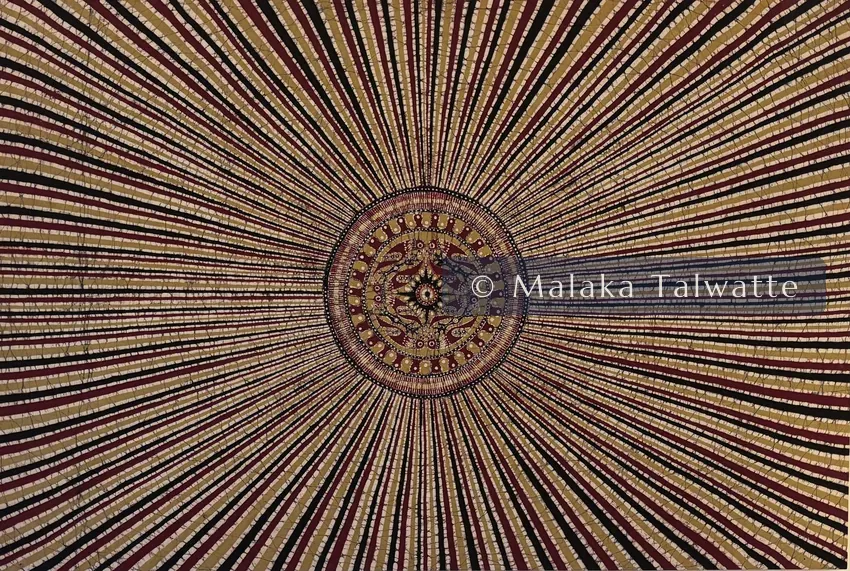
The house was also a workshop. In its courtyard Ena de Silva set out, waxed, dyed and finished cloth, and from that courtyard she did as much as anyone to rebuild the Sri Lankan batik tradition. She had formed a batik firm in 1960 with Laki Senanayake and others, and her designs, all worked by hand and crowned by her recurring ‘Tree of Life’, carried batik from a village craft to something an architect would hang in his grandest rooms. Bawa did precisely that, commissioning batik flags, ceiling and wall panels from her for buildings including the Bentota Beach Hotel and the new Parliament, and her cloth travelled abroad to exhibition as well.
In 1964 she founded what began as the Matale Heritage Centre, a cooperative of artisans working in batik, embroidery, carpentry and brass, and in the 1980s she turned her family’s ancestral home at Aluwihare into its base, teaching a village a living in craft. The centre outlived her: it was later renamed the Aluwihare Heritage Centre, for her family and her village. In 2011 the Geoffrey Bawa Trust gave her a lifetime achievement award.
She died in 2015, in the district she came from. Her house did not stay where it was built. Rather than let it fall to a demolition order, its rescuers carried it piece by numbered piece to Lunuganga, Bawa’s own garden, where it stands again today, oriented to the south as it always was, the courtyard that once held wax and dye rebuilt whole in a quieter place.
Sources
- Bandaranayake, Senake, and Albert Dharmasiri. Sri Lankan Painting in the 20th Century. Colombo: National Trust of Sri Lanka, 2009.
- The Geoffrey Bawa Trust.
- Lunuganga Trust.
How to cite this profile
Malaka Talwatte, “Ena de Silva,” Malaka Talwatte: Sri Lankan Art and Ceylon Antiquaria, https://malakatalwatte.pages.dev/artists/ena-de-silva/.
Quote and cite freely with attribution; please do not republish a whole essay, or a photograph, without permission.