Classical · Site
The forest monasteries
Away from the great painted and carved viharas of the cities stood monasteries built to be lived in rather than looked at. The forest monks who called themselves the pamsukulika, the rag-robed, who wore cloth taken from the cremation grounds and kept the older austerity, made monasteries in which almost nothing is decorated, and the art of these places is an art of restraint: precise stone laid with great care and left entirely plain.
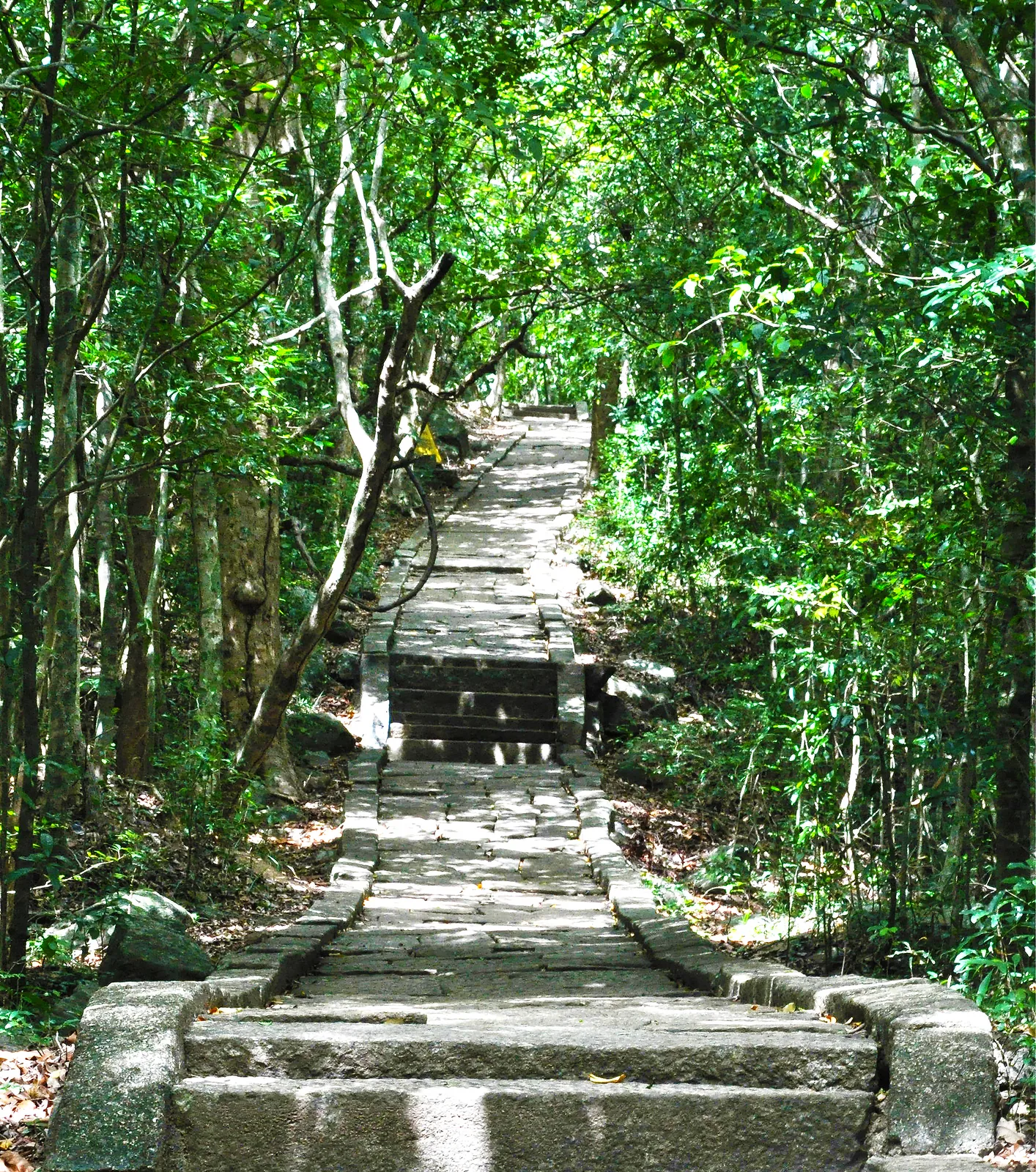
Ritigala
On the wooded slopes of Ritigala the pamsukulika built the double-platform meditation houses that are the type of their kind: pairs of dressed-stone terraces set on one axis and joined by a narrow stone bridge, reached by long paved paths that run for hundreds of metres through the trees, with stone-lined ponds along the way. Across some fifty of these platform-pairs there is no image-house, no carved ornament, no painting; the whole care of the builders went into the cut and the fit of the stone and the proportion of the plan. The monastery is given to the ninth century and to King Sena I, who endowed the forest ascetics; its restraint was a choice, a turning away from the wealth of the city monasteries, set down in masonry.
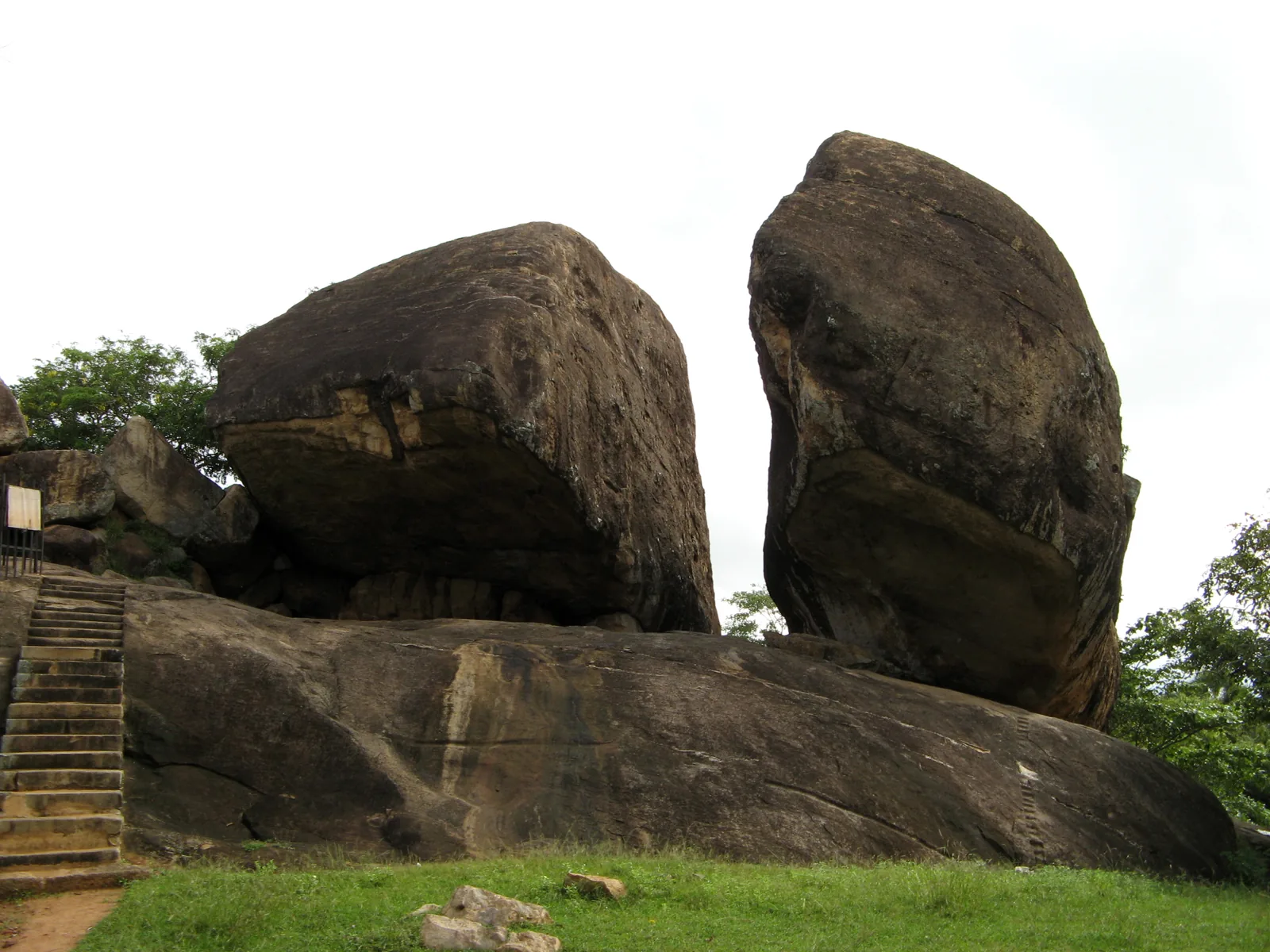
Vessagiriya
Nearer Anuradhapura, below Isurumuniya, the boulders of Vessagiriya hold an older kind of forest dwelling: natural granite caves whose brows were cut with a drip-ledge to throw the rain clear, given by lay donors to the monks in the earliest centuries of the island’s Buddhism. Under the ledges run the donors’ names in early Brahmi, and tradition holds that the missionary Mahinda ordained five hundred men of the householder class here, from which it took its name as the monastery of the commoners. Here too the art is the setting itself, the boulder and the cave and the cut ledge, worked with care and left unadorned.
The masons of the forest monasteries are unknown, as all of them are, and the monks who used these places wished it so: the beauty they left is the beauty of a plain thing made exactly, the counterweight in the island’s art to the carved and painted shrines of its kings.
Sources
- Bandaranayake, Senake. Sinhalese Monastic Architecture: The Viharas of Anuradhapura. Leiden: Brill, 1974.
- Paranavitana, Senarath. Inscriptions of Ceylon, Vol. I.
- Department of Archaeology, Sri Lanka.
How to cite this profile
Malaka Talwatte, “The forest monasteries,” Malaka Talwatte: Sri Lankan Art and Ceylon Antiquaria, https://malakatalwatte.pages.dev/artists/forest-monasteries/.
Quote and cite freely with attribution; please do not republish a whole essay, or a photograph, without permission.