Classical · Site
The Gal Potha
The Gal Potha is a book made of stone. Nissanka Malla had a single slab of granite, some eight metres long and better than fifteen tons, dressed and incised to look like a palm-leaf manuscript, the long lines of its text running the length of the stone as the written lines run down an ola leaf, and set it up at Polonnaruwa as the largest inscription the island holds.
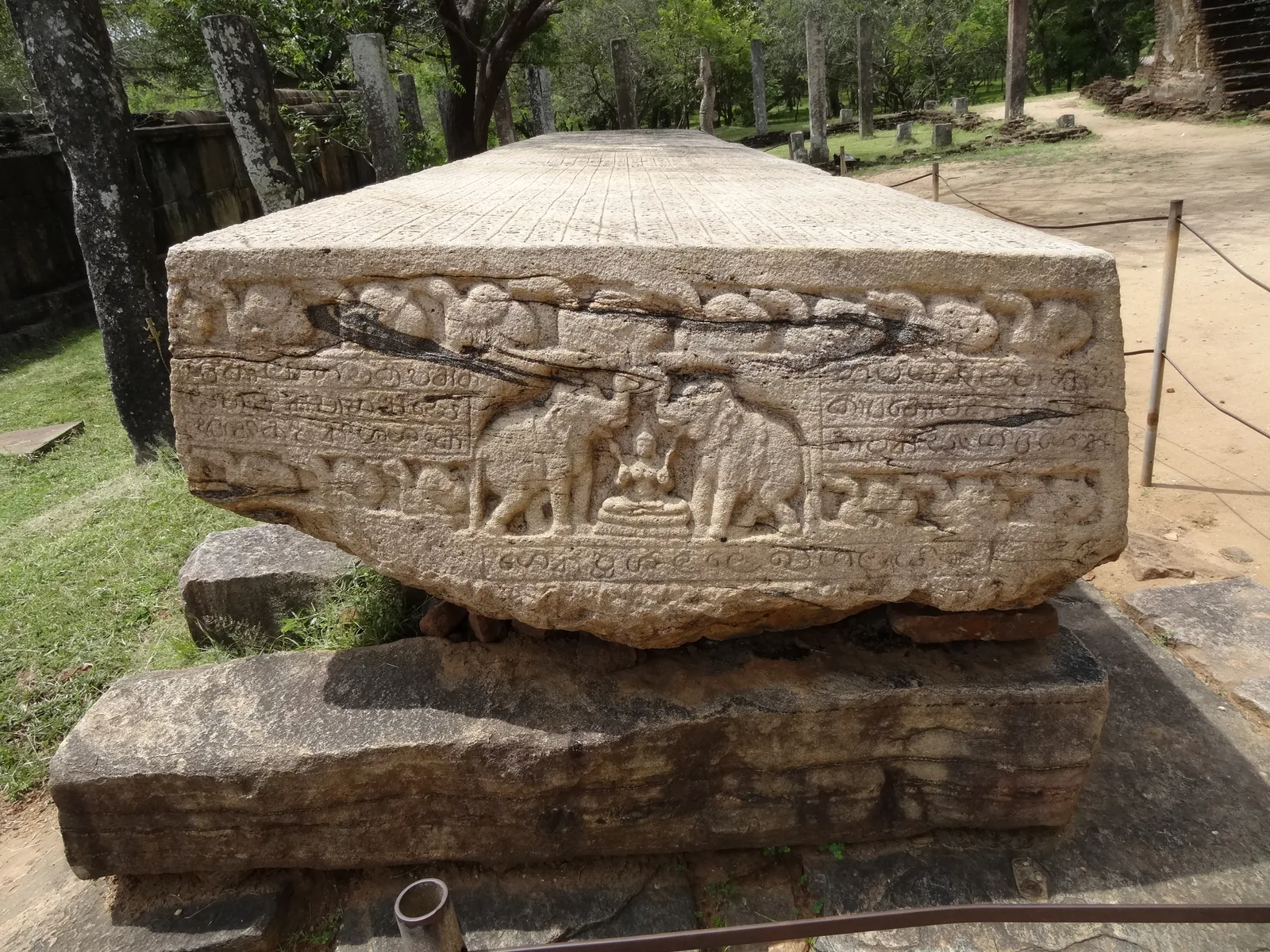
The conceit is carried into the carving. Down the two long sides runs a border of hamsa, the sacred geese, in file, and at the end of the slab is a panel of Gajalakshmi, the goddess of fortune seated with a pair of elephants raising their trunks to pour water over her, the old Indian image of prosperity set at the head of the king’s record. Some of the letters kept traces of gilding. What the stone book says is the king himself: his descent, his deeds, his view of the duties of a king, the whole a monument to Nissanka Malla’s account of his own reign, a ruler much given to writing his merits into stone.
The slab was not quarried where it stands. The inscription itself records that the stone was brought from Mihintale, near Anuradhapura, dragged the better part of a hundred kilometres by the king’s men under one of his officers; the story that elephants hauled it is a later embellishment, for the text credits men. The masons who cut the geese and the goddess and the four thousand letters are unnamed, as they always are, and the king who had a book made of stone so his name would outlast a book of leaves has, in that at least, had his wish.
Sources
- Wickremasinghe, D.M. de Z., ed. Epigraphia Zeylanica, Vol. II, 1928.
- Ranawella, Sirimal. Inscriptions of Ceylon, Vol. V, 2007.
- Paranavitana, Senarath. Art of the Ancient Sinhalese. Colombo: Lake House, 1971.
- UNESCO World Heritage Centre. ‘Ancient City of Polonnaruwa’ (inscribed 1982).
How to cite this profile
Malaka Talwatte, “The Gal Potha,” Malaka Talwatte: Sri Lankan Art and Ceylon Antiquaria, https://malakatalwatte.pages.dev/artists/gal-potha/.
Quote and cite freely with attribution; please do not republish a whole essay, or a photograph, without permission.