Classical · Site
Gal Vihara
From a single long wall of grey granite at Polonnaruwa, in the reign of Parakramabahu I between about 1153 and 1186, sculptors cut four images of the Buddha and left them standing in the rock that bore them. The group was the image hall of the Uttararama, the northern monastery of the king’s rebuilt capital, and it survives as the high point of Sinhalese sculpture in stone: a seated Buddha in meditation, a smaller seated figure set within an artificial cavern, a standing figure with the arms folded across the chest, and a recumbent Buddha of some fourteen metres passing into his final nirvana.
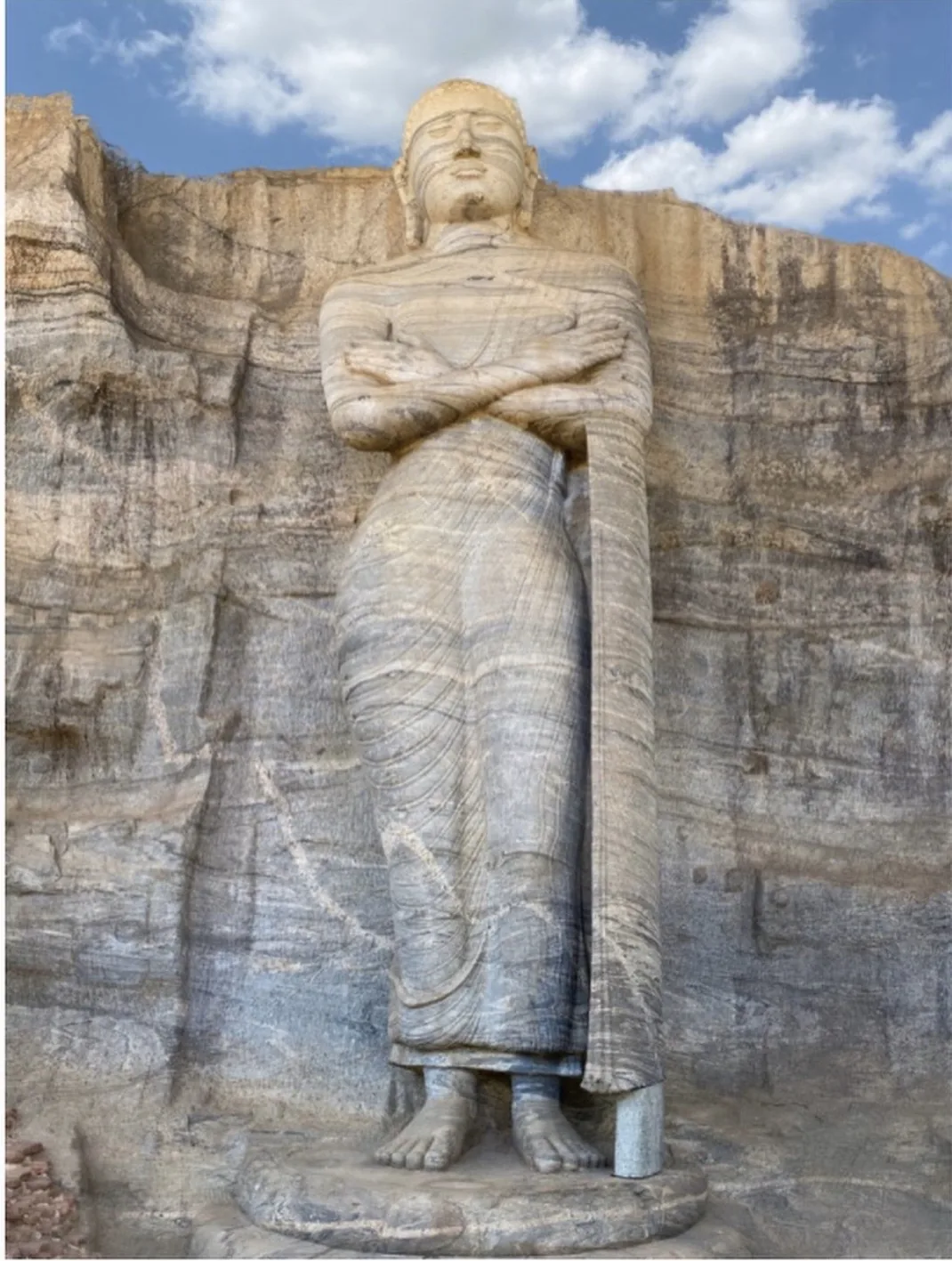
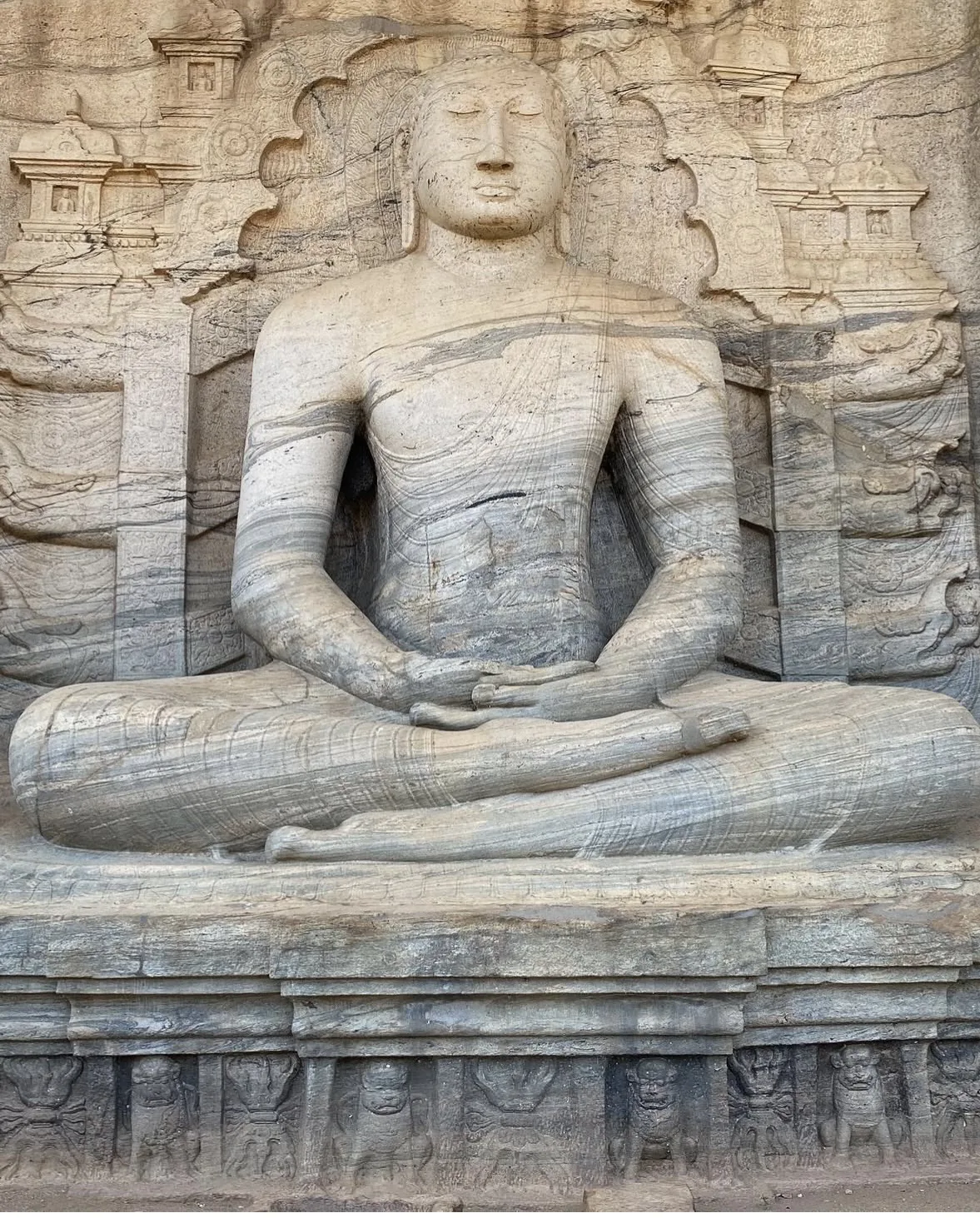
The seated image in meditation, a little over four and a half metres high, holds the hands in the dhyana mudra on a lotus throne backed by a carved screen of makara and lion and a row of small seated Buddhas, and it is the still centre of the group, the calm against which the other two set their feeling. The standing Buddha beside it, close to seven metres and cut on its own low lotus pedestal, has drawn more argument than any single work of the island’s sculpture. The early excavators, H.C.P. Bell among them, read it as Ananda, the Buddha’s attendant, grieving at his master’s deathbed, an identification the folded arms and the sorrowing face appeared to support. Senarath Paranavitana set that reading aside: the figure carries the Buddha’s own cranial curls and lengthened ears and stands upon the lotus reserved for the Buddha, and he took it for the Buddha himself in the rare attitude of para-dukkha-dukkhita, sorrowing at the sorrows of others. Leelananda Prematilleke afterwards proposed the Buddha of the animisalocana, the week of motionless gazing at the Bodhi tree in gratitude after the enlightenment, a reading many now follow. The question stays open, and the figure holds its silence over all of it.
The smallest of the four, a seated Buddha a little under a metre and a half, sits within a hollow cut back into the rock, its head flanked by figures taken to be Brahma and Vishnu; the chronicle names this the Vidyadhara Guha, the cavern of the celestial vidyadharas, though which of the shrines the Culavamsa records answers to which surviving image is itself disputed. The recumbent Buddha, longest of the group, is the most closely observed of all. Its carver marked the moment of death rather than sleep in ways a patient eye still catches: the bolster beneath the head is shown pressed down under its weight, and the upper foot is drawn back a little short of the lower, the slight unevenness that the tradition reads as the sign of the parinirvana.
To see the group as it stands now, in bare grey granite veined and lustrous where weather has polished it, is to see a stripped state. In the twelfth century these were coloured images. On the evidence of the island’s long painting tradition, and of Paranavitana, who held that the Gal Vihara figures were originally gilded, the stone would have carried a fine skin of lime plaster and then colour: the robes in the earth reds and yellows the tradition drew from guru stone and gokatu ochre, the flesh gilded, the hair laid in the blue-black that convention kept for it, the eyes set in and opened. Traces of painting survive even now on the walls of the cavern beside the small seated Buddha, the remnant of a scheme that once ran across plaster and rock alike. By the practice of the craft an image was not held complete until its eyes were painted and opened, the rite that was said to bring it to life, so that what we admire today as the raw work of the chisel is closer to the ghost of a painted and gilded presence, weathered back to stone.
In their drapery the images carry a long descent, the clinging monastic robe with its fine parallel folds reaching back to the Amaravati and Gupta schools of India and remade at Polonnaruwa in an idiom of the island’s own, a lineage the scholarship from Ananda Coomaraswamy’s Mediaeval Sinhalese Art onward has traced. Of the hands that carved and painted them the record keeps nothing. The classical sculptor of the island worked without a signature, one of the hereditary craft communities that served the crown by the tenure of their land, the same lineages from which the sittara, the temple painters, would later come; the canon was fixed and handed down, and personal authorship was never the frame. The chronicle credits the king who ordered the work and the reform it served; the men who cut four Buddhas from the living rock it leaves unnamed, as it leaves unnamed the painters who worked the face of Sigiriya seven centuries before them.
Each image once stood within its own brick image house whose plastered walls were painted, and the sockets cut into the rock and the lines of foundation brick are what survive of them; the shelter over the group today is modern. On the polished rock between the cavern and the standing figure the king had the katikavata incised, the code of monastic discipline he set down when he gathered the three fraternities of the order into one, so that the reformed rule stood in the stone beside the images it governed. The Uttararama took its later name, Gal Vihara, the rock temple, from the material that outlasted everything raised around it. The brick halls fell, the colour went, the monastery emptied when Polonnaruwa was abandoned to the forest, and the four images kept their places in the open where they were carved, inscribed with the rest of the ancient city as a UNESCO World Heritage Site in 1982, and standing still as the measure against which the island’s sculpture in stone is judged.
Sources
- Coomaraswamy, Ananda K. Mediaeval Sinhalese Art. Broad Campden: Essex House Press, 1908.
- Paranavitana, Senarath. Art of the Ancient Sinhalese. Colombo: Lake House, 1971.
- von Schroeder, Ulrich. Buddhist Sculptures of Sri Lanka. Hong Kong: Visual Dharma, 1990.
- Bandaranayake, Senake. The Rock and Wall Paintings of Sri Lanka. Colombo, 1986.
- de Zoysa, Asoka, and Vajira Nalinda Jayathilaka. Buddhist Image Houses. Samkathana Research Team.
- UNESCO World Heritage Centre. ‘Ancient City of Polonnaruwa’ (inscribed 1982).
How to cite this profile
Malaka Talwatte, “Gal Vihara,” Malaka Talwatte: Sri Lankan Art and Ceylon Antiquaria, https://malakatalwatte.pages.dev/artists/gal-vihara/.
Quote and cite freely with attribution; please do not republish a whole essay, or a photograph, without permission.