Modern · Artist
George Keyt
George Keyt is the towering figure of modern Sri Lankan painting. Over a long life he took the broken structure of Picasso and the travelling line of Matisse and set them against the temple fresco, the Kandyan village and the love poetry of the Sanskrit world, and from that meeting he drew a single figure wholly his own, sensuous, weighted and rhythmic, that belongs to the island and to nowhere else. He was born in Kandy on 17 April 1901 into a Dutch Burgher family, English-speaking and Christian, whose home stood close to the Malwatte temple, so that the Buddhist and Kandyan life of the hill country was around him from the first. That double inheritance, the Burgher’s Europe and the Kandyan’s Lanka, became the whole material of his art, and it carried his name from Colombo to Bombay, London and Paris, and his work into the Victoria and Albert Museum in London and the National Gallery of Modern Art in New Delhi.
A child of Kandy
His father, Henry Keyt, surveyed land for the Government Survey and Ordnance Department; his mother, Constance Evelyn Sproule, was a proctor’s daughter. What set the household apart from the ordinary Burgher home was that long, warm connection with the Malwatte Vihara, seat of one of the two great chapters of the Siyam Nikaya, the senior monastic order of the island’s Buddhists, so that the life of the temple was familiar to Keyt from his earliest years rather than something he found later.
He was unusual from the start. He drew before he could read, making pictures of the stories read aloud to him, and did not read or write until he was nearly ten. School came only after Alexander Garden Fraser, the reforming principal of Trinity College, Kandy, came upon the boy at play and asked whether he was at school. At Trinity he would not be taught in the ordinary way and read instead, working through the library while the masters, exceptionally, let him be; he carried off the College art prize at fourteen and showed his first drawing at the Ceylon Society of Arts in 1916. He left in 1918 without finishing, and Fraser saw that he kept the run of the library even after he had gone.
The poet
Once the words came, they took hold as fast as the pictures had. He read Shakespeare at eleven and moved through the Romantics to the Pre-Raphaelites, taking Shelley, then Swinburne, Rossetti and William Morris as his models; the last two, painters and poets both, seem to have answered the two sides of his own nature. He and Lionel Wendt would dress as fin-de-siècle dandies and read Swinburne aloud to each other.
He reached print as a writer well before he took up painting as a vocation. From 1923 he contributed essays and poems to the Buddhist press, among them the essay ‘The Light of the Dhamma’ and the prize poem ‘Arahan’ in the Buddhist Annual of Ceylon. Two collections followed, ‘Poems’ (1936) and ‘The Darkness Disrobed’ (Kandy, 1937), the second carrying ‘The Survival of Patterns’, a poem dedicated to the monk who taught him. He kept writing all his life, in verse and in prose, and the fuller shape of that work is taken up later in this account.
The turn inward
After Trinity, Keyt gave himself in earnest to the Buddhist and Kandyan world he had grown up beside. He became a constant visitor at the Malwatte monastery and formed a friendship of nearly two decades with the scholar-monk and poet Pinnawela Dheerananda, who taught him Sinhala, the Buddhist texts, and the history and folklore of the land. His Trinity years had left him widely read in English; it was the monk who gave him the learning of his own country, its language, its literature and its belief. He wished at one point to enter the Sangha, and was gently dissuaded. He was drawn, too, into the temple’s own arts, among them ves natum, the sacred dance of the Kandyan tradition, whose rhythm and stance would surface later in the dancers he came to paint.
He took up painting in earnest in 1927. His earliest lessons came from the painter George de Niese, and the circle he entered was the Colombo Art Club, run by C.F. Winzer, the government’s Inspector of Art, who used it to argue for a modern art that would grow from the island’s own ancient tradition rather than copy Europe. The work of Keyt’s first decade holds to a measured naturalism, and Winzer’s mark is on it: the recovered grace of Sigiriya, drawn in a flowing line over a careful European finish. He married Ruth Jansz in 1930, and through those early years painted portraits, Buddhist subjects and quiet scenes of Kandyan life, among them a portrait of his teacher, the monk Pinnawela Dheerananda. In 1928, before those settled years, he had painted Govindamma, thought to be the first female nude by a Ceylonese painter, and the naked figure would stay central to his art for the rest of his life. The figures already carry the grave, simplified weight that would become his signature, and these years, of his first family and his deepest immersion in the island’s past, laid the ground for what followed. About 1930, when a hall belonging to a Christian body objected to the nudes in a show he was hanging with Beling, the Chilean poet Pablo Neruda, then consul in Colombo, is said to have told them the pictures could hang outside; Keyt gave him a painting, which Neruda kept by him through his travels.
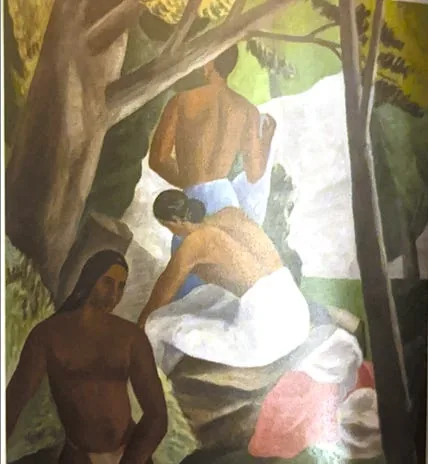
In the late 1930s he went further still, leaving the settled Burgher path, and the marriage he had made, to live in the Kandyan countryside, at Amunugama and then Sirimalwatte, with a Kandyan woman, Menike, who became, in his own account, his medium and his guide to the culture he had taken as his own. The paintings of these years take their subjects from the village: women carrying firewood, fruitsellers, the labour of ploughing and harvest, figures bathing at the well, each given a grave, sculptural dignity rather than treated as a picturesque type. In them the modelling of the early years falls away, the figure grows monumental and still, and the observed likeness gives place to a weightier, more designed form. Simple village heroines such as these would grow into the Nayika of his mature work. He played a real part, too, in the revival of Kandyan dance, championing the master dancers of Amunugama and helping to found the Madhyama Lanka Nritya Mandalaya, central Ceylon’s dance institute, opened in 1949.
The temple wall: the Gotami Vihara murals
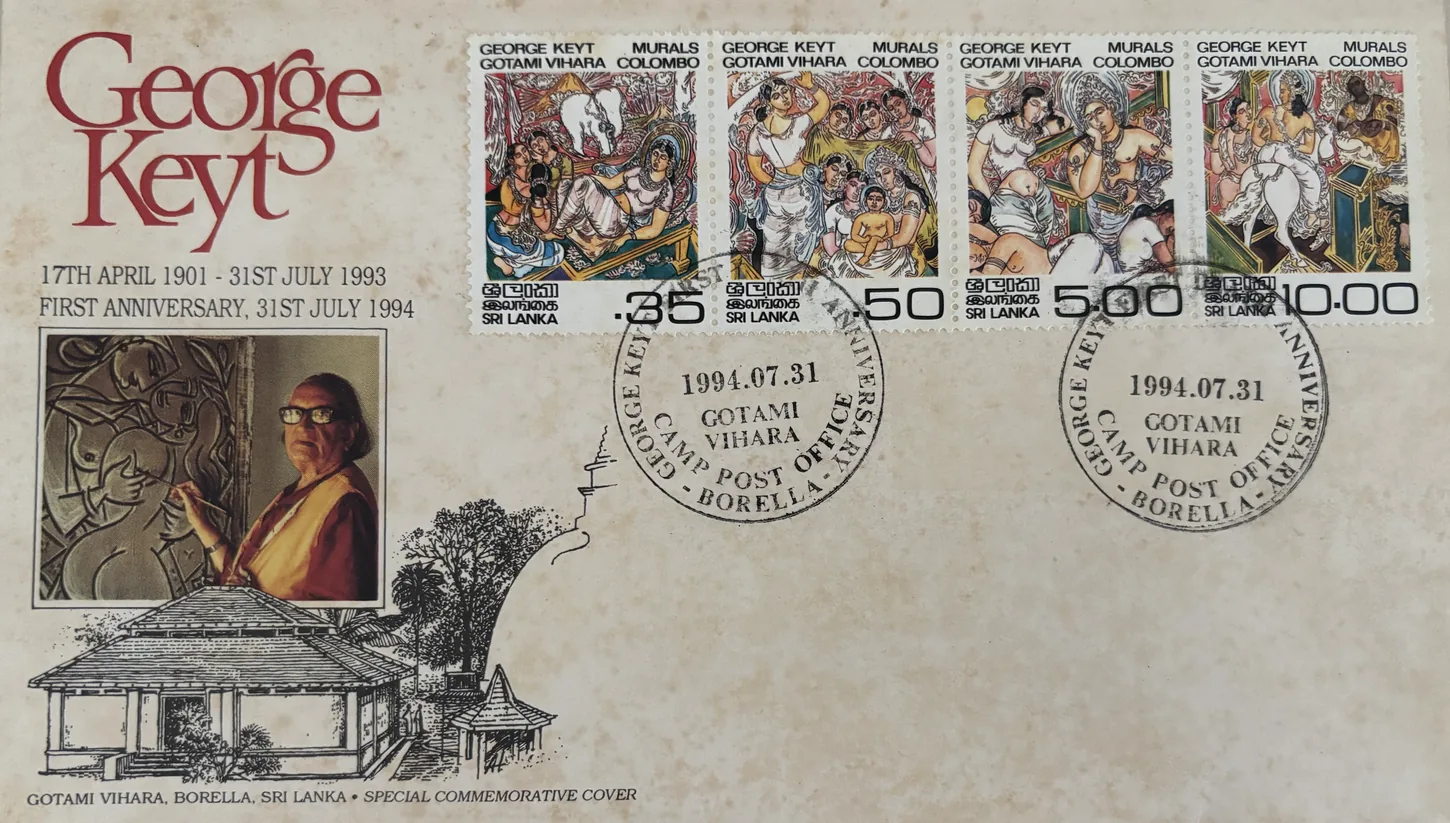
His deepest Buddhist years produced his single greatest work, and it was made on a wall. Across 1939 and 1940 Keyt painted the life of the Buddha along the inner ambulatory of the Gotami Vihara at Borella, in Colombo, a cycle since counted among the landmarks of twentieth-century Sri Lankan art. He came to it through family: his sister Peggy had married Harold Peiris, whose family had founded the temple, its land given in 1900 by Lady Apolonia de Soysa, mother of the independence leader Sir James Peiris, and it was Harold Peiris who opened its walls to his brother-in-law.
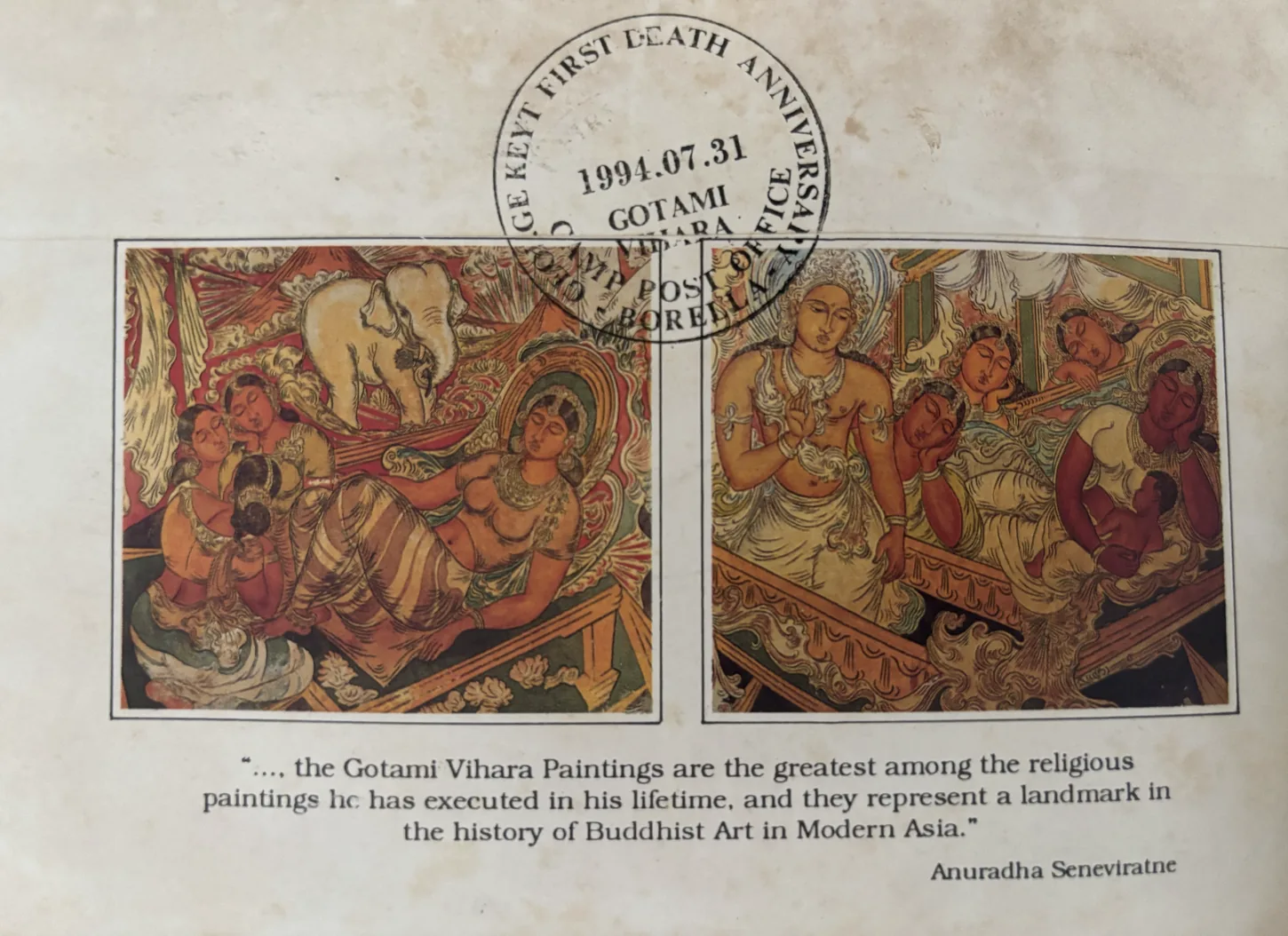
He worked for nothing, asking only the cost of the paints and his food from the temple’s lay supporters. The architect Andrew Boyd, who had built the new shrine-room walls for the cycle, chose the scenes, seventeen episodes from the invitation of the gods and the dream of Mahamaya, through the birth, the four signs, the great renunciation and the defeat of Mara, to the first sermon and the passing away. Keyt set them down without a preliminary sketch, drawing straight onto the dry plaster in a burnt-sienna outline that was later thickened; the colour was laid across the line at the asking of the temple’s resident scholar-monk, the Venerable Telwatte Amarawansa, who guided the painter on the life of the Buddha and whom Keyt worked into the cycle in tribute. Each frame stands six feet three inches high, the largest scale of drawing he ever attained, and three episodes, the leaving of Kapilavastu, the first sermon and the passing away, are set apart and larger still on the outer face of the ambulatory wall. The floral borders that frame the cycle are the work of another hand, the monk-painter L.T.P. Manjusri, who decorated the panels and afterwards made the copies through which the murals reached a wider public.
What resulted reads at once as a continuation and a departure. The stylised, frozen forms of the classical fresco and the Kandyan temple wall are in it, and so are the friezes of Borobudur and the sculpture of Amaravati and Nagarjunakonda, yet the modern line lies easily along the ancient surface. Anuradha Seneviratne called the Gotami Vihara paintings the greatest of the religious works Keyt made in his life, and a landmark in the history of Buddhist art in modern Asia.
The break with representation
Keyt met European modernism on paper. He had first seen it in reproduction in 1919, black-and-white plates of Gauguin that left him unmoved until colour reproductions, brought to the island by the collector Hugh Modder, changed his mind. The decisive channel was Lionel Wendt, the photographer, his closest friend since 1913, who returned from London in 1924 with art books, fine reproductions and subscriptions to the journals in which the École de Paris was being made, chief among them Cahiers d’Art. Through those pages, rather than any European academy, Keyt found Cubism; what others took from Paris itself, he took from the printed page.
The change showed almost at once. ‘Still Life with Mangoes’ (1933) already shows him taking from Picasso and Braque the analytic breaking-up of form, the assembly of an object from many angles at once, the mask-like face and the wide, staring eye. What he made his own was the line: a heavy, continuous, weighted contour that draws nose and brow in a single unbroken stroke and binds the figures together across the surface. He believed colonial naturalism had put a facile likeness-making in place of the island’s own tradition, and he set out, through distortion and rhythm, to rebuild the figure from an older root.
His manner then changed by the decade, and it never turned back. The first years, from 1927, were a modified naturalism, the figure carefully built and structured, nearer to Cezanne and Derain than to the academy; by 1932 he had left it for good. The mid-1930s were his years of experiment, the analytic Cubism of Braque and Picasso breaking the object into planes and setting a face full-on and in profile at once, while the still lifes of Buddhist objects welded their parts together along a single line. Out of that came the mature synthesis of 1936 and 1937, in which the swelling, rounded figure, learned as much from Matisse and Léger as from the Sigiriya damsels and the Indian miniature, settled into the form that the rest of his life would vary. The 1940s swung between the calm of romance and the fury of the war years, Bhima and Jarasandha locked in their wrestling; a spare profile, the far eye pushed to the edge in the manner of the Jain miniatures, marks the 1950s; and in the 1970s, exchanging oil for fast-drying acrylic, he moved to a flatter, harder, more sharply geometric late manner. He remade himself in each decade, and returned to naturalism in none.
A vast vehicle: India and the Hindu world
The tradition he was reaching for was, in the end, an Indian one, and it carried him to India itself. The pull had come early: as a young man, turning from his Western upbringing, he had applied to Rabindranath Tagore’s school at Santiniketan and been accepted, though he never took up the place, and he met Tagore himself in Ceylon in the 1930s. He first travelled to India in 1939 and based himself in Bombay from 1946 to 1949, returning through the 1950s, for the better part of a year in 1960, and again in the 1970s; India, he said, was the ready-made world in which he felt at home. His doorway was Sanskrit poetry. Drawn at Malwatte to Jayadeva’s twelfth-century ‘Gita Govinda’, the cycle of the loves of Krishna and Radha, he published a translation in 1940, dedicated to Wendt, and later gave it a celebrated set of line drawings; the divine lovers of that poem returned to his work for decades, in paintings such as ‘Krishna painting Radha’ (1948) and ‘Sringara Rasa’ (1956), both now in the Victoria and Albert Museum in London. He read the Mahabharata and the Ramayana, the Bhagavad Gita, Kalidasa and the Bhakti poets, and drew from Hindu mythology his most enduring subjects: Krishna and Radha, Shiva as Nataraja and as the essence of fury, the goddess Durga, the wrestling of Bhima and Jarasandha.
His eye ranged far past Paris, as he always insisted. He took from the Kalighat folk watercolours of Bengal their broad strokes, minimal line and large staring eyes; from the Basohli and Mewar miniatures their red grounds, sharp profiles and deliberately enlarged eye; and from the temple sculpture of Khajuraho, Konark, Bhubaneswar and the Tamil south the sensuous, swaying female form. Music entered on the same current. In India he met Ravi Shankar, encouraged his own sons at the sitar, and painted while they played; he pioneered Ragamala painting, the visualising of the musical modes, and worked to the classical theory of rasa, the essential flavour a work must evoke, returning above all to the sringara of erotic love and the raudra of fury. He once called himself a ‘spiritual voluptuary’, a phrase that names the fusion exactly. That his closest friend, Wendt, was one of the finest Western pianists the island had, and that no Western music ever entered his art, is a measure of how complete the turn had been.
The Nayika years
The synthesis of village heroine, Sanskrit convention, Cubist structure and miniature line produced the phase for which he is best remembered. The nayika, the adored heroine of the old Indian treatises on dance and drama, gives her name to the series that runs through the 1940s and 1950s, and the drawings and paintings of the early 1940s, the nayika sequence and ‘Nara and Narayana’ among them, mark the height of his powers. She is not the likeness of any one woman but an ideal of womanhood itself, and Keyt marked the distinction in a remark that set his art beside Justin Daraniyagala’s, that Daraniyagala painted women while he painted Woman.
The line was the heart of it. Goonetileke thought Keyt’s drawings poems without words, the single unbroken stroke wandering across the sheet with the freedom Paul Klee once claimed for a line; it is the same stroke that carries a whole figure in a Gita Govinda drawing and that holds the figures of the paintings together. The many nayikas that so exercised his critics are best understood as a musician understands a raga, one mode taken up again and never played the same way twice, so that what a hurried eye calls repetition is really variation, an art that finds its abundance in the familiar.
The ’43 Group and the world
In August 1943 Keyt was among the painters who met in Colombo and resolved that the island would have a modern art of its own. He became a founder member of the ’43 Group and, in time, its best-known name, showing in all sixteen of its exhibitions between 1943 and 1967. The British collector Martin Russell became his devoted patron and, over the years, the owner of the largest holding of his work, and his correspondent for decades; in 1950 Russell wrote the first monograph on him, published by Marg in Bombay, that carried the painter’s name to Europe.
Recognition abroad came in force in the early 1950s, though his work had reached the West far earlier: in 1930 his paintings had hung at the Zwemmer Gallery in London, alongside those of Braque and Picasso. The ’43 Group showed at the Imperial Institute in London in 1952, with a catalogue foreword by the young John Berger, who called Keyt an artist of genius, and at the Petit Palais in Paris in 1953, and at the Venice and São Paulo Biennales; in January 1954 Keyt’s own London exhibition at the Institute of Contemporary Arts was hung from paintings chosen by Herbert Read and Roland Penrose, and travelled on to Rotterdam; a Cambridge showing of a hundred paintings at the Heffer Gallery was opened, that February, by E.M. Forster. Writing in London’s Studio that year, William Graham called the ’43 Group ‘the most significant movement in Eastern art today’. The homecoming exhibition followed the same year at Peradeniya, with a foreword by Mulk Raj Anand, the Indian novelist and founder of the journal Marg, who by his own account ‘went to Sri Lanka in search of Keyt’ and placed him at the centre of Indian modernism; Keyt’s first solo international exhibition had been held at the University of Bombay in 1947, and he contributed drawings to Anand’s ‘The Story of India’ (1949). The Chilean poet Pablo Neruda, who had served as consul in Ceylon, wrote of Keyt’s Sinhalese figures that they ‘take on a strange expressive grandeur and radiate an aura of intensely profound feelings’. In 1956 Keyt and the monk-painter Manjusri were each invited to engrave a design on Steuben crystal for an exhibition of work by Asian artists. For the Ceylon pavilion at Expo 67 in Montreal he made a large design, Lanka Matha, a village woman bearing the punkalasa, the brimming pot of plenty; the canvas, more than five metres across, was rendered by the Whitefriars studio in London into seven stained-glass panels that became the pavilion’s centrepiece, and it stands today in the Bibliothèque Marie-Uguay in Montreal. A preliminary design for it is kept at the Sapumal Foundation. The shows continued to the end, at the Commonwealth Institute in London in 1974, the National Gallery of Modern Art in New Delhi in 1975, and the Patrick Seale Gallery in London in 1982. He cared little for the machinery of a reputation, and though he refused an OBE in 1950, he accepted, in 1968, an honorary Doctorate of Letters from the University of Ceylon at Peradeniya.
Keyt the writer
He never set writing aside, and the body of it was large; by the reckoning of his friend and bibliographer H.A.I. Goonetileke he left dozens of poems, essays, translations and books of his own. It ran along three lines, the poetry, the translations from Sanskrit and Sinhala, and the prose on art, and each fed the painting.
The poetry came first. The three volumes he published in the mid-1930s, ‘Poems’ (1936), ‘The Darkness Disrobed’ (1937) and ‘Image in Absence’ (1937), turn almost all on a single note, virahadukkha, the pain of separation in love, the longing that also runs through the Sanskrit verse he loved. Introducing the collected poems, the critic Ashley Halpé found in them a genuine strain of the surreal, closer to Éluard and Mallarmé, read through Wendt, than to anything else then being written on the island. The love and the loss are plain in the lines that a painting of the period grew from: ‘Beneath flowering branches, / You sit relaxed like the twilight / With the blue sky and the yellow sun on either side of you’.
The translations carried the same devotion into scholarship. His rendering of Jayadeva’s ‘Gita Govinda’ from the Sanskrit, made with the help of his brother-in-law Harold Peiris, ran into several editions; in its preface he set out the conviction behind so much of his art, that in this order of love the physical is not something distinct from the spiritual. He put out one of the earliest anthologies of classical and folk Sinhala verse in English, ‘Poetry from the Sinhalese’ (1938), and translated the ‘Jayamangala Gatha’ from Pali.
The prose was where he set down what he believed about art. He wrote essays across the decades, among them ‘The Vision of the Painter’, ‘Reality in Art’ and ‘Art Cannot be Fettered’, and in Bombay late in 1946, at Mulk Raj Anand’s suggestion, he composed a set of ‘Aphorisms on Art’ to hand to interviewers in place of conversation; they were printed in a Peradeniya catalogue, reissued as ‘Art and the Beholder’, and later translated into Sinhala. What they say is of a piece with what he painted: that a picture should reach past physical likeness to the face as it is ‘seen in the mind on recollection’, and that once the making has begun the influences that fed it drop away and the picture works out its own logic alone. The one form he left untouched was fiction for grown readers. His narrative prose is a book of the island’s folk tales retold for children, and a handful of prize stories from his schoolboy years; the storyteller in him went, in the end, into the pictures.
The long late years
His work entered the Victoria and Albert Museum in London and the National Gallery of Modern Art in New Delhi. He remained, by his own choosing, apart from the political turmoil of the new nation, withdrawing into a private world of romance, myth and literary symbol; that refusal of the public world, in a country coming apart around him, is one of the most revealing things about his art. His later painting has divided opinion. Some find that after the peak of the 1940s it settled into a familiar Keytian manner, inspired in some canvases and merely repeated in others; the drawings, by common consent, kept their vitality to the end.
His later decades were restless and often painful. A late attachment, to Kusum Narayan, whom he had met in Bombay and who followed him to Sri Lanka in 1973, drew him away from Sirimalwatte through Nugegoda, Galle and Piliyandala and back again, and he painted incessantly through years of failing health and constant want. He died in Colombo on 31 July 1993; his body lay in state for two days at the National Art Gallery, the highest honour the country pays an artist. In 1988 his admirers had established the George Keyt Foundation in Colombo, which promotes the island’s art through exhibitions, the annual open-air Kala Pola art fair, shows that bring on younger painters and a programme of publications, and which took on the rehabilitation of the Gotami Vihara shrine room itself. At Borella the friezes he set along the ambulatory wall of the Gotami Vihara remain where he left them, the modern line still lying easily along the temple wall, the work of a man who spent his life making the island’s oldest tradition new, and modern art unmistakably the island’s own.
Sources
- Tammita-Delgoda, SinhaRaja. George Keyt: The Absence of a Desired Image. c. 2021–2022.
- Bandaranayake, Senake, and Albert Dharmasiri. Sri Lankan Painting in the 20th Century. Colombo: National Trust of Sri Lanka, 2009.
- Dalmia, Yashodhara. Buddha to Krishna: Life and Times of George Keyt. Routledge, 2017.
- Goonetileke, H.A.I. George Keyt: A Life in Art. The George Keyt Foundation, 1989.
- Goonetileke, H.A.I. George Keyt Drawings. 1990.
- Goonasekera, Sunil. George Keyt: Interpretations. Institute of Fundamental Studies, 1991.
- George Keyt: A Felicitation Volume. The George Keyt Felicitation Committee, 1977.
- George Keyt: A Centennial Anthology. The George Keyt Foundation, 2001.
- Keyt, George. Gotama Buddha Murals. Text by Anuradha Seneviratna. Colombo: The George Keyt Foundation, 1993.
- Russell, Martin. George Keyt. Bombay: Marg, 1950.
- Russell, Martin. ‘Obituary of George Keyt’. The Independent, 12 August 1993.
- Dissanayake, Ellen. ‘The Poetry of George Keyt’. Journal of South Asian Literature, 1976.
- Dissanayake, Ellen. ‘George Keyt: Breaking with Tradition’. Orientations, 1976.
- Victoria and Albert Museum, ‘Explore the Collections’; the George Keyt Foundation.
- The commemorative cover and the 1982 photograph. The Talwatte Collection.
- Sunday Observer (Colombo). ‘George Keyt: Sri Lanka’s Living Legend of the Arts.’ 27 April 2003.
- Goonetileke, H.A.I. ‘Lionel Wendt and George Keyt: A Close-up’. The Island (Colombo), 26 November 2000.
- Kurukulasuriya, Lasanda. ‘Keyt Back in Kandy’. Weekend (Colombo), 24 May 1981.
- Keyt, Diana. ‘Those Sweet Kandy Days’. Sunday Times (Colombo).
- Weereratne, Neville. 43 Group: A Chronicle of Fifty Years in the Art of Sri Lanka. Melbourne: Lantana, 1993.
- de Soysa, Rohan. ’The ‘43 Group: Origins, Aims, Activities and Legacy.’ National Trust of Sri Lanka, 29 September 2016. https://thenationaltrust.lk/wp-content/uploads/2018/06/The-43-Group.pdf
- Art Public Montréal. ‘George Keyt.’ https://artpublicmontreal.ca/en/artiste/keyt-george/
- Expo 67. ‘Ceylon Pavilion: Lanka Matha by George Keyt.’ http://expo67.ncf.ca/ceylon_pavilion_art-abstract-by-George-Keyt-p1.html
How to cite this profile
Malaka Talwatte, “George Keyt,” Malaka Talwatte: Sri Lankan Art and Ceylon Antiquaria, https://malakatalwatte.pages.dev/artists/george-keyt/.
Quote and cite freely with attribution; please do not republish a whole essay, or a photograph, without permission.