Classical · Sculpture
The Guardstone
At the foot of every important staircase in the ancient city a pair of carved slabs stood to meet the visitor, one at each side, and on the finest of them the guardian took the form of a jewelled serpent-king holding a brimming vase. The muragala, the guardstone, is the third of the three carved elements of a classical Sinhalese entrance, the moonstone laid flat on the ground, the balustrade climbing the sides, and the guardstone upright at the foot, and its history is the slow filling-in of that upright slab. The earliest, from about the first century, are plain; a pot of plenty, the punkalasa, is carved on them in the middle centuries; a dwarf appears at its foot; and by the later Anuradhapura period the slab holds a full standing figure, the Nagaraja or cobra-king, beneath an arch of makaras, a dwarf at his feet and a hood of cobra heads spread behind him. The archaeologist Charles Godakumbura set out that sequence, and it is the frame in which every guardstone is now read.
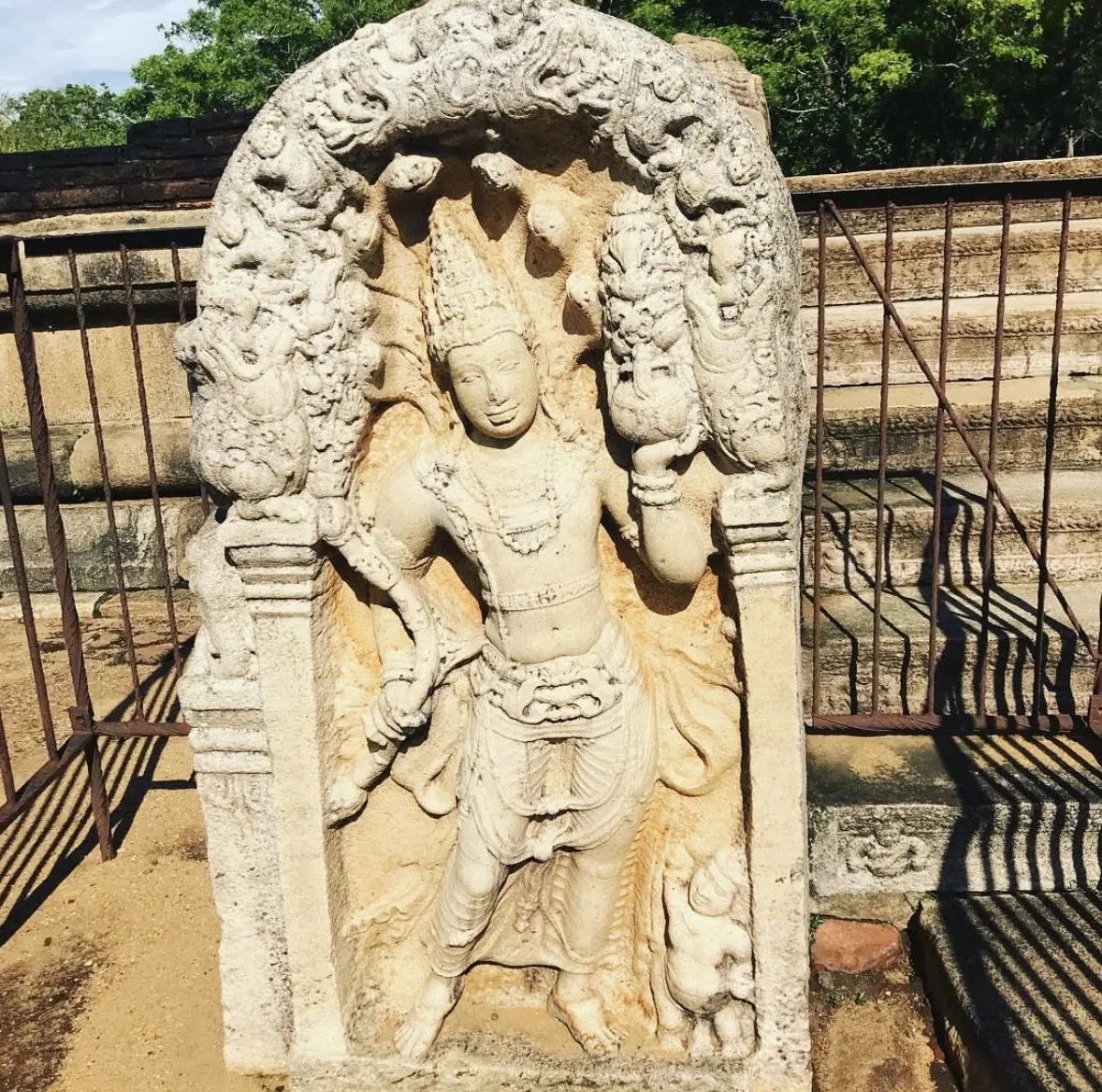
The greatest of them stands at the Ratnaprasada, the ‘gem palace’ of the Abhayagiri monastery at Anuradhapura, and it is commonly held the finest guardstone the island has produced. The Nagaraja stands in an easy, princely bearing, a tall crown above his face and the cobra hood behind it, a flowering branch in one hand and in the other the punkalasa, the vase of abundance spilling leaf and bud; a small attendant dwarf stands at his foot, and the makara arch that frames him pours lions and dwarfs and dancing figures from the mouths of its sea-monsters. The modelling has the serene, heavy-lidded calm of the bodhisattva images of its day, though the figure is a Nagaraja and not a bodhisattva, a guardian spirit of water and fertility whose Buddhist warrant is the serpent-king Mucalinda, who sheltered the meditating Buddha beneath his hood.
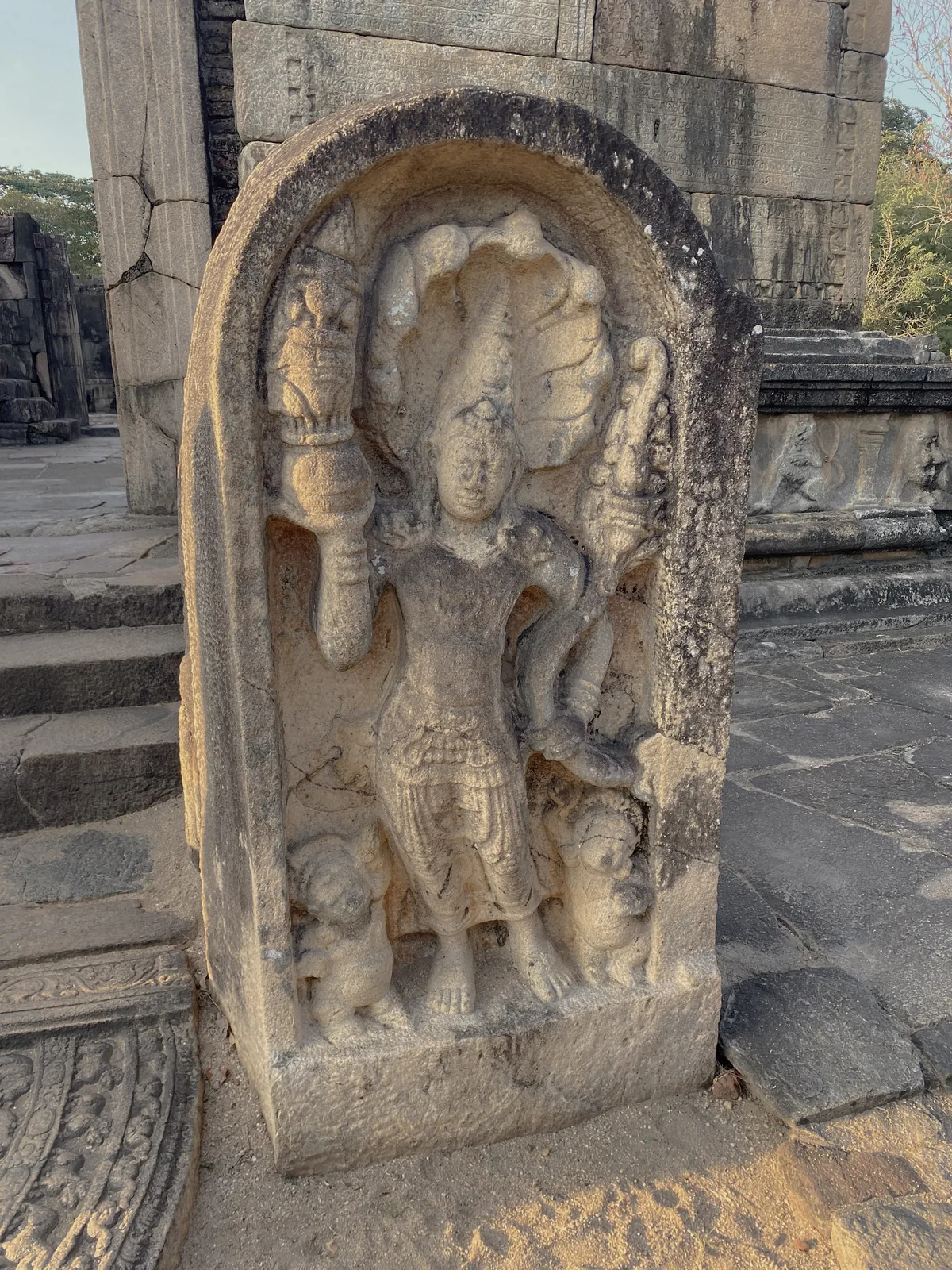
The guardstones of the Polonnaruwa Vatadage are counted, with the Ratnaprasada, among the finest the island cut, the same Nagaraja with his pot and his hood carried into the second capital three centuries later.
The palace it guarded was first built by Kanittha Tissa in the second century, but the guardstone belongs to the great rebuilding under Mahinda II in the eighth century, and it is to that reign, on the evidence of style, that the carving is given. The vase it holds is abundance, the dwarf is an attendant, the serpent is protection; the whole slab is a wish for prosperity set at the threshold and a guard against what should not pass it.
It was cut from a single block of granite in high relief, the arch so deeply undercut that the figures stand almost free of the stone. No trace of its original colour is recorded, and it is seen now as worked granite. Of the sculptor, here as everywhere in the classical age, the record keeps nothing: the guardstone is the work of the anonymous craft tradition that served the monasteries, and the wonder of the Ratnaprasada stone is that so much grace and richness was given to a slab whose one duty was to stand at the side of a stair.
The third of the entrance stones completes the set. Where the moonstone lies flat on the ground and the guardstone stands upright at the foot, the balustrade, the korawakgala, runs up the outer edge of the steps, and its end is carved as a makara, the mythical water-beast, its body curling down into a great scroll and its open jaws pouring out a lion or a dwarf. The moonstone, the guardstone and the makara balustrade together make the carved threshold of a Sinhalese building, the ground the worshipper crossed on the way in worked at every step.
Sources
- Coomaraswamy, Ananda K. Mediaeval Sinhalese Art. Broad Campden: Essex House Press, 1908.
- Paranavitana, Senarath. Art of the Ancient Sinhalese. Colombo: Lake House, 1971.
- Wijesekera, Nandadeva. Early Sinhalese Sculpture. Colombo.
- Bandaranayake, Senake. Sinhalese Monastic Architecture. Leiden: Brill, 1974.
How to cite this profile
Malaka Talwatte, “The Guardstone,” Malaka Talwatte: Sri Lankan Art and Ceylon Antiquaria, https://malakatalwatte.pages.dev/artists/guardstones/.
Quote and cite freely with attribution; please do not republish a whole essay, or a photograph, without permission.