Contemporary · Artist
Hashan Cooray
Hashan Cooray came to painting from the far side of the image. Born in Colombo in 1987, he built a career in advertising, rising to senior art director at Leo Burnett, and taught himself to paint alongside it, so that by the time he began to show his work he was already fluent in the visual language of the very industry his art would come to question. He lives and works at Rajagiriya, on the edge of Colombo.
His subject is the human face, though never as likeness. Hashan calls his stance an anti-art, and his portraits are made to disturb rather than to please: gestural and dark, built up in acrylic and charcoal with brushes he fashions himself from coir and sticks, the features surfacing from raw canvas and dissolving again into passages of black. He has described the faces as representations of the soul rather than mirror images, some of them mouthless, many carrying scribbled marks and notations like the workings of an interrogator.
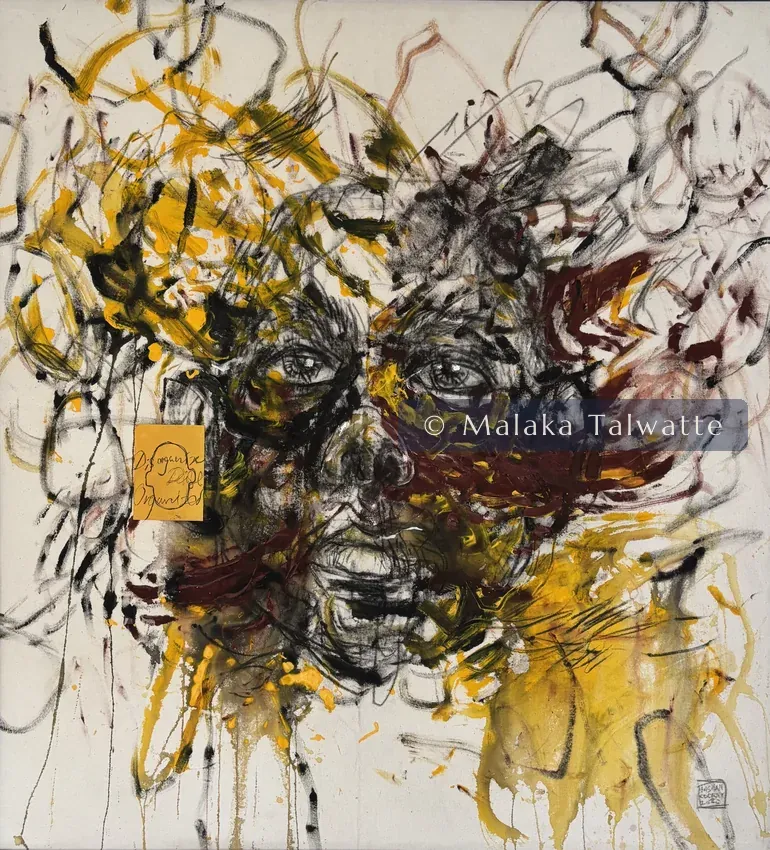
Behind the faces is an argument about what the modern world is making of us. Across the exhibitions that have carried his work at the Saskia Fernando Gallery, among them Parahuman in 2019, Desire in 2020, Stick No Bills in 2022 and Dystopia in 2024, he has returned to media saturation, consumerism, populism and nationalism, repurposing the posters and advertisements of his old trade to picture a new kind of human driven by power and appetite over conscience.
His work has been shown at the JDA Perera and Lionel Wendt galleries and the Sapumal Foundation, and taken into private collections in Sri Lanka and abroad. The painting held here is one of those gestural portraits, a face worked in red, black and yellow washes and dripping line, psychological rather than descriptive, made in his own words to engage, disturb and grab the viewer.
Sources
- Ocula.
- The George Keyt Foundation, Nawakalakaruwo exhibitions.
How to cite this profile
Malaka Talwatte, “Hashan Cooray,” Malaka Talwatte: Sri Lankan Art and Ceylon Antiquaria, https://malakatalwatte.pages.dev/artists/hashan-cooray/.
Quote and cite freely with attribution; please do not republish a whole essay, or a photograph, without permission.