Contemporary · Artist
Hema Shironi
A needle draws its thread through an old family photograph, and where the printed image once sat flat and finished, Hema Shironi leaves a raised seam. She embroiders by hand into paper and salvaged cloth, layering one generation’s face over another’s until the surface becomes a record of people who have been moved, separated and made to begin again. To understand why a Sri Lankan artist should sew memory back together stitch by stitch, you have to begin with a child born in Kandy in 1991, and with a country coming apart around her.
She grew up Tamil in the years of the civil war, in a society where language, home and belonging could be taken from a family with little warning. That experience of colonisation, war, displacement and migration became the ground of her practice, and the work reaches from there into questions of language, culture, memory, gender and equality. She took her Bachelor of Fine Arts at the Ramanathan Academy of Fine Arts at the University of Jaffna in 2014, then a Master of Fine Arts at Beaconhouse National University in Lahore in 2019, studying under Salima Hashmi; she now lives and works in Kilinochchi, in the island’s far north.
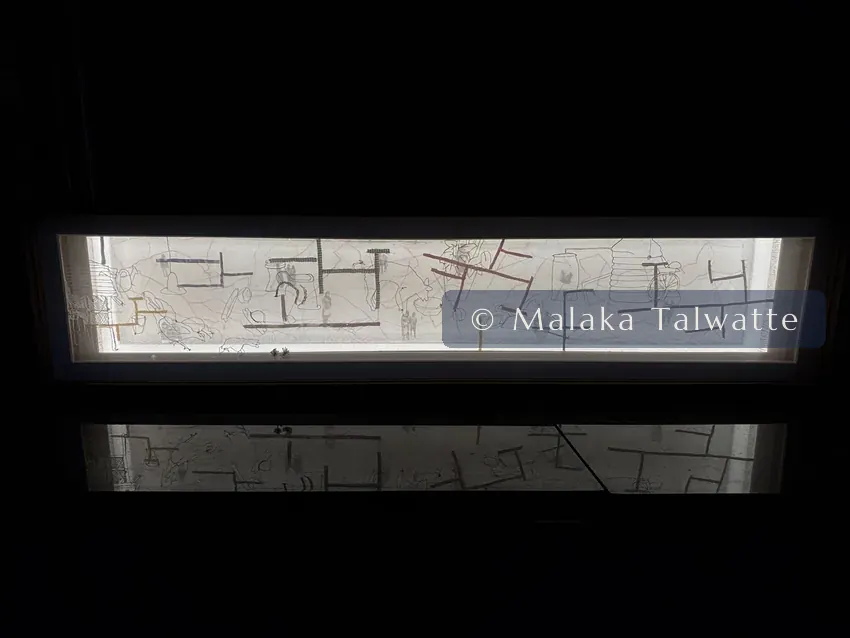
Embroidery is the argument, rather than the decoration. The choice to stitch, in place of paint or print, carries its own history: needlework was long treated as women’s craft, domestic and unsigned, and Hema takes that quiet, patient labour and makes it hold the weight of a divided public history. Her closely stitched surfaces gather old family photographs, printed paper and vintage fabric into one plane, layer settling over layer until a face surfaces through the weave and the thread draws back together what circumstance pulled apart. The seam is left visible on purpose, because the mend is the point.
Recognition has followed the work outward from Colombo. In 2026 she received the Asia Arts Future (South Asia) Award at the tenth Asia Arts Game Changer Awards India, presented by the Asia Society, a distinction that turned toward Sri Lanka that year. Her work was shown at the eleventh Asia Pacific Triennial of Contemporary Art in Brisbane in 2024 and entered the collection of the Queensland Art Gallery; it has appeared at the thirteenth Taipei Biennial, at successive editions of Colomboscope in Colombo, and at the ZKM Center for Art and Media in Karlsruhe. She is represented by the Saskia Fernando Gallery.
The needle returns at the end where it began. What Hema does with thread is repair of a difficult kind, since the tear stays legible under the stitching; it is the slower work of holding a torn story in one hand and refusing to let the pieces drift apart. The girl from Kandy who watched belonging come undone now sits with needle and thread, and sews the scattered faces back into one whole.
Sources
- Ocula. ‘Hema Shironi.’ https://ocula.com/artists/hema-shironi/
- The Sunday Times (Sri Lanka). ‘Stitching Together Memories of War and Her Grandmother’s Stories.’ 25 August 2024. https://www.sundaytimes.lk/240825/plus/stitching-together-memories-of-war-and-her-grandmothers-stories-568217.html
How to cite this profile
Malaka Talwatte, “Hema Shironi,” Malaka Talwatte: Sri Lankan Art and Ceylon Antiquaria, https://malakatalwatte.pages.dev/artists/hema-shironi/.
Quote and cite freely with attribution; please do not republish a whole essay, or a photograph, without permission.