Pre-modern · Artist
Henry Salt
Henry Salt was born at Lichfield on 14 June 1780, the son of Thomas Salt, a physician, and came to art through portraiture, studying in London before he turned to the topographical work that made his early name.
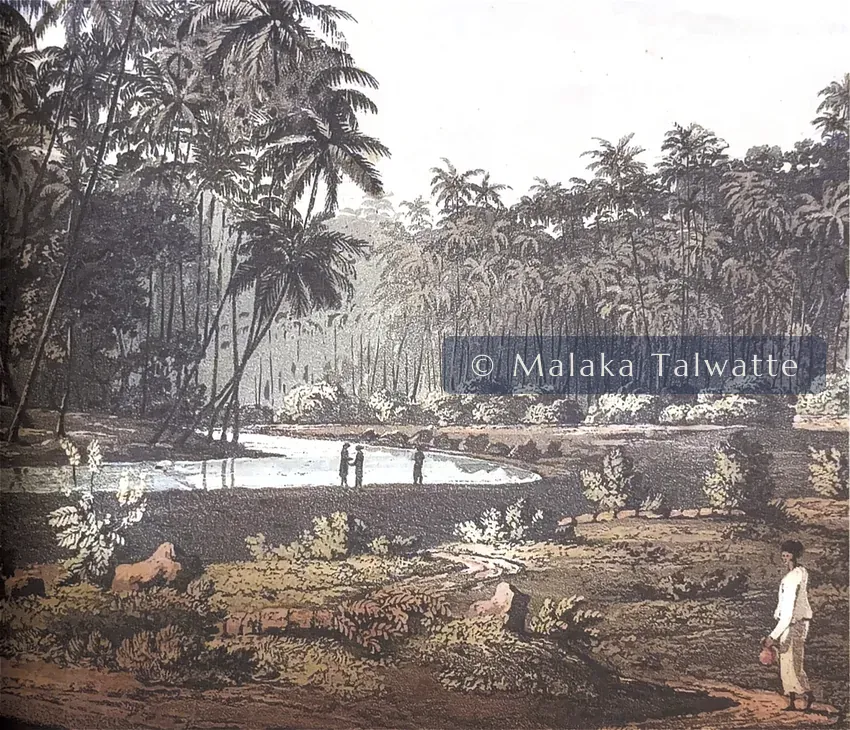
Henry Salt (1780–1827) came out in 1802 as secretary and draughtsman to George, Viscount Valentia, upon a grand tour of the East, having studied under Joseph Farington and John Hoppner, both Royal Academicians, before his departure. Of the twenty-four aquatints he published in London in 1809, printed in colours and engraved by D. Havell, J. Hill and J. Bluck, but a single plate represents Ceylon, a view of Point de Galle; it exhibits, nonetheless, an authority to which Cordiner’s drawings do not attain. Salt was afterwards to become one of the foremost Egyptologists in Britain and Consul-General in Egypt, under whose patronage Abu Simbel was first cleared; yet the Ceylon view, made when he was but twenty-two, already displays the precision of eye and the assurance of hand that were to characterise the whole of his subsequent career.
The volume that carried the Ceylon plate, ‘Twenty Four Views taken in St. Helena, the Cape, India, Ceylon, Abyssinia and Egypt’, was issued in London by William Miller and dedicated to the Marquis Wellesley, the Governor-General who had received the Valentia party at Calcutta; its Ceylon sheet is lettered ‘View near the Point de Galle’. Salt returned to Britain in 1806, undertook a government mission to Abyssinia between 1809 and 1811, and in 1816 took up the post of British Consul-General in Egypt, which he held until his death. There he employed Giovanni Belzoni to work at Thebes, Giza and Abu Simbel, and directed the removal of the colossal head of Ramesses II, the ‘Younger Memnon’, to London; the first of his great collections of Egyptian antiquities, purchased in 1823, formed the nucleus of the British Museum’s holdings from ancient Egypt. He died at Desouk, in the Nile delta, on 30 October 1827, in his forty-eighth year.
Sources
- Talwatte, Malaka. ‘19th Century Views of Ceylon by British Artists’.
- De Silva, Rajpal Kumar. Early Prints of Ceylon (Sri Lanka), 1800 to 1900. London: Serendib Publications, 1985.
- Twenty Four Views taken in St. Helena, the Cape, India, Ceylon, Abyssinia and Egypt. London: William Miller, 1809.
How to cite this profile
Source noteExtracted verbatim from Malaka Talwatte, '19th Century Views of Ceylon by British Artists'. Where this page reproduces a previously published essay, cite that original in preference to this page.
Malaka Talwatte, “Henry Salt,” Malaka Talwatte: Sri Lankan Art and Ceylon Antiquaria, https://malakatalwatte.pages.dev/artists/henry-salt/.
Quote and cite freely with attribution; please do not republish a whole essay, or a photograph, without permission.