Late Modern · Artist
Ismeth Raheem
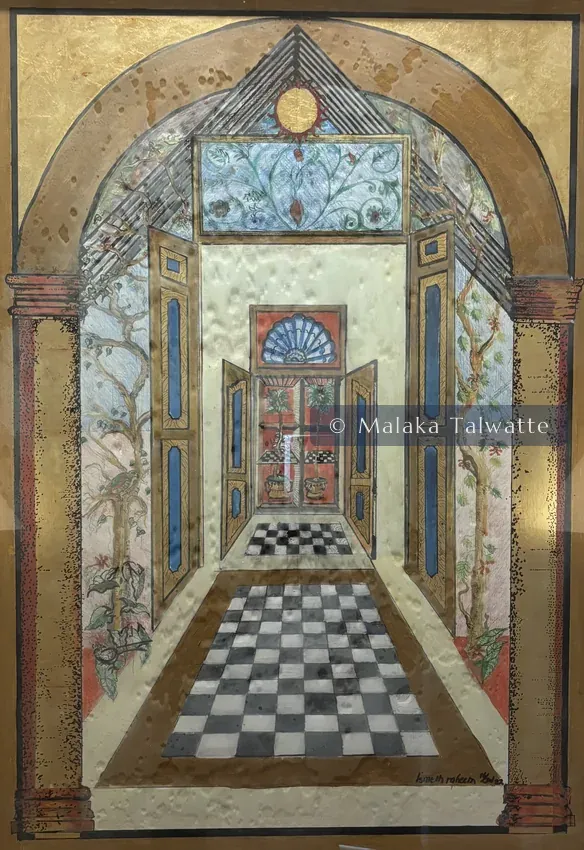
Drawing and painting have been a near-daily ritual across most of Ismeth Raheem’s adult life, and the habit has outlasted every other discipline he has practised. On the page a building comes apart and reassembles itself against the logic of a Persian miniature: façades tilt, floors rise into view that no single eye could hold, tile patterns and flat fields of colour lock together until architectural space becomes a puzzle of geometry rather than a window of depth. To follow how a Sri Lankan architect arrived at this way of seeing, you have to begin with a man who refused the wall the modern world builds between one discipline and the next.
A many-sided beginning
He was born in 1941, into a family of Jaffna-peninsula origin, and grew up in Colombo, where he made his beginning as an artist young. He was schooled at Royal College, and there, with his contemporaries Laki Senanayake and Turner Wickremasinghe, he attended Cora Abraham’s Melbourne Art Classes and formed the Young Artist Group, which held regular exhibitions in Colombo between 1962 and 1966. His first work shown in public came earlier still. In 1958, aged sixteen, he submitted an oil to the Ceylon Society of Art and was listed in its Special Mention category: a locomotive wreathed in steam and smoke as it drew in to the Fort station, its subject and treatment taken from Claude Monet’s ‘La Gare Saint-Lazare’ of 1877. His eye for the history of art was recognised at school, where he twice carried off the Royal College History of Art Prize, in 1957 and 1958, and in 1959 his work, with that of the Royal College Art Circle of which he was secretary, hung in an exhibition organised by UNESCO in Paris.
Architecture and the Bawa circle
His formation as an artist happened inside one of the defining workshops of Sri Lankan modernism. By the early 1960s he was working part-time as an assistant architect, first in the office of Billimoria and de Silva and then at Edwards, Reid and Begg, the firm that came to be led by Geoffrey Bawa. In 1962 he entered the very first intake of the architecture course at the Katubedde Technical College, later the University of Moratuwa, and went on with his fellow assistants to the Royal Danish Academy of Fine Arts in Copenhagen, where he studied from October 1966 to January 1969 and took up engraving, lithography and ceramics in its fine-arts department, his passage there helped by the Danish architect Ulrik Plesner, who had joined Bawa in 1959. The circle around the firm drew in Ena de Silva, Barbara Sansoni and Laki Senanayake, the makers who rethought the bond between art, craft and building in the decades after independence; his encounter with Ena de Silva turned him toward batik and toward an abstraction rooted in geometric design. In 1978 he left Bawa’s practice to set up his own firm with Pheroze Choksy, a fellow architect who had studied beside him in Copenhagen, and their work ran to banks, hotels and houses in Sri Lanka and the Maldives. The most notable of the hotels was the Cinnamon Lodge at Habarana, which he designed and landscaped through the early 1980s, planting a garden of more than a hundred and twenty native species across its chena acres; when import controls shut out foreign paints, he ground his hotel murals from what the island gave him, the yellow-ochre earth called Samara and laundry ‘Robin’ blue.
A way of seeing
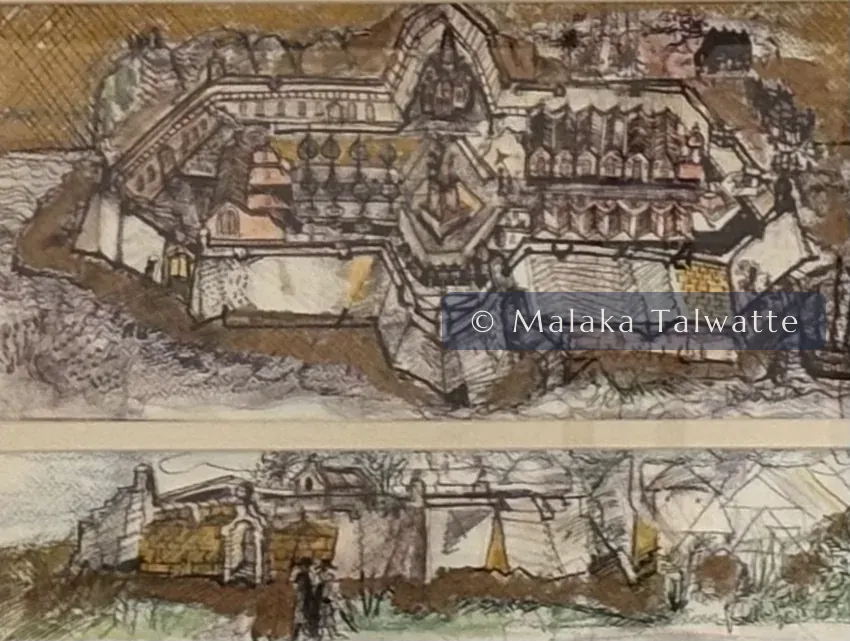
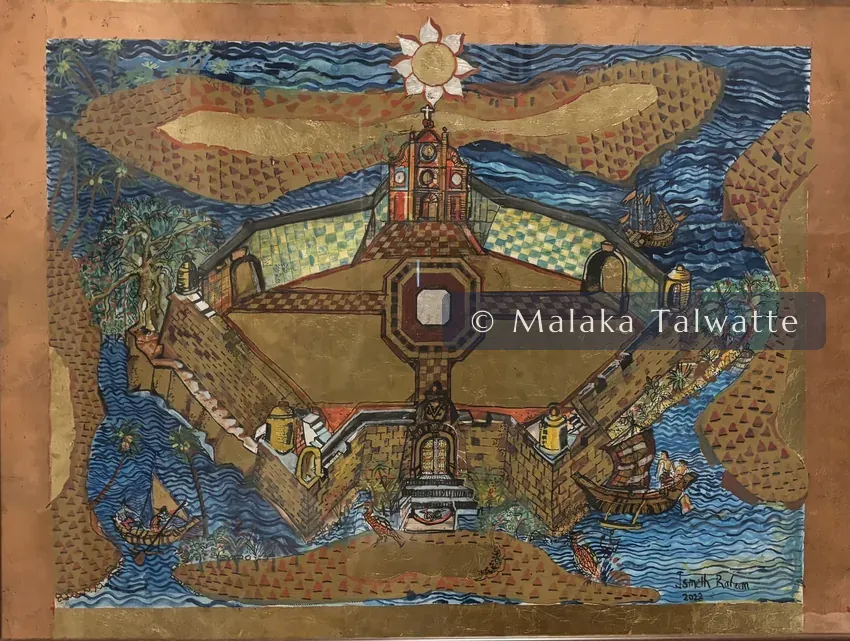
The paintings turn the architect’s discipline inside out. Where perspective gathers a scene toward a single vanishing point, Raheem works in reverse, the manner of the Persian and Indian miniaturist, so that lines open outward and the far edge of a courtyard reads as wide as the near one; walls fold flat, roofs and floors are seen at once, and the whole is held together by pattern and by even, unshadowed fields of colour rather than by depth. The line that carries it he learned in part from the Australian painter Donald Friend, who lived in Sri Lanka between 1957 and 1962, at Bevis Bawa’s ‘Brief’ at Aluthgama, and whose mastery of pen and ink Raheem watched at first hand and made his own. His range of materials has stayed deliberately wide, in keeping with a practice that refused from the first to sit still in one medium: pen and ink, pencil, watercolour, oil and acrylic, the woodcut and the engraving, and the applied gold leaf that lends certain sheets the character of an illuminated page. From a studio he and Laki Senanayake kept at the Lionel Wendt he designed for the stage as well, among them the sets for Arthur Miller’s ‘Death of a Salesman’. Streetscapes, façades and the social life of the island recur as his subjects, the built world set down with the exactness of a man who has also drawn it to be constructed.
Birds, history and the archive
His art has always run beside his history and his natural science rather than behind them. As a young man he gave himself to the study of birds, made a monthly and sometimes weekly habit of the wildlife parks, worked the annual waterfowl census, and joined the Ceylon Bird Club, of which he became president in the late 1990s. A great many of his paintings return to the birds of the island, among them a series drawn after Colonel William Vincent Legge’s ‘History of the Birds of Ceylon’, the great nineteenth-century monograph on the island’s avifauna, and to the question that runs through all his historical work, how a place was seen and recorded before the camera. That question became scholarship. He wrote ‘Images of British Ceylon: Nineteenth Century Photography of Sri Lanka’, with Percy Colin-Thomé, and ‘Archaeology and Photography: The Early Years, 1868 to 1880’, researched and wrote the catalogues of a succession of exhibitions on the history of painting, engraving and photography, and gave much of his later effort to preserving and showing the work of friends and colleagues, Geoffrey Bawa among them.
The return to exhibiting
For decades he made no effort to put his own work before the public, choosing instead to mount the art of others. After his retirement in 2015 the painting only intensified, and in 2019 he showed at the Harold Peiris Gallery in Colombo, his first public exhibition of his own art since the 1970s. The gathering has continued since: ARTRA devoted an edition, ‘Art and Design of Ismeth Raheem’, to his life and work, and the John Keells Foundation and Cinnamon Life presented an ‘Artist Spotlight’ on him, curated by Kasun Jayamanne, that set the drawings and paintings before a fresh audience. The ritual at the drawing table holds it all in one place. A senior figure whose reach runs from Bawa’s studio to the Ceylon Bird Club, Raheem has spent a lifetime dissolving the borders others draw, and turning architecture, ornithology and history into a single, still-unfolding way of seeing.
Sources
- Raheem, Ismeth. ‘Art As Record’. In Artist Spotlight: Ismeth Raheem. John Keells Foundation and Cinnamon Life.
- Bandaranayake, Senake, and Albert Dharmasiri. Sri Lankan Painting in the 20th Century. Colombo: National Trust of Sri Lanka, 2009.
- Raheem, Ismeth, and Percy Colin-Thomé. Images of British Ceylon: Nineteenth Century Photography of Sri Lanka. 2000. https://search.worldcat.org/title/892483499
- Archaeology and Photography: The Early Years, 1868–1880. The National Trust of Sri Lanka. https://thenationaltrust.lk/books/archaeology-photography-the-early-years-1868-1880/
- The Sunday Times (Sri Lanka). ‘Island in Transition.’ 11 October 2015. https://www.sundaytimes.lk/151011/plus/island-in-transition-167303.html
How to cite this profile
Malaka Talwatte, “Ismeth Raheem,” Malaka Talwatte: Sri Lankan Art and Ceylon Antiquaria, https://malakatalwatte.pages.dev/artists/ismeth-raheem/.
Quote and cite freely with attribution; please do not republish a whole essay, or a photograph, without permission.