Classical · Site
Isurumuniya
The most reproduced carving in the island’s ancient art shows a man seated with a woman on his knee, her hand raised towards his chest, and no one can say for certain who they are. The relief known as the Isurumuniya Lovers, cut on a granite slab and now kept in the small museum below the rock, has been read as Prince Saliya, the son of Dutugamunu who is said to have given up his claim to the throne for the low-caste Asokamala, and as the god Shiva with Parvati, and as a bodhisattva with his consort; what holds across every reading is the carving itself, the ease of the two bodies, the woman’s half-shy gesture, and the strong Gupta feeling in the modelling that ties the work to the India of the fifth or sixth century.
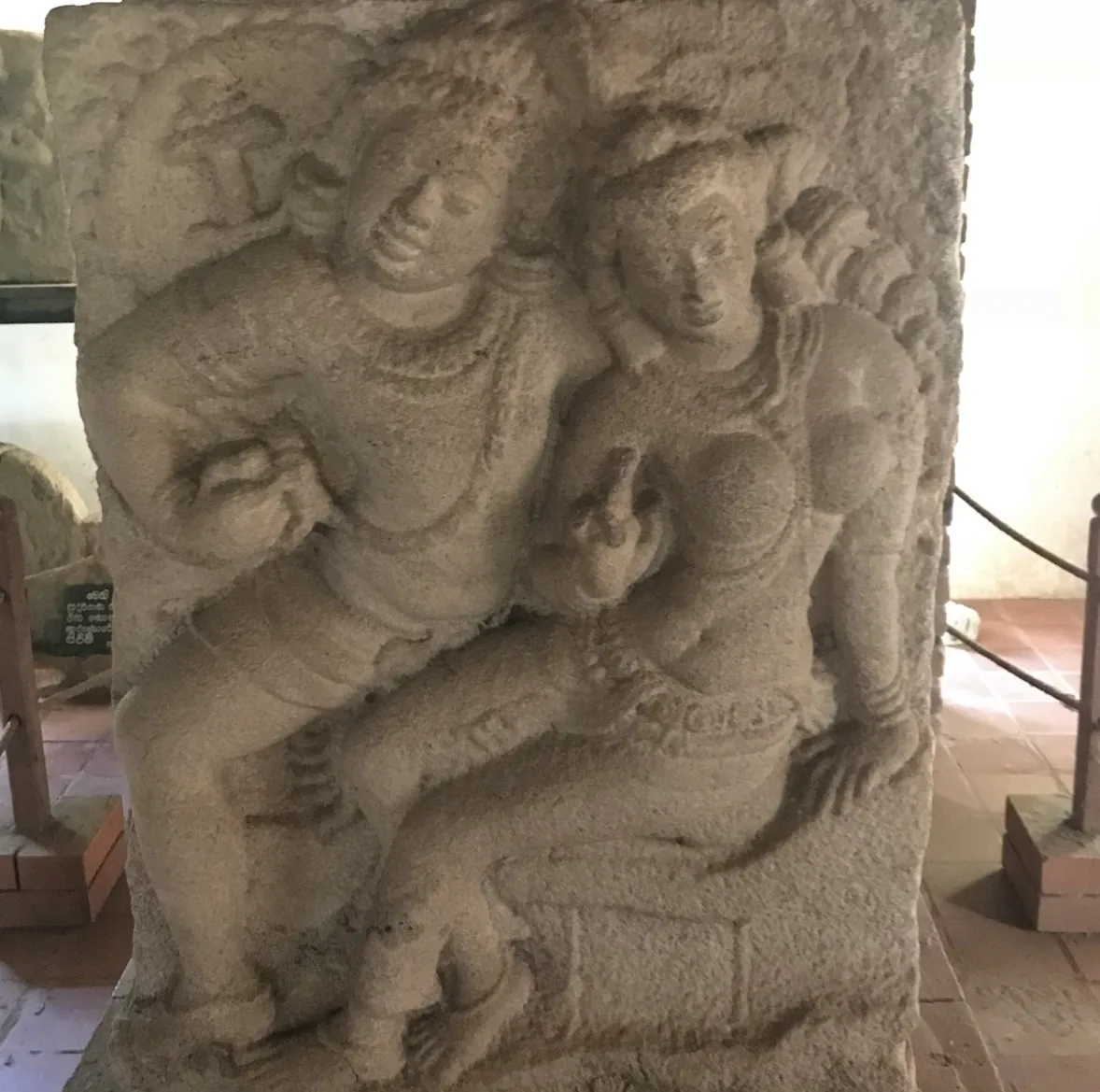
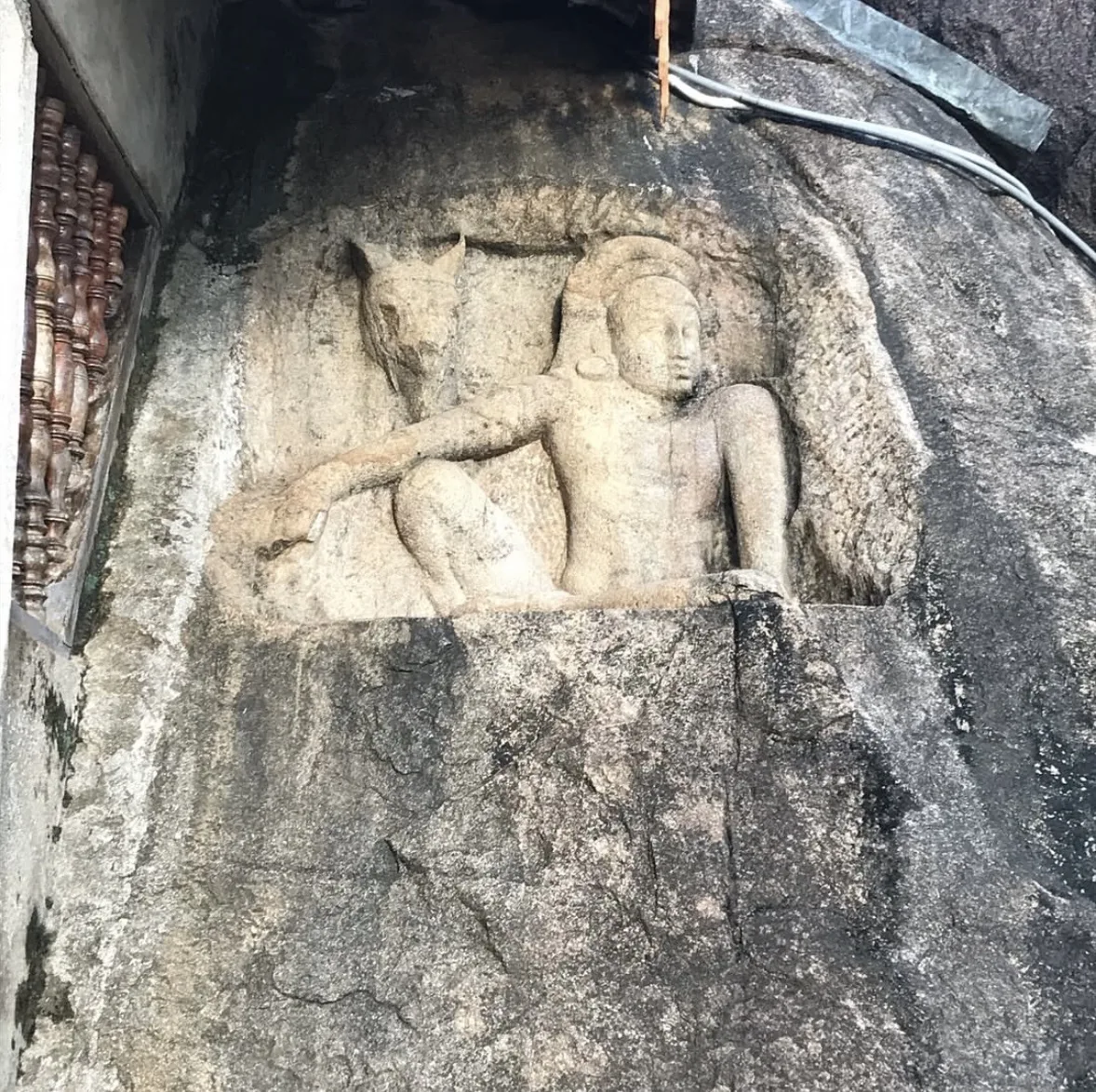
The Lovers is one of four famous reliefs at Isurumuniya, and the arguments over them have run for a century. Higher on the rock beside the stair a second panel, the Man and Horse, shows a helmeted figure seated in the posture of royal ease with a horse’s head rising from the stone behind him; Laurence Binyon called it ‘a tremendous work, impossible to forget when once seen’. Who he is has divided the scholars more sharply than any other Sinhalese carving. Ananda Coomaraswamy read him as the sage Kapila; J.Ph. Vogel and William Cohn rejected that as untrue to the figure’s soldierly bearing; Senarath Paranavitana, in the first careful study of the group, made him part of a rain cult, the horse the fire-born Agni and the man the rain-god Parjanya; the Dutch scholar van Lohuizen-de Leeuw proposed Aiyanar, the guardian of the tanks and the fields. The panel is given to the Pallava manner and dated, on style alone, to about the sixth or seventh century.
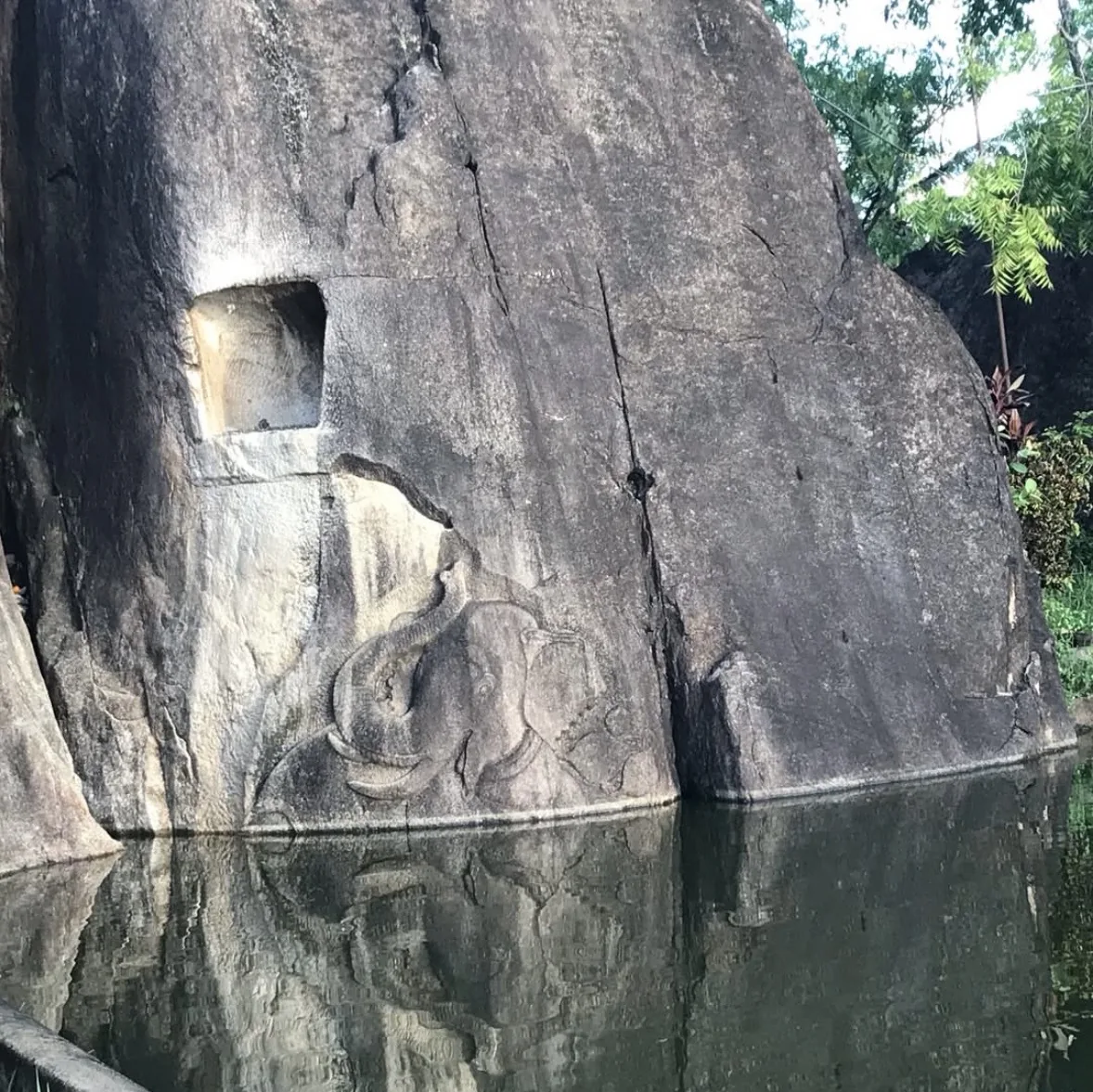
At the foot of the rock, where a pool gathers against the stone, a group of elephants is carved in low relief, so placed that the animals seem to bathe in the water that laps the boulder. The work is Pallava in feeling and is set beside the elephant reliefs at Mamallapuram on the South Indian coast; Paranavitana read the elephants too into his rain cult, the beasts standing for the clouds and the fertility that rain brings, though the panel reads as easily as a plain scene of elephants at play. A fourth slab, the Royal Family, five figures in a court group now in the museum, carries the Gupta manner into perhaps the eighth century, and Paranavitana would have it show Dutugamunu meeting Saliya and Asokamala, the same legend that clings to the Lovers.
Together the reliefs are the fullest showing of the Indian currents that shaped Anuradhapura sculpture, the Amaravati, the Gupta and the Pallava one after another, and it is by those resemblances, not by any inscription, that they are dated across the fifth to the eighth centuries. The pieces are not of one hand or one moment, so the ‘Isurumuniya school’ is better understood as a family of Indian-touched works of different phases than a single workshop. They are cut in the living granite and on slabs, in the low relief the Sinhala term calls ardha-unnata, the half-raised cut; the Lovers and the Royal Family were lifted from the rock into the museum, the Man and Horse and the elephants left where they were carved.
The rock itself is among the oldest monastic sites at Anuradhapura, a cave shrine above a pond beside the Tissa Wewa, its founding given by tradition to Devanampiya Tissa in the third century before Christ, when it was called Meghagiri; a small stupa crowns the rock and a shrine is built into the cave beneath. Kasyapa I, the king of Sigiriya, is said to have rebuilt it in the fifth century, joining it to the neighbouring Vessagiriya and renaming the whole for himself and two of his daughters, and the Lovers and the Royal Family panel may have been cut under his patronage. Of the carvers the record keeps nothing, as it keeps nothing of the classical sculptor anywhere on the island, and the reliefs have held their arguments and their beauty for thirteen centuries with not one name attached to them.
Sources
- Coomaraswamy, Ananda K. Mediaeval Sinhalese Art. Broad Campden: Essex House Press, 1908.
- Paranavitana, Senarath. Art of the Ancient Sinhalese. Colombo: Lake House, 1971.
- von Schroeder, Ulrich. Buddhist Sculptures of Sri Lanka. Hong Kong: Visual Dharma, 1990.
- Wijesekera, Nandadeva. Early Sinhalese Sculpture. Colombo.
How to cite this profile
Malaka Talwatte, “Isurumuniya,” Malaka Talwatte: Sri Lankan Art and Ceylon Antiquaria, https://malakatalwatte.pages.dev/artists/isurumuniya/.
Quote and cite freely with attribution; please do not republish a whole essay, or a photograph, without permission.