Pre-modern · Artist
Sir James Emerson Tennent
More threads of the island’s art history converge upon Sir James Emerson Tennent (1804–1869) than upon any other figure in British Ceylon art. Colonial Secretary to the government of the island from 1845 to 1850, he was the author of Ceylon: An Account of the Island, Physical, Historical and Topographical, published in 1859. The work, which passed through five editions within its first eight months, was the fullest account of the island that had then appeared in English; and Tennent, determined that it should be illustrated as amply as it was written, selected as his principal illustrator a fellow Irishman, Andrew Nicholl (1804–1886).
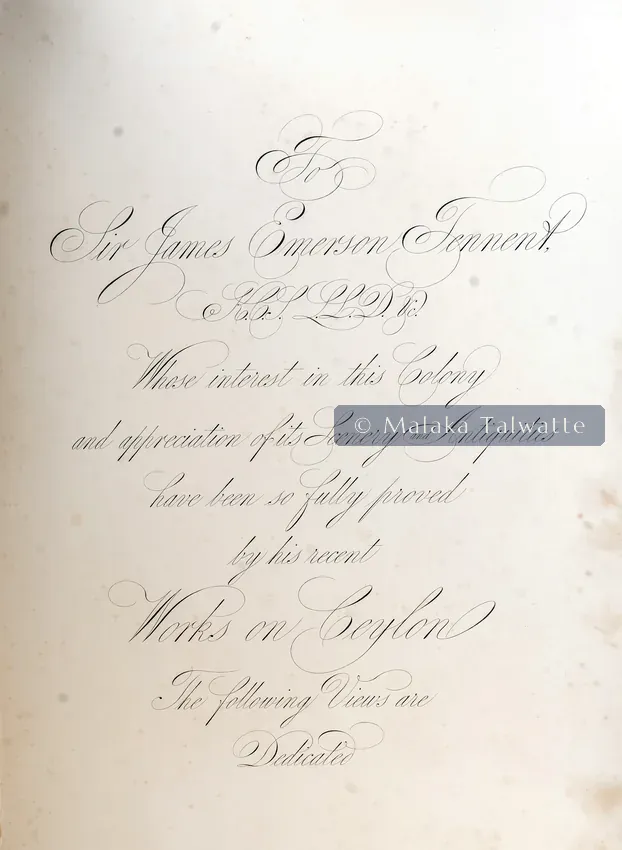
Tennent was born in Belfast on 7 April 1804, sat in the House of Commons for Belfast and afterwards for Lisburn, and was knighted in 1845, shortly before taking up his Ceylon post; he was created a baronet in 1867 and died in London on 6 March 1869. His election as a Fellow of the Royal Society in 1862 acknowledged the encyclopaedic surveys the island had drawn from him, and during his years in Ceylon he served as the second President of the Ceylon Branch of the Royal Asiatic Society, from 1846 to 1857, an office that set him at the centre of learned inquiry into the island.
His place in that history is that of a patron and author rather than a practitioner. He drew and painted nothing himself; the visual record gathered around his book. Ceylon was conceived as a description so complete that it called for a matching body of images, and Tennent’s resolve to see it fully illustrated brought Nicholl into the work as his chosen illustrator and, at one remove, prompted Captain Charles O’Brien’s Series of Fifteen Views of 1864, published expressly to illustrate the same text. The book’s authority did as much as any commission: its rapid succession of editions carried Nicholl’s plates and Tennent’s descriptions to a wide readership and fixed, for a generation of British readers, the way the island was seen.
Sources
- Talwatte, Malaka. ‘19th Century Views of Ceylon by British Artists’.
- Tennent, Sir James Emerson. Ceylon: An Account of the Island, Physical, Historical and Topographical. 1859.
- The Talwatte Collection.
How to cite this profile
Source noteExtracted verbatim from Malaka Talwatte, '19th Century Views of Ceylon by British Artists'. Where this page reproduces a previously published essay, cite that original in preference to this page.
Malaka Talwatte, “Sir James Emerson Tennent,” Malaka Talwatte: Sri Lankan Art and Ceylon Antiquaria, https://malakatalwatte.pages.dev/artists/james-emerson-tennent/.
Quote and cite freely with attribution; please do not republish a whole essay, or a photograph, without permission.