Pre-modern · Artist
James Stephanoff
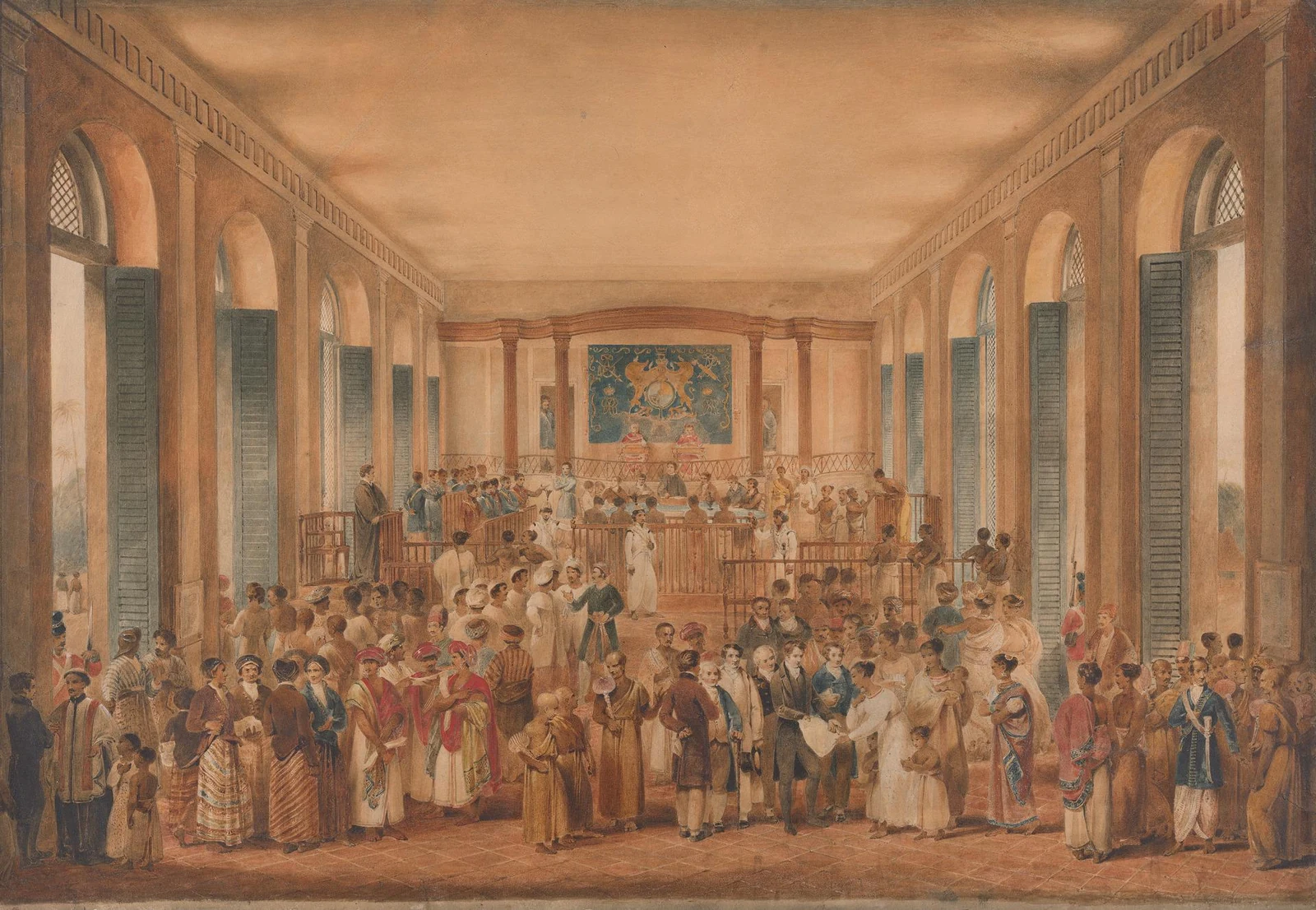
James Stephanoff (c.1787–1874), Historical Painter in Watercolours to King William IV and a contributor to Pyne’s History of the Royal Residences. About 1820 he executed an image of rare historical consequence, The Supreme Court of Judicature in the Island of Ceylon, published as a hand-coloured aquatint by Rudolph Ackermann, engraved by J. Bennet, and dedicated to the Chief Justice, Sir Alexander Johnston. Its subject is a moment in the history of law and conscience: the Supreme Court of Judicature at Colombo, where the first native jury in the British empire had sat since 1810, and where the abolition of domestic enslavement was proclaimed in August 1816. Stephanoff had observed none of it, working instead from a sketch dispatched to London by a Sinhalese juror; and the aquatint was afterwards put to a use more extraordinary still, for in the hands of Chief Justice Johnston this depiction of a courtroom the artist had never entered became an instrument in a constitutional contest over the independence of the judiciary, perhaps the most remarkable purpose to which such a print has ever been put. The original is held at the Yale Center for British Art.
Sources
- Talwatte, Malaka. ‘19th Century Views of Ceylon by British Artists’.
- Pyne. History of the Royal Residences.
- Yale Center for British Art.
- De Silva, Rajpal Kumar. Early Prints of Ceylon (Sri Lanka) 1800-1900. London: Serendib Publications, 1985.
How to cite this profile
Source noteExtracted verbatim from Malaka Talwatte, '19th Century Views of Ceylon by British Artists'. Where this page reproduces a previously published essay, cite that original in preference to this page.
Malaka Talwatte, “James Stephanoff,” Malaka Talwatte: Sri Lankan Art and Ceylon Antiquaria, https://malakatalwatte.pages.dev/artists/james-stephanoff/.
Quote and cite freely with attribution; please do not republish a whole essay, or a photograph, without permission.