Classical · Site
Jetavanaramaya
When the Jetavana stupa at Anuradhapura was completed at the end of the third century, it stood some hundred and twenty metres high, the tallest stupa ever built and, after the two great pyramids at Giza, the third-tallest structure of the ancient world. It is a mountain of brick: an estimated ninety million and more fired bricks raised into a dome on foundations sunk eight metres to bedrock, and it holds its rank among the largest brick monuments anywhere to this day.
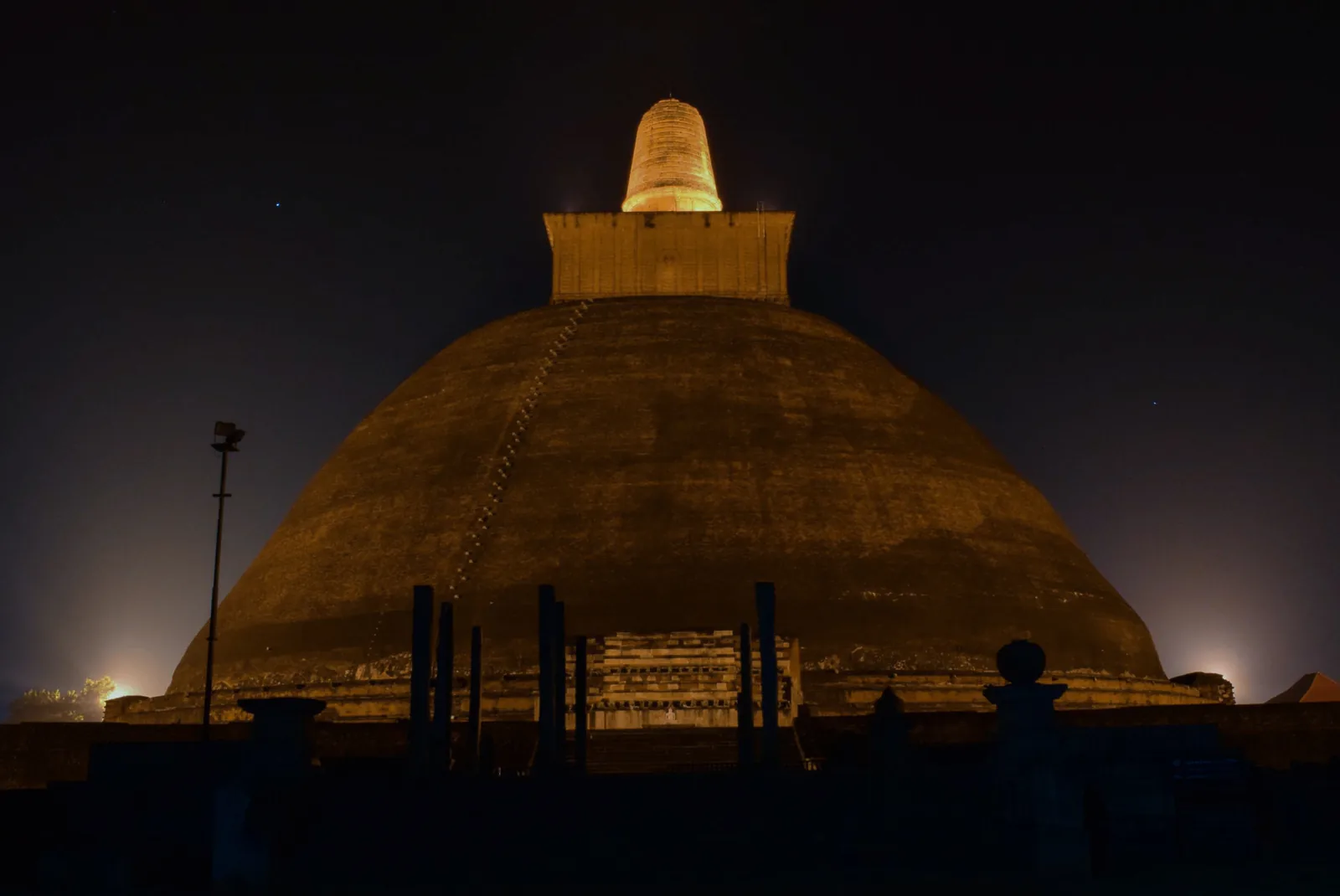
Where the Ruwanwelisaya is kept white, the Jetavana is left as its brick, and the bare dome is the better teacher for it, a vast dark curve of masonry that shows what the plaster elsewhere conceals: the sheer labour, and the sureness of the setting-out, that a dome of this size demanded, the courses running true around a brick dome more than a hundred metres across, the whole raised on a platform of some three hectares. The form is classed as the heap of paddy, the long low swelling profile, though at this scale the eye reads it first as landscape and only then as design. Its present height, the spire long gone, is about seventy metres, half of what it once was, and even halved it dwarfs everything around it.
The stupa gave up a treasure to the spade in modern times. Among the finds of its late twentieth-century excavation were nine thin gold plates incised with a Buddhist text, the Perfection of Wisdom, a rare survival of the goldsmith’s and the scribe’s art from the classical age, distinct from the relic the dome was raised to hold, which tradition names as a part of the sash or belt of the Buddha.
Swallowed by the forest after Anuradhapura was abandoned, the Jetavana was cleared and, from the 1980s, stabilised and partly re-faced by the Cultural Triangle project under UNESCO, its bricks remade to the recipe of the originals. Mahasena, who began it in the course of a reign torn by religious dispute, is remembered as its patron, though its completion fell to his son; the masons who stacked its ninety million bricks are not, as none of them are. It remains the great proof of what the classical island could raise in earth and fire, a designed form at the scale of a hill.
Sources
- Paranavitana, Senarath. The Stupa in Ceylon (Memoirs of the Archaeological Survey of Ceylon, Vol. V). 1946.
- The Mahavamsa.
- UNESCO World Heritage Centre. ‘Sacred City of Anuradhapura’ (inscribed 1982).
- Central Cultural Fund, the Cultural Triangle.
How to cite this profile
Malaka Talwatte, “Jetavanaramaya,” Malaka Talwatte: Sri Lankan Art and Ceylon Antiquaria, https://malakatalwatte.pages.dev/artists/jetavanaramaya/.
Quote and cite freely with attribution; please do not republish a whole essay, or a photograph, without permission.