Pre-modern · Artist
J.L.K. van Dort
Any account of the visual record of British Ceylon must include J.L.K. Van Dort (1831–1898), a Ceylonese artist who probably received some tuition from Andrew Nicholl at the Colombo Academy in the 1840s and became the finest indigenous illustrator of the colonial period, serving for nearly three decades as local artistic correspondent to The Graphic, The Daily Graphic and the Illustrated London News. In him something of Nicholl’s influence may be traced: the Irish teacher who landed at Colombo in 1846, and the Ceylonese hand that was to produce the most sustained visual chronicle of daily life in British Ceylon that the nineteenth century would yield.
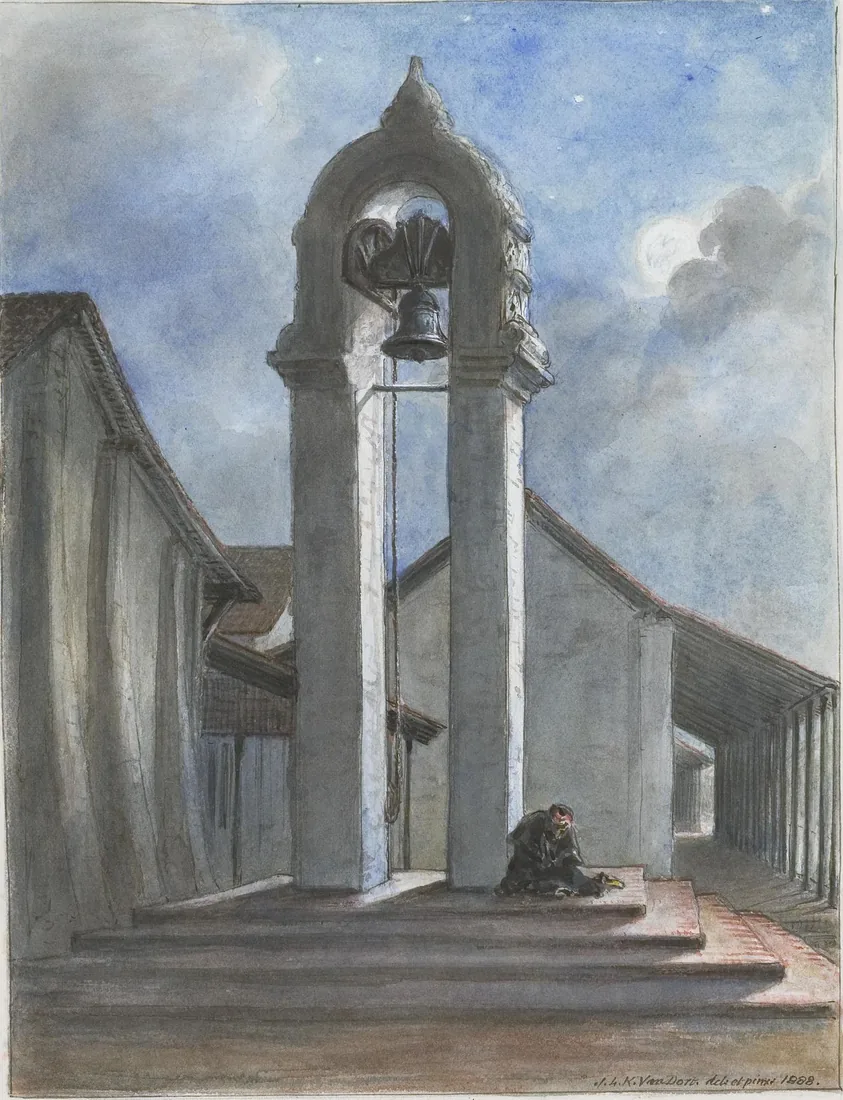
John Leonard Kalenberg van Dort was born in Colombo on 28 July 1831, the eldest of the nine children of Johannes Jacobus van Dort and Petronella Margaretta née Kalenberg, into the settled Dutch Burgher society of the maritime provinces. He was schooled at St Paul’s parochial school in Pettah and at the Colombo Academy, where the principal, Dr Barcroft Boake, thought him a prodigy; drawing formed no part of the curriculum, so what discipline he acquired came privately, from Nicholl and, it is thought, from the drawing master Philippe Antoine Hippolyte Silvaf. From 1855 he earned his living as a draughtsman in the Surveyor-General’s office, a post that trained the exact, patient hand visible in all his later work. In 1861 he married Cornelia Henrietta Spittel.
He belonged to the Dutch Burghers of the maritime provinces, the descendants of the Dutch East India Company’s servants who had stayed on after the British took the coast in 1796. They kept a settled world of their own, with their own cookery, their lamprais and breudher, and their own place in the life of colonial Colombo. Van Dort became its most attentive recorder, the eye through which the streets, the people and the occasions of British Ceylon passed into pictures.
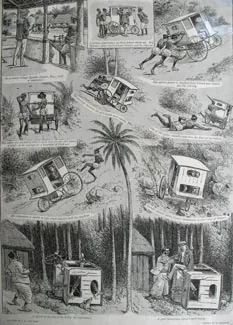
He was essentially a man of pen and pencil, working in monochrome, closely crosshatched and shaded, and turning to watercolour only occasionally, when he reinforced the wash with drawing in the manner he had learned from Nicholl, and to oil more rarely still. His gift was for the crowded human scene, observed with a satirist’s eye that has invited comparison with Rowlandson and Hogarth, and earned him among his contemporaries the name of the Hogarth of Ceylon. For his published work he studied closely the illustrations in such novels of Dickens and Lever as he could find, and something of their crowded, character-filled pages passed into his own. He drew for the Ceylon Observer, The Examiner and the monthly Young Ceylon, and for the comic paper Muniandi from its first appearance in 1869, working on it for some three years and, as a Government servant who could not put his name to caricature, leaving it unsigned. His hand carried Ceylon into the London press through The Graphic, to which he was taken up after the special correspondents attending Prince Alfred, Duke of Edinburgh, on the royal visit of 1870 remarked his facility, and for which he recorded events such as the arrival of Arabi Pasha at Colombo in 1883, though the London engravers, unfamiliar with the island, often flattened the individuality of his line. His illustrations furnished a series of books that now stand as a record of the age: the law-court characters for A.M. Ferguson’s Souvenirs of Ceylon of 1868, John Capper’s The Duke of Edinburgh in Ceylon of 1871, the Lapidarium Zeylanicum of 1877, John Capper’s Old Ceylon of 1877, and the clinical plates for the government report on the parangi disease of 1881, made for the Principal Civil Medical Officer, William Kynsey.
The work he was paid for was not the work that mattered most to him. His living came from safe commissions that asked little of his gift: illuminated addresses of welcome lettered on vellum, which Colombo had prized since Governor North’s day, coloured enlargements of a daguerreotype (an early photograph on a silvered copper plate) after a death in the family, and the painted transparencies got up for a public celebration. What drew out the best in him was the crowd. As a schoolboy he had stood on the Slave Island bridge at race time and sketched the throng pouring across it on foot and in bullock carts, and that appetite for the whole human scene never left him. His eye was a satirist’s, but never a cruel one: sharp as his humour could be, it left no sting. He delighted in drawing the soldiers of Mozambican descent then serving on the island, and in Dancing the Caffrinha, his record of the Afro-Portuguese dance he loved as much as any subject, for he danced it himself and played the three-stringed bandrinha that an old musician had left him.
He was, in the phrase of his own century, essentially an illustrator, thinking in black and white with the pen and pencil his chosen instruments. A notebook went everywhere with him, and a few swift lines and smudges were enough to fix the atmosphere of a landscape that had caught his eye; many of the sketches run to less than two inches square, and together they are a precious memorial of the island in a time of rapid change. Bhikkhus and buffaloes, rural sports and dancing girls, palms and palanquins, governors and the old temple pillar that served as the hundred-and-third milepost at Dondra, the whole working life of the country is set down in them, caught in passing. His drawing could break out anywhere: staying with the Walbeoff family at Katugastota in the 1880s, he covered the walls of the house with sketches overnight, a work that stood until the home was later sold.
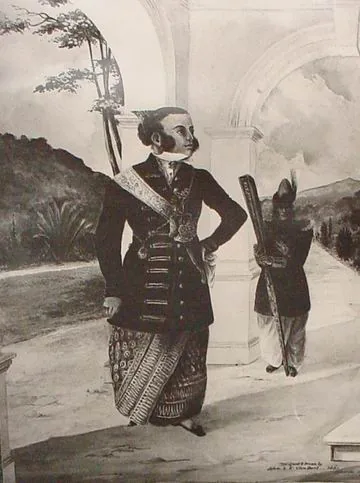
He set down more of everyday colonial Ceylon than any contemporary hand. Toward 1888 and 1889 he was commissioned to record the surviving Dutch forts, canals and inscriptions of the island, and forty-nine of those watercolours, gathered as his ‘Reminiscences of the Dutch Occupation’ and painted on a Dutch commission, are today held at the KITLV in Leiden; his series of the costumes of Ceylon is largely at the National Museum of Colombo, and lithographs after his work entered the Royal Collection. Among his records of the island’s Dutch inheritance are watercolours of the Wolvendaal church in Colombo and the Reformed churches at Galle and Matara. In 1893 he supplied eight large decorative panels for the Ceylon Court at the World’s Columbian Exposition in Chicago, the pavilion built of the island’s own timbers, carrying the pageants and everyday scenes of Ceylon before an American public for the first time. His last years were passed at a house near the sea at Bambalapitiya that he named Dordrecht, and he worked almost to his death in March 1898, and The Graphic, the London paper he had served so long, carried his obituary on 24 March; two of his children followed him into art: Grace, a painter in oils and watercolour who became secretary of the Ceylon Society of Arts, and Ernest Francis, a landscape painter in oils.
For all that he set down, his own countrymen had little chance to weigh his gift. The work lay scattered through newspapers and private hands, and no exhibition gathered it in his lifetime. It was only in 1951, more than half a century after his death, that Hilda Obeyesekere Pieris drew a monograph of his drawings together, Ceylon: The Near Past, and published it in Colombo, giving the island at last some measure of the man. His pen had recorded everyone else’s Ceylon; the reckoning of his own worth came late, and quietly, long after the hand that made it was still.
Sources
- Van Dort, J.L.K. Ceylon: The Near Past. Compiled by Hilda Obeyesekere Pieris. Colombo, 1951.
- Talwatte, Malaka. ‘19th Century Views of Ceylon by British Artists’.
- Sadanandan, Renuka. ‘Canvas of Memories.’ The Sunday Times (Sri Lanka), 23 May 2004. https://www.sundaytimes.lk/040523/plus/1.html
How to cite this profile
Source noteCore sentences extracted verbatim from Malaka Talwatte, '19th Century Views of Ceylon by British Artists'; surrounding biography researched and added. Where this page reproduces a previously published essay, cite that original in preference to this page.
Malaka Talwatte, “J.L.K. van Dort,” Malaka Talwatte: Sri Lankan Art and Ceylon Antiquaria, https://malakatalwatte.pages.dev/artists/jlk-van-dort/.
Quote and cite freely with attribution; please do not republish a whole essay, or a photograph, without permission.