Pre-modern · Artist
Johann Wolfgang Heydt
Johann Wolfgang Heydt is at once among the earliest artists to leave a detailed printed record of Dutch Ceylon and among the most shadowy. His birth and death are not securely recorded. What can be established is that he was a German draughtsman, engraver and surveying architect who entered the service of the Dutch East India Company, the VOC, about 1733, and sailed from Texel in 1734 bound for Ceylon, having signed with the Company at Amsterdam that year; the ship that carried him, the Meermond, brought him to Colombo. He spent about two and a half years on the island, and found useful friends there, among them Aggreen, the old captain of Colombo, and Governor van Domburg, who sent him out to make drawings. About 1736 he moved on to Batavia, where under the governor-general Adriaan Valckenier he served as a draughtsman and architect to the Company. He returned to Europe about 1740 and in later life held the post of building director to the house of Hohenlohe at Wilhermsdorf, near Nuremberg.
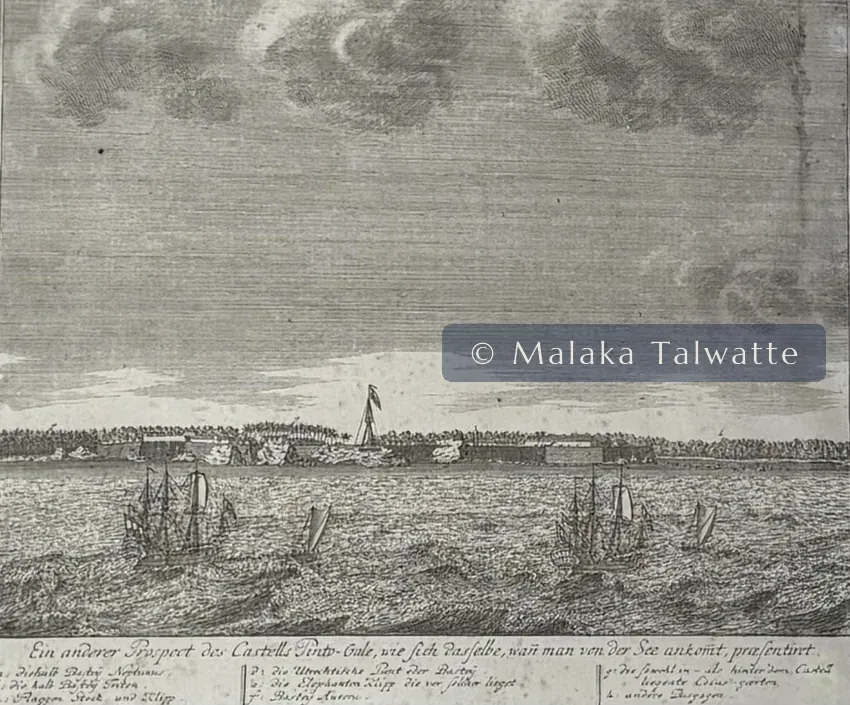
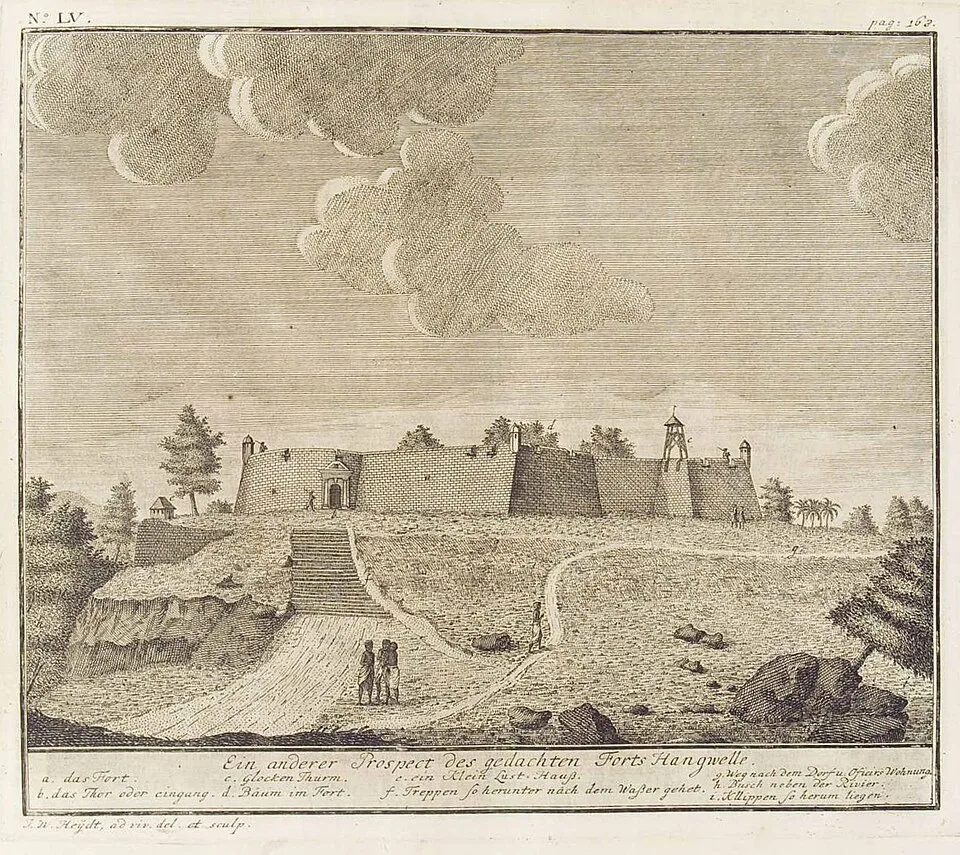
His years in the East yielded one work of lasting importance. In 1744, issued jointly at Wilhermsdorf and Nuremberg, he published the Allerneuester Geographisch- und Topographischer Schau-Platz von Africa und Ost-Indien, a described tour of the principal factories and forts of the Company from the Cape of Good Hope to Japan. It carries a hundred and fifteen full-page engravings, drawn, as the title page claims, from life, and both drawn and cut by his own hand.
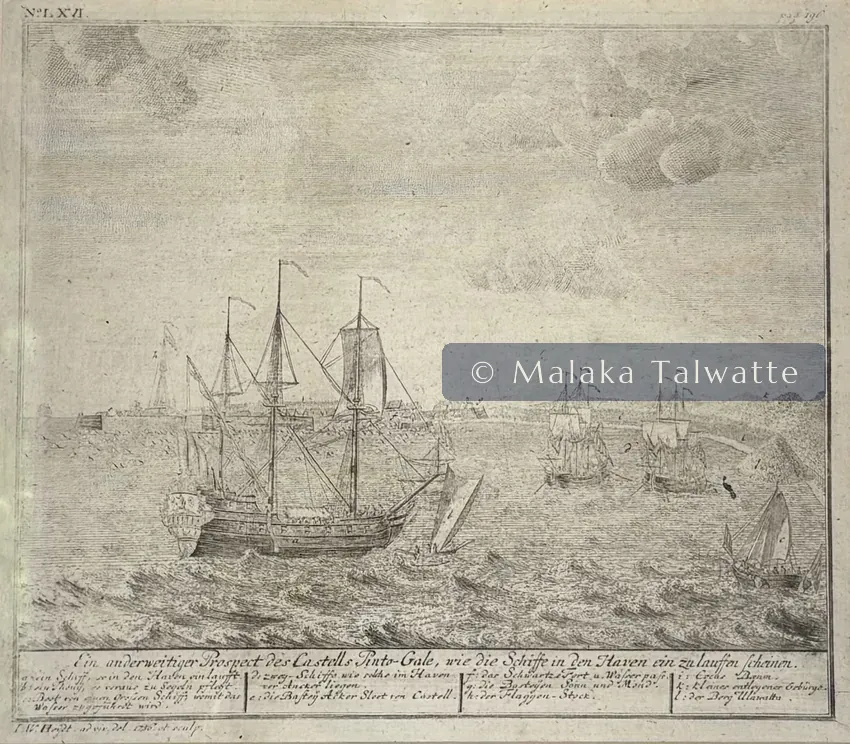
Ceylon is among the most fully illustrated regions in the book. Its plates give the castle at Point de Galle as it stood from the harbour, the towns of Colombo and Matara, Adam’s Peak seen from several quarters, the rock temple at Mulgirigala, and the interior of a Buddhist shrine. Together they amount to a survey of the maritime provinces under Dutch rule such as little else of the period records at comparable length: the forts and harbours, the plans of the towns, the colonial architecture, and the sacred sites of the interior. The Ceylon section runs to forty-eight plates, numbered forty-eight to ninety-five, engraved by Heydt himself and for the most part topographically accurate; where his own knowledge fell short he drew on the earlier accounts of Baldaeus and Knox.
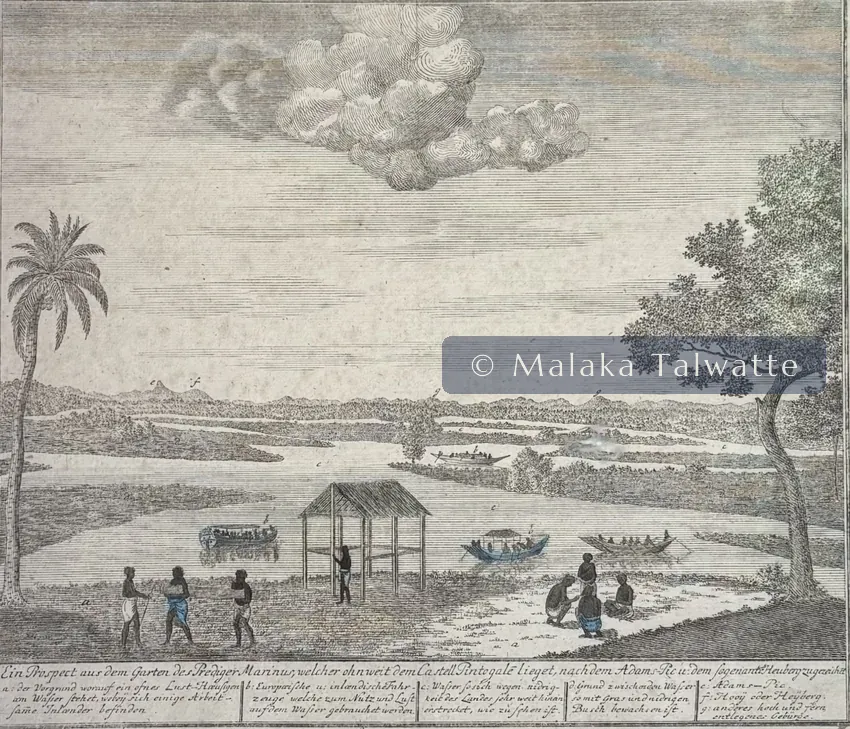
Some of the Ceylon plates are more than eyewitness views of Heydt’s own making. A number transmit earlier drawings, among them the sketches of the draughtsman Arent Jansen, lost work made about 1735, which Heydt engraved afresh and openly acknowledged as another’s. Whatever their immediate source, the plates survive as a primary visual record of the eighteenth-century island, and his name stands in the first rank of the topographical record of Dutch Ceylon.
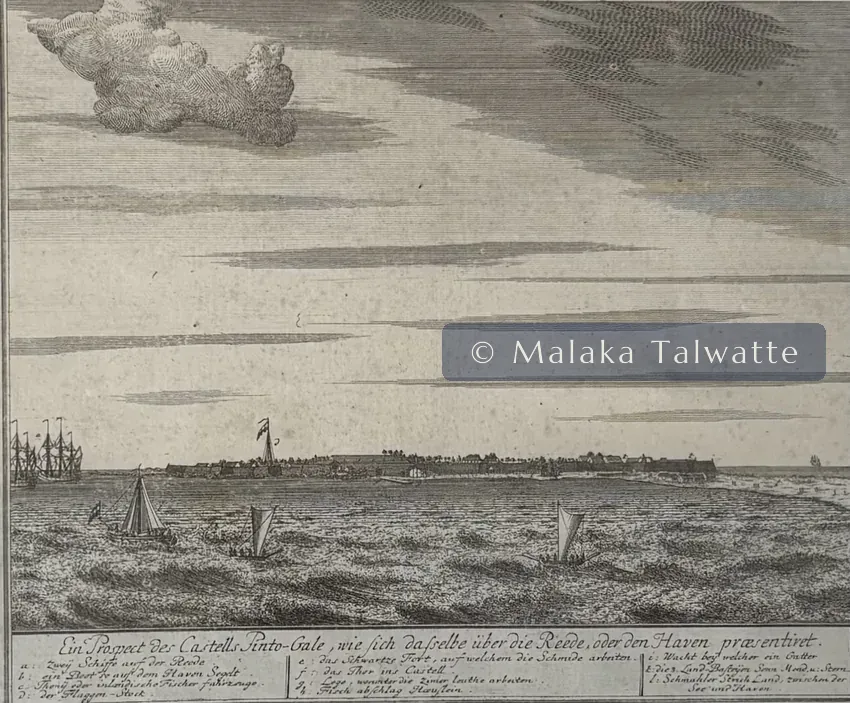
Heydt’s manner is the surveying architect’s, and it governs the whole Ceylon suite. He drew the fort and the town from a raised vantage, half bird’s-eye and half elevation, so that walls, streets and buildings could be counted and measured as much as looked at, and he kept the same even, patient line whether the subject was a bastion or a shrine. Rare among the makers of the Dutch record, he both drew and cut his plates himself, so no engraver stood between his eye and the sheet, and the unusual consistency of the hundred and fifteen views owes much to that single authorship. The result is less a set of pictures than a survey in print, the maritime provinces set down fort by fort and town by town with an engineer’s completeness.
Sources
- Heydt, Johann Wolfgang. Allerneuester geographischer und topographischer Schauplatz von Afrika und Ost-Indien. Wilhermsdorf and Nuremberg, 1744.
- de Silva, R.K., and W.G.M. Beumer. Illustrations and Views of Dutch Ceylon 1602–1796. London and Leiden: E.J. Brill, 1988.
How to cite this profile
Malaka Talwatte, “Johann Wolfgang Heydt,” Malaka Talwatte: Sri Lankan Art and Ceylon Antiquaria, https://malakatalwatte.pages.dev/artists/johann-wolfgang-heydt/.
Quote and cite freely with attribution; please do not republish a whole essay, or a photograph, without permission.