Start typing to search the essays, the artists and the collection.
Pre-modern · Artist
Captain John Deschamps
Captain John Deschamps, an Adjutant in the Royal Artillery, arrived in 1828 and remained in garrison for a decade. His Scenery and Reminiscences of Ceylon, published by Ackermann and Co. in London in 1845, seven years after his departure, comprises twelve hand-coloured lithographs, drawn on stone by J. West Giles and printed by M. and N. Hanhart. He directed his attention to the western coast: to the Fort of Colombo and the Galle Face Esplanade, to Slave Island and the Buddhist temples, to the Ferry at Bentotte and the Rock of Mulkirri. His volume is a soldier’s memoir in pictures, exact and affectionate, and everywhere informed by the daily observation of a garrison officer who had spent that decade among the island’s people.
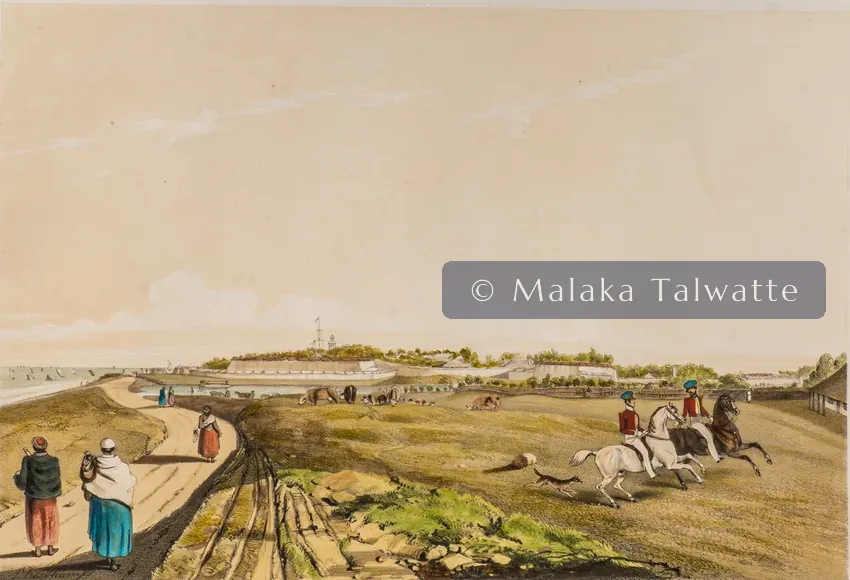
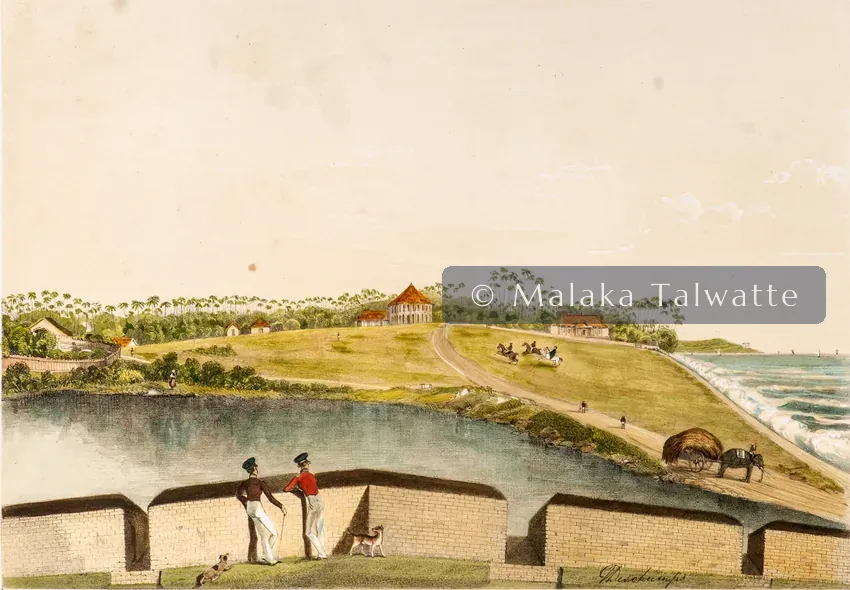
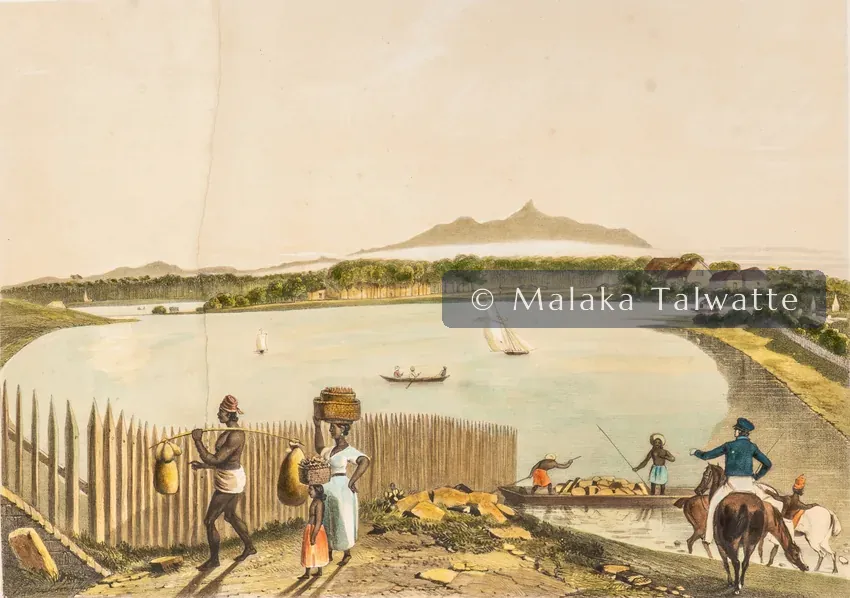
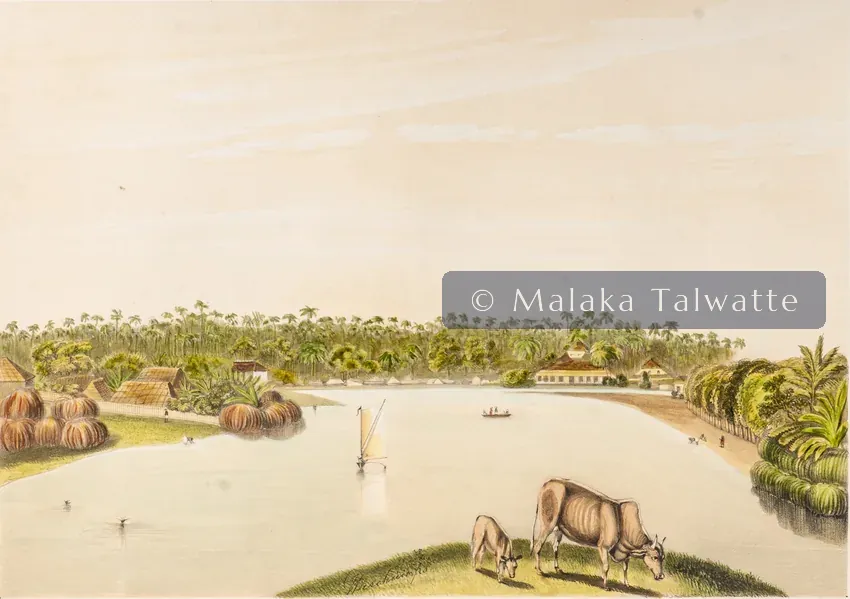
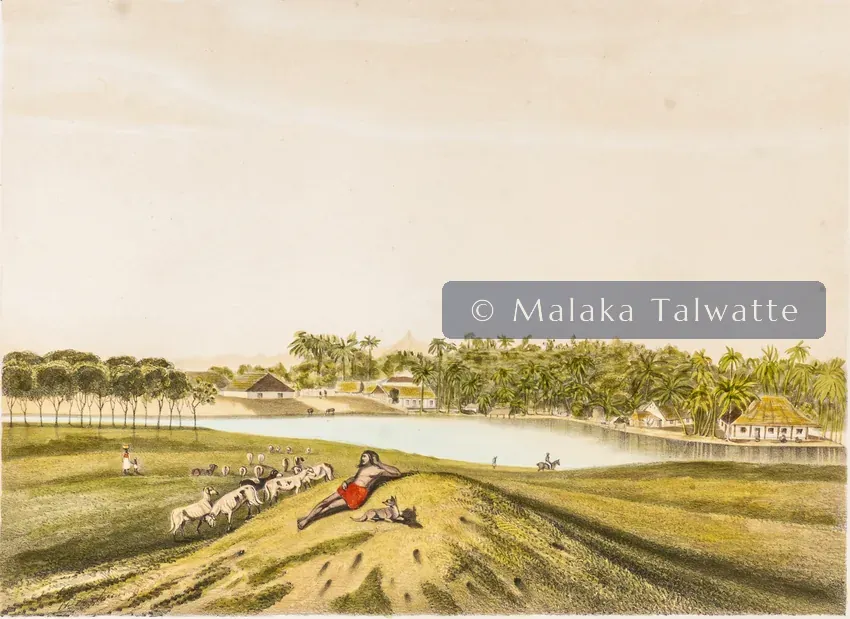
John Deschamps, The Fort of Colombo From the Galle-Face Esplanade, 1845. Lithographed. Hand coloured and heightened with varnish, 32 × 49 cm, private collection. The Fort (or, more correctly, the Town and Fort) of Colombo is situated on the west side of the Island, in lat. 7° N., and long. 79° 58'E. of Greenwich. It stands on a rocky point of land, projecting into the sea, from which circumstance it derives many advantages, both in a military and mercantile point of view, and it moreover enjoys the full benefit of the sea-breeze, which renders the air comparatively temperate and salubrious, though so near the equator. The government-house, which commands a fine view of the roadstead, is a long and capacious building of two stories, more commodious than elegant. Adjoining the garden of the government-house is the flagstaff battery, in which stands the lighthouse, one of the most elegant buildings of its kind in the world; the light is also considered by nautical men to be an excellent one. (De Silva, Rajpal Kumar. 1985. Early Prints of Ceylon (Sri Lanka) 1800-1900.)John Deschamps, The Galle-Face Esplanade, From Middleburg Counterguard, 1845. Lithographed. Hand coloured and heightened with varnish, 32 × 49 cm, private collection. Thís esplanade, or open space, on the side of the Fort towards Point de Galle (the high road to which runs through the centre of it), forms not only the principal exercising ground of the garrison, but also the general promenade of the inhabitants of Colombo and its vicinity, who repair thither morning and evening, on foot, on horseback, or in carriages, to inhale the delicious breeze which is almost always to be found by the sea-side of this part of the Island. (De Silva, Rajpal Kumar. 1985. Early Prints of Ceylon (Sri Lanka) 1800-1900.)John Deschamps, Adam's Peak and the Lake of Colombo From the Galle Barrier, 1845. Lithographed. Hand coloured and heightened with varnish, 32 × 49 cm, private collection. This view is taken just outside the barrier, on the road leading to Point de Galle and the Esplanade (one of the points already mentioned, where the lake is barely separated from the sea), a little before the setting in of the south-west monsoon - indications of which be perceived in the threatening appearance of the sky. The Peak, however, called in Cinghalese Hamalella, is the most prominent object in the Island, and is visible many leagues off at sea, in the north-east monsoon. (De Silva, Rajpal Kumar. 1985. Early Prints of Ceylon (Sri Lanka) 1800-1900.)John Deschamps, The Lake and Slave Island, From the Glacis, 1845. Lithographed. Hand coloured and heightened with varnish, 32 × 49 cm, private collection. The Lake of Colombo is a fine piece of water, supplied by several small tributary streams, and extending, as has already been said, from the glacis of the Fort, four or five miles in a north easterly direction. A native canoe being introduced, a description of these peculiar boats may here be given. Their construction is very simple, but has been allowed by scientific nautical men to be that best adapted to give the greatest swiftness to a sailing machine. In the midst of the lake stands ‘Slave Island,' so called by the Dutch from their keeping their sick and refractory slaves there. (De Silva, Rajpal Kumar. 1985. Early Prints of Ceylon (Sri Lanka) 1800-1900.)John Deschamps, Adam's Peak and Slave Island, From the Galle-Face Esplanade, 1845. Lithographed. Hand coloured and heightened with varnish, 32 × 49 cm, private collection. This view of the Peak is taken from the upper part of the Esplanade, looking across the western arm of the Lake and Slave Island, all of which having been already described, no further notice of them is necessary here. Some sheep have been introduced in the foreground to shew the character of these animals in Ceylon, and the opposite coast, from whence they are generally imported, by way of Jaffna. (De Silva, Rajpal Kumar. 1985. Early Prints of Ceylon (Sri Lanka) 1800-1900.)
He served ten years in all, from 1828 to 1838, sketching throughout before working the drawings up for the press after his return. The plates carry the eye further along that coast and a little inland: to Colpetty, to Adam’s Peak seen across the lake of Colombo, to the great elephant kraal, and to the ferry houses of the southern road. Forty-eight pages of letterpress accompany them, setting down a concise history of the island from its earliest records through the Dutch cession of 1796 to the subjugation of the Kandyan kingdom in 1815 and 1817, with notes on the dress, customs and occupations of its people; Deschamps meant the book to represent Ceylon whole, its scenery and its working life together.
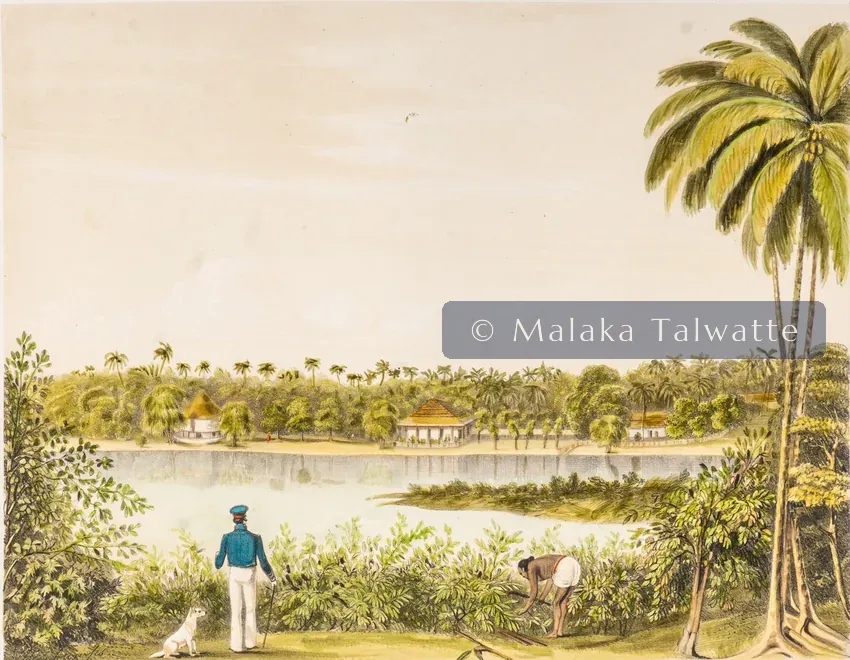
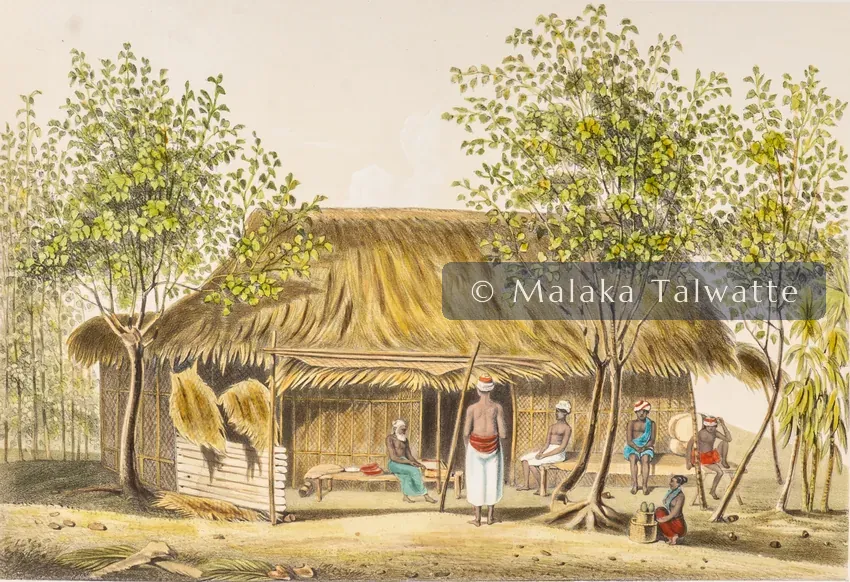
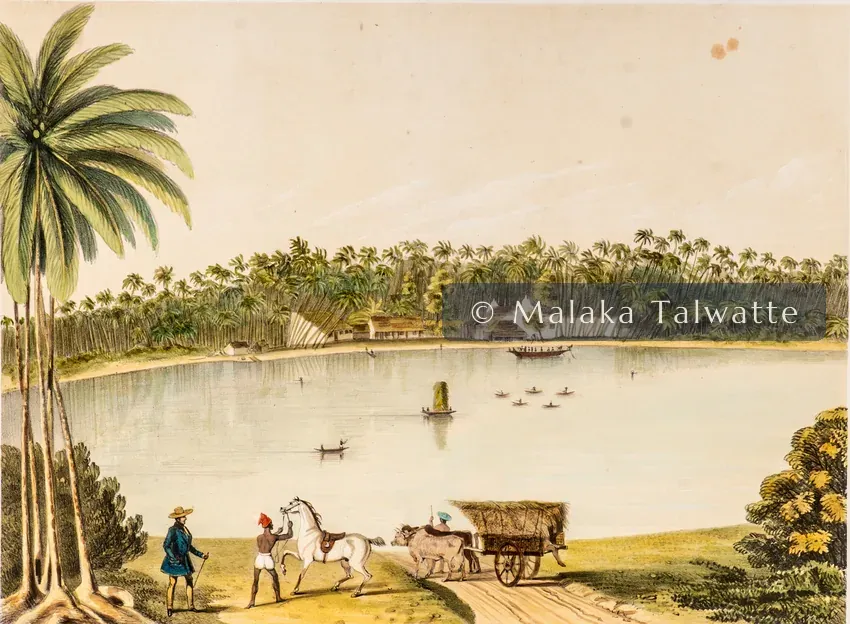
John Deschamps, Colpitty, from the Cinnamon Gardens, 1845. Lithographed. Hand coloured and heightened with varnish, 32 × 49 cm, private collection. This is a back view of the residence built and formerly occupied by Robert Boyd, Esq; one of the senior members of the Ceylon civil service, who about nine years since retired on a pension, after a long and honourable service on the island. In the foreground a man is represented in the act of cutting cinnamon for peeling, (De Silva, Rajpal Kumar. 1985. Early Prints of Ceylon (Sri Lanka) 1800-1900.)John Deschamps, The Ferry House at Pantura, 1845. Lithographed. Hand coloured and heightened with varnish, 32 × 49 cm, private collection. The village of Pantura is sixteen miles from Colombo, on the road to Point de Galle, and here is the first ferry over what is commonly called the Pantura river, but which is, in fact, an estuary of the sea. The ferry-house is a good specimen of a Cinghalese hut, being built entirely of kejhans and the wattling hereafter described. The trees afford a specimen of the hibiscus populneus, mentioned in the description of the Fort. Under the verandah sits the old ferryman counting his receipts, and on the other bench are a travelling Moorman and his cooley, with a large bale of cloth, waiting for a return of the ferryboat. In front of the hut stands a native servant, or appoo, and near him is a woman with cocoa-nuts for sale, sitting on her heels in the manner peculiar to Asiatics. (De Silva, Rajpal Kumar. 1985. Early Prints of Ceylon (Sri Lanka) 1800-1900.)John Deschamps, Buddhist Temples Near Bolgodde, 1845. Lithographed. Hand coloured and heightened with varnish, 32 × 49 cm, private collection. These Temples are distant about three miles from Pantura, on the other side of the ferry, the road winding through beautiful lanes, shaded with a variety of trees, being studded continually with cottages and gardens, and skirted by a thick jungle. The Temple, properly so called, in Cinghalese Dewalé, is situated (as the author has generally observed these structures to be) on the side of a hill, near the top; and below it are the preaching-house, built pagoda-like, and the dwellings of the priests, all beautifully shaded by noble trees, their dark green foliage contrasting finely with the whitewashed walls and red-tiled roofs. The top of the hill affords a splendid view of the Lake of Bolgoddé, which washes its base, the shores of which are covered with forests as far as the eye can reach. (De Silva, Rajpal Kumar. 1985. Early Prints of Ceylon (Sri Lanka) 1800-1900.)John Deschamps, The Ferry and Rest-House at Bentotte, 1845. Lithographed. Hand coloured and heightened with varnish, 32 × 49 cm, private collection. Bentotte is twelve miles beyond Caltura, twenty-two beyond Pantura, and thirty-eight from Colombo, on the road to Point de Galle. The road is, in most parts, good, running close to the sea-shore, which is generally low, and of a sandy soil fruitful in the production of cocoa-nut trees. The river at Bentotte is a fine stream, nearly 500 yards broad at the ferry, but shallow, except for about 150 yards in the middle, as may be conjectured from the way in which the natives are represented, fishing, in the Plate. On one of the boats may be observed a very primitive sail, formed of a single cocoa-nut leaf. On the south, or Galle side of the river, as at the other two places, is a capital rest-house, the picturesque gables of which testify that it was built by the Dutch. (De Silva, Rajpal Kumar. 1985. Early Prints of Ceylon (Sri Lanka) 1800-1900.)
Where the earlier British records of the island had been engraved as aquatints, in the manner of the Daniells and of Lyttleton, Deschamps’s views were drawn on stone, a mark of the lithographic printing then displacing the older medium. Catalogued as Abbey Travel 414, the folio is now uncommon and survives chiefly in institutional and private collections.
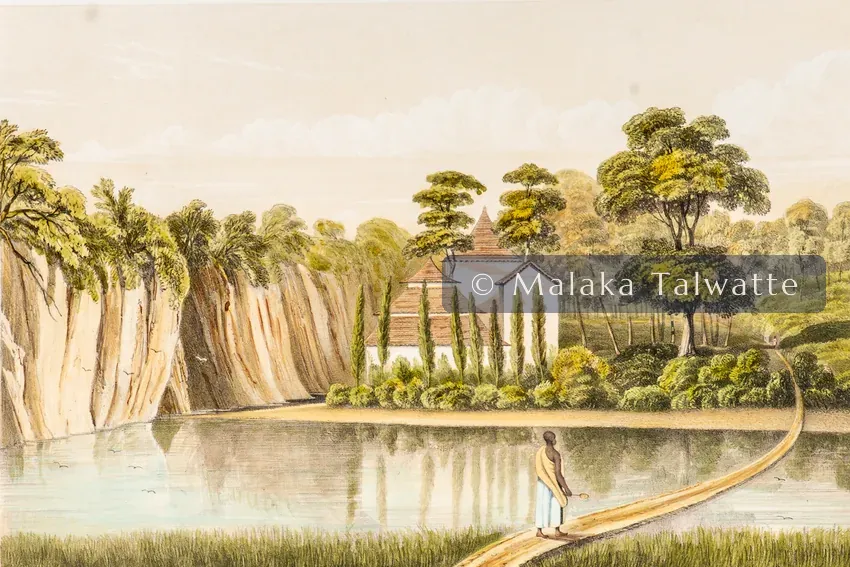
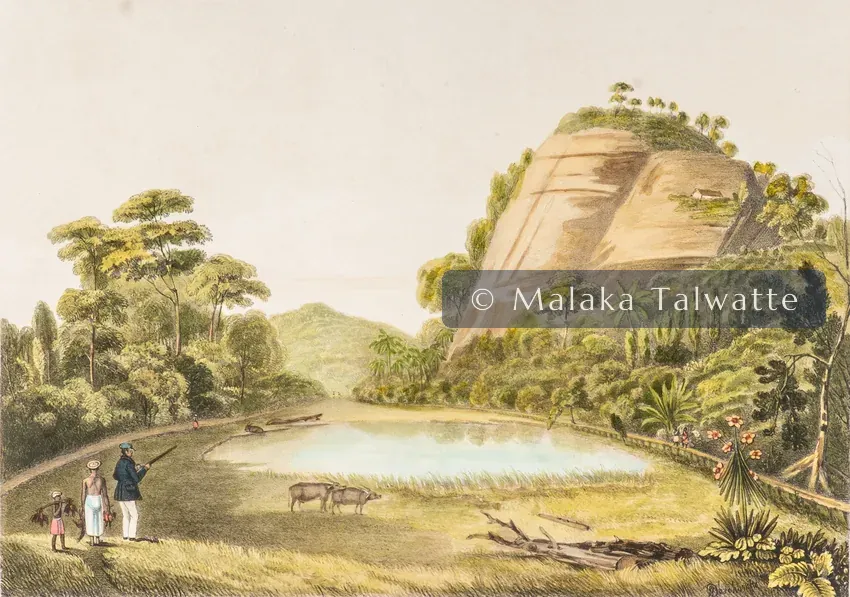
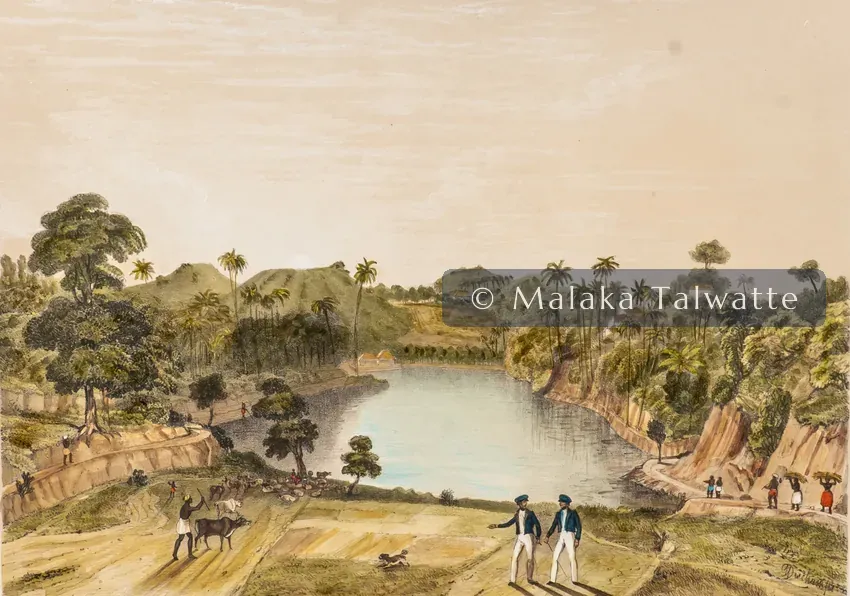
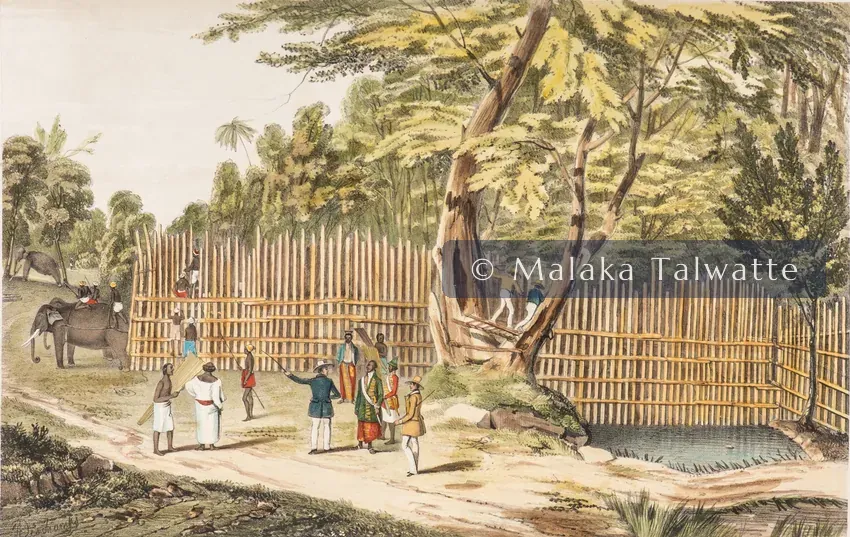
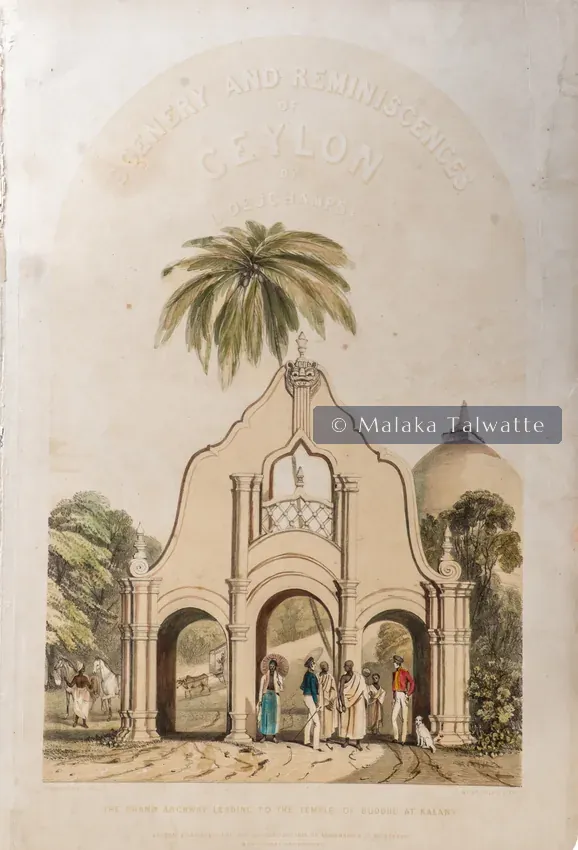
John Deschamps, The Rock of Mulkirrigalle, 1845. Lithographed. Hand coloured and heightened with varnish, 32 × 49 cm, private collection. This extraordinary mountain of rock, called by the Dutch Adam's Brecht, or Adam's Berg, is about twelve miles from Tangalle (which is 120 from Colombo), by a wretched cross-road, through narrow lanes, overgrown in places with jungle, and continually up and down hill. At Kattawatta there is a stream, about twenty yards broad, with a bridge over it. The country at the foot of the beholder is richly wooded and verdant, and watered by winding streams; this splendid view being bounded to the southward and eastward by the sea and Tangalle, and, in the opposite direction, by a fine chain of mountains, some of the Kandyan ones being just visible in the distance. On the summit of the rock is one of the white bell-shaped monuments called, in Cinghalese, Dagobah, whích are attached to almost every Buddhist temple, and are said to cover some precious relíc of that god. (De Silva, Rajpal Kumar. 1985. Early Prints of Ceylon (Sri Lanka) 1800-1900.)John Deschamps, The Lake of Kandy, 1845. Lithographed. Hand coloured and heightened with varnish, 32 × 49 cm, private collection. Kandy is seventy-two miles from Colombo, by the new and splendid road made under the direction of the royal engineer department, during the government of Sir Edward Barnes. The Lake, which lies nearly east and west, is one of the most attractive features of Kandy, being embosomed in hills which, in some parts, rise abruptly from its margin, their bases having been scarped to make the road, which runs all round it (a distance of about two miles), and forms one of the most favourite walks and drives of the European inhabitants, as well as a bathing and washing place for the natives. (De Silva, Rajpal Kumar. 1985. Early Prints of Ceylon (Sri Lanka) 1800-1900.)John Deschamps, The Great Elephant Kraal at Cottawya, 1845. Lithographed. Hand coloured and heightened with varnish, 49 × 32 cm, private collection. Cottawya is about eight miles from Tangalle, by a wretched cross-road, chiefly through paddy fields, the country, where not cleared, being covered with a low bush or jungle, abounding peacocks, jungle-fowl, deer, wild hog, and other game, from the jack-snipe to the elephant. The kraal is of triangular shape, and vast dimensions, and may be compared to a funnel, the extremity, or pipe, specially called the funnel, being just wide enough to admit one elephant, which, when once in, cannot turn, and is goaded on by the hunters through the posts. Branches of trees are heaped up on the outside to mask the inclosure, and two long lines of fires are formed on the prolongation of the wings, between which the elephants are driven to the immediate vicinity of the kraal, by a host of natives employed by the government, and, formerly, pressed for the service. (De Silva, Rajpal Kumar. 1985. Early Prints of Ceylon (Sri Lanka) 1800-1900.)John Deschamps, The Grand Archway Leading to the Temple of Buddhu at Kalany, 1845. Lithographed. Hand coloured and heightened with varnish, 49 × 32 cm, private collection. The Grand Archway still exists as depicted in the painting, with a few additional features including a flight of steps leading up to the arch. It bears examples of the traditional medieval Sinhalese architecture used above doorways and images, and is called a makara thorana. The makara thorana is an ornamental arch springing from the profiles of two makara facing each other and with a kibihi face in the position of the keystone; the intermediate space on either side is treated in several ways. Deschamps has used this plate to depict various costumes, the saffron robes worn by Buddhist priests; a horse keeper (muttu) almost certainly Tamil, is shown with the customary shawl around his head and wearing a cloth (verti); a Sinhalese man wearing a sarong and a comb in his hair; and, two European army officers. (De Silva, Rajpal Kumar. 1985. Early Prints of Ceylon (Sri Lanka) 1800-1900.)
The book behind the plates
Deschamps dated the preface to his book London, 20 December 1844, and in those few paragraphs he set down, with a soldier’s plainness, why it existed at all. He had not made it for fame. He made it, he wrote, at the urging of the friends in the civil and military services with whom he had served, men who wanted a memento of the island where many of them had passed the best years of their lives; and he made it, too, to beguile the idle hours that, for the first time in his life, hung heavy on his hands once the garrison years were behind him. A working officer for a decade, he found retirement long, and turned it to the press.
He allowed himself one hope beyond that private circle. Attention was turning to Ceylon just then, its cinnamon monopoly newly abolished and its interior lands opened for coffee planting, and he thought the book might catch a public curious about the island’s resources. He meant it, in his own frank phrase, for an ornament to the drawing-room table, and he apologised in advance for a work ‘got up… on the spur of the moment, and with great expedition’.
The twelve plates are only half of it. Bound with them are some forty-eight pages of letterpress, a concise history of the island from its earliest mention through the British conquest of the maritime provinces from the Dutch in 1795 and 1796 to the final subjugation of the Kandyan kingdom in the campaigns of 1815 and 1817, with notes on the dress, customs and occupations of its people, the statistical detail drawn, he was careful to say, from the best authorities and honestly acknowledged. He chose the views for their familiarity to anyone who knew Ceylon, and took every chance in them to show the costumes and the working life of the country, closing with the great elephant kraal, a practice he already thought falling into disuse. The whole was meant to stand for the island entire, its scenery and its people together, a garrison officer’s affectionate compendium made at speed for friends, and left, almost by accident, as one of the earliest lithographic records of Ceylon.
This essay draws on Deschamps’s own preface to Scenery and Reminiscences of Ceylon (Ackermann and Co., London, 1845).
Sources
Talwatte, Malaka. ‘19th Century Views of Ceylon by British Artists’.
Deschamps. Scenery and Reminiscences of Ceylon. London: Ackermann and Co., 1845.
De Silva, Rajpal Kumar. Early Prints of Ceylon (Sri Lanka) 1800-1900. London: Serendib Publications, 1985.
How to cite this profile
Source noteExtracted verbatim from Malaka Talwatte, '19th Century Views of Ceylon by British Artists'. Where this page reproduces a previously published essay, cite that original in preference to this page.
Malaka Talwatte, “Captain John Deschamps,” Malaka Talwatte: Sri Lankan Art and Ceylon Antiquaria, https://malakatalwatte.pages.dev/artists/john-deschamps/.
Quote and cite freely with attribution; please do not republish a whole essay, or a photograph, without permission.