Pre-modern · Artist
Joseph Lawton
Joseph Lawton was active as a photographer in Ceylon between 1866 and 1872, and it is for a single commission of those years that he is chiefly remembered. He had at first been employed by the firm of H. C. Bryde, and by the middle 1860s he had set up his own studio at Kandy. In 1870 the Archaeological Committee, which the Governor of Ceylon had established in 1868, commissioned him to photograph the principal ancient sites of the island, and across 1870 and 1871 he worked at Anuradhapura, Mihintale, Polonnaruwa and Sigiriya.
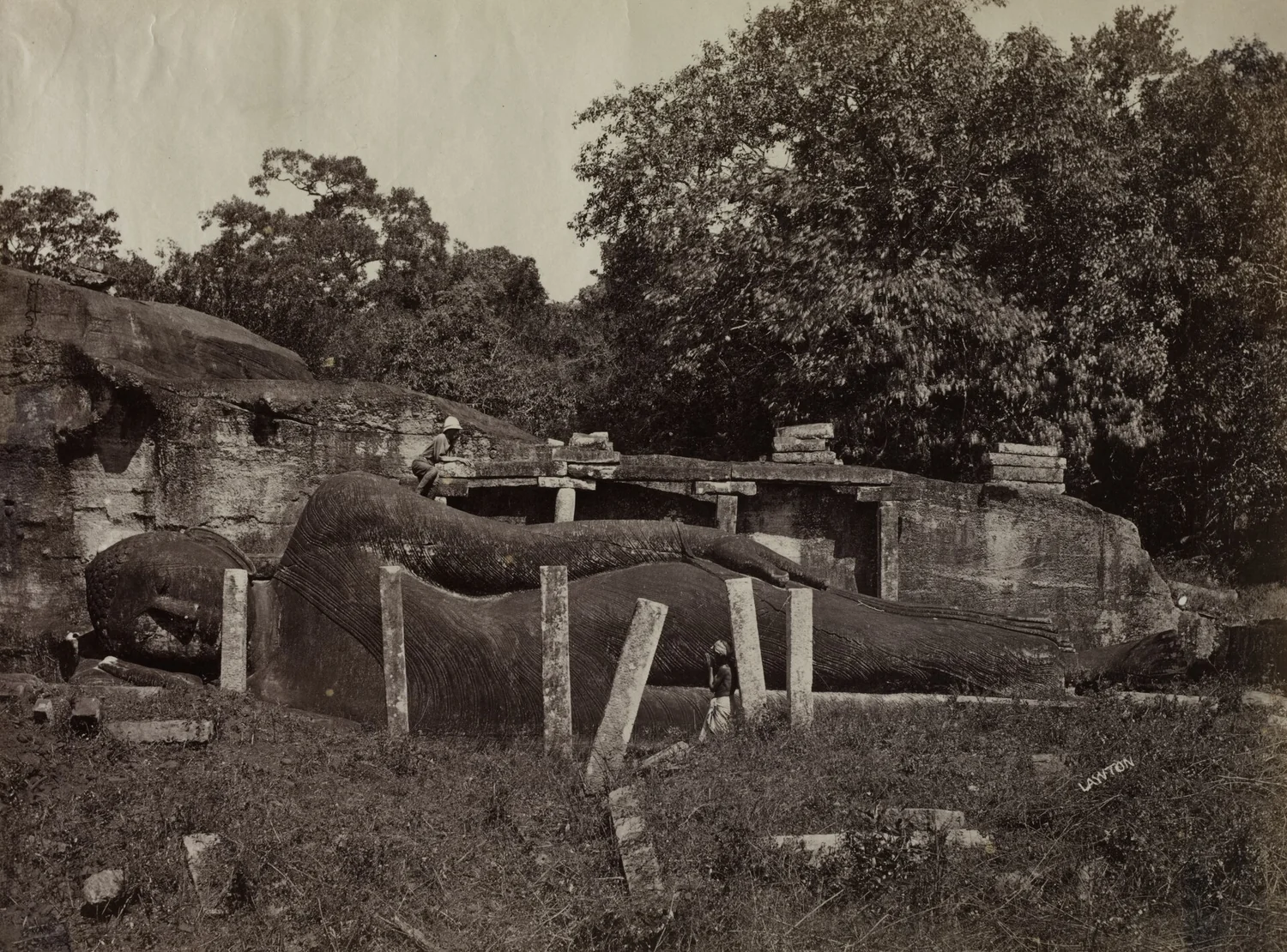
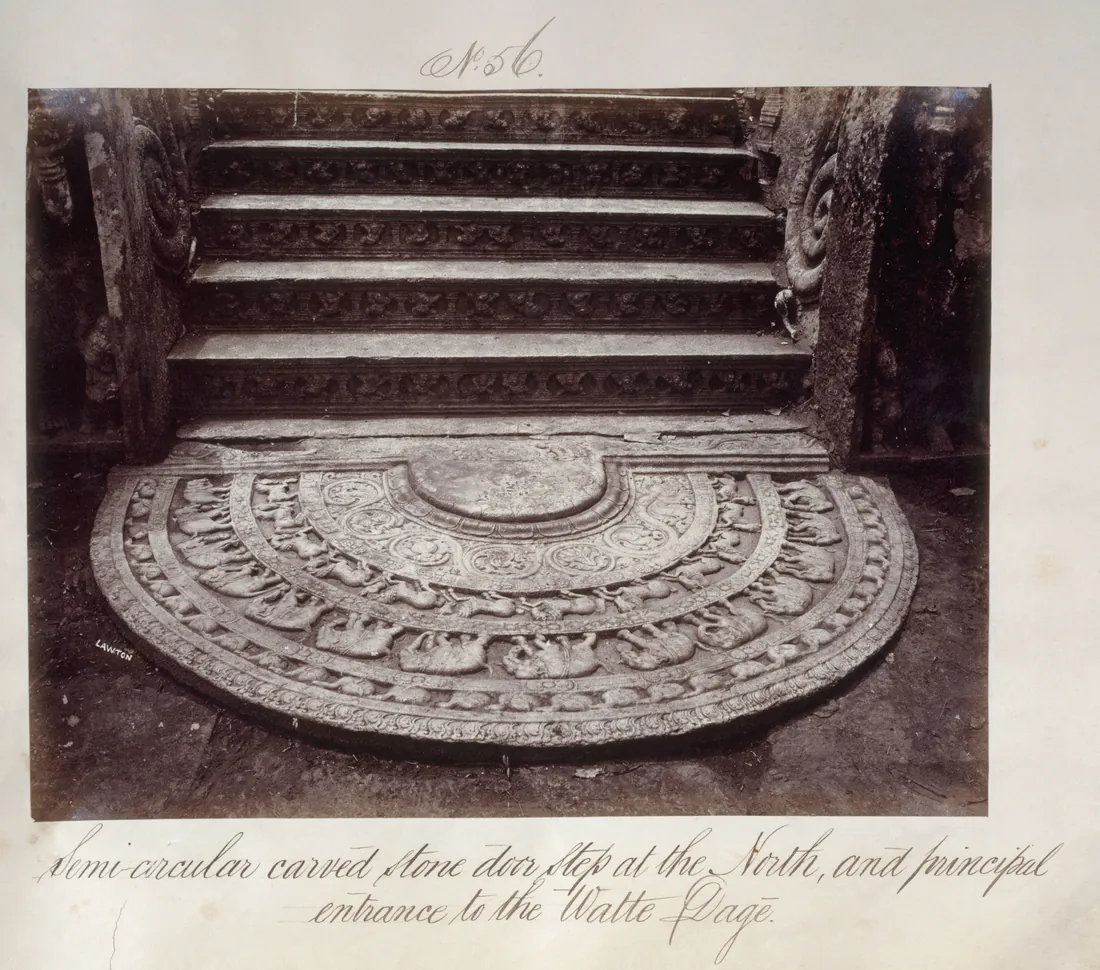
The resulting series is among the earliest sustained photographic records of the buried cities of the interior, the dagobas, the Watadage at Polonnaruwa, the rock chambers of Anuradhapura and the long stone stairways of Mihintale, many of them still half taken back by the jungle. Anuradhapura and Polonnaruwa had been the royal capitals of the island, left to the forest after the kingdom withdrew to the south-west from the thirteenth century. Lawton was a commercial photographer, and his views were framed to satisfy the antiquarian purpose of the commission and, at the same time, the traveller’s appetite for the picturesque: ruins overgrown with creepers and gnarled trees, composed for sale to visitors and to buyers overseas.
The work told upon his health. Lawton fell ill during or soon after the survey, returned to England to recover, and died there in 1872. His studio was carried on for a time by his widow, Helen, who continued to sell his photographs to the tourist market, until the business passed to R. Charter in 1885; the original negatives were later dispersed among various buyers and are now generally considered lost. Prints of the ruins survive in institutional collections, among them the Victoria and Albert Museum, the Metropolitan Museum of Art, the Pitt Rivers Museum and Cambridge University Library’s Royal Commonwealth Society collection.
Sources
- Falconer, John. ‘Nineteenth Century Photography in Ceylon’. The Photographic Collector (Summer 1981), pp. 39–54.
- Lawton, Joseph. Photographs of the ancient sites of Ceylon (1870–71). Victoria and Albert Museum, London. https://collections.vam.ac.uk/item/O175846/polonnaruwa-the-watadage-photograph-lawton-joseph/
- Lawton, Joseph. Ceylon. Ruins of Anuradhapura. Metropolitan Museum of Art, New York. https://www.metmuseum.org/art/collection/search/263177
How to cite this profile
Malaka Talwatte, “Joseph Lawton,” Malaka Talwatte: Sri Lankan Art and Ceylon Antiquaria, https://malakatalwatte.pages.dev/artists/joseph-lawton/.
Quote and cite freely with attribution; please do not republish a whole essay, or a photograph, without permission.