Transitional · Site
Kataluwa Purvarama
A three-masted ship rides a band of wavy blue water on the ambulatory wall at Kataluwa, and a file of yellow-robed figures is being handed aboard by fair-skinned boatmen in buttoned coats. Who those figures are is now among the liveliest arguments in the study of southern temple painting, and it turns on something as fine as the way a robe is worn. The panel is among the most closely looked-at stretches of wall in the maritime lowlands, and it still refuses to settle into a single agreed meaning.
The temple and its wall
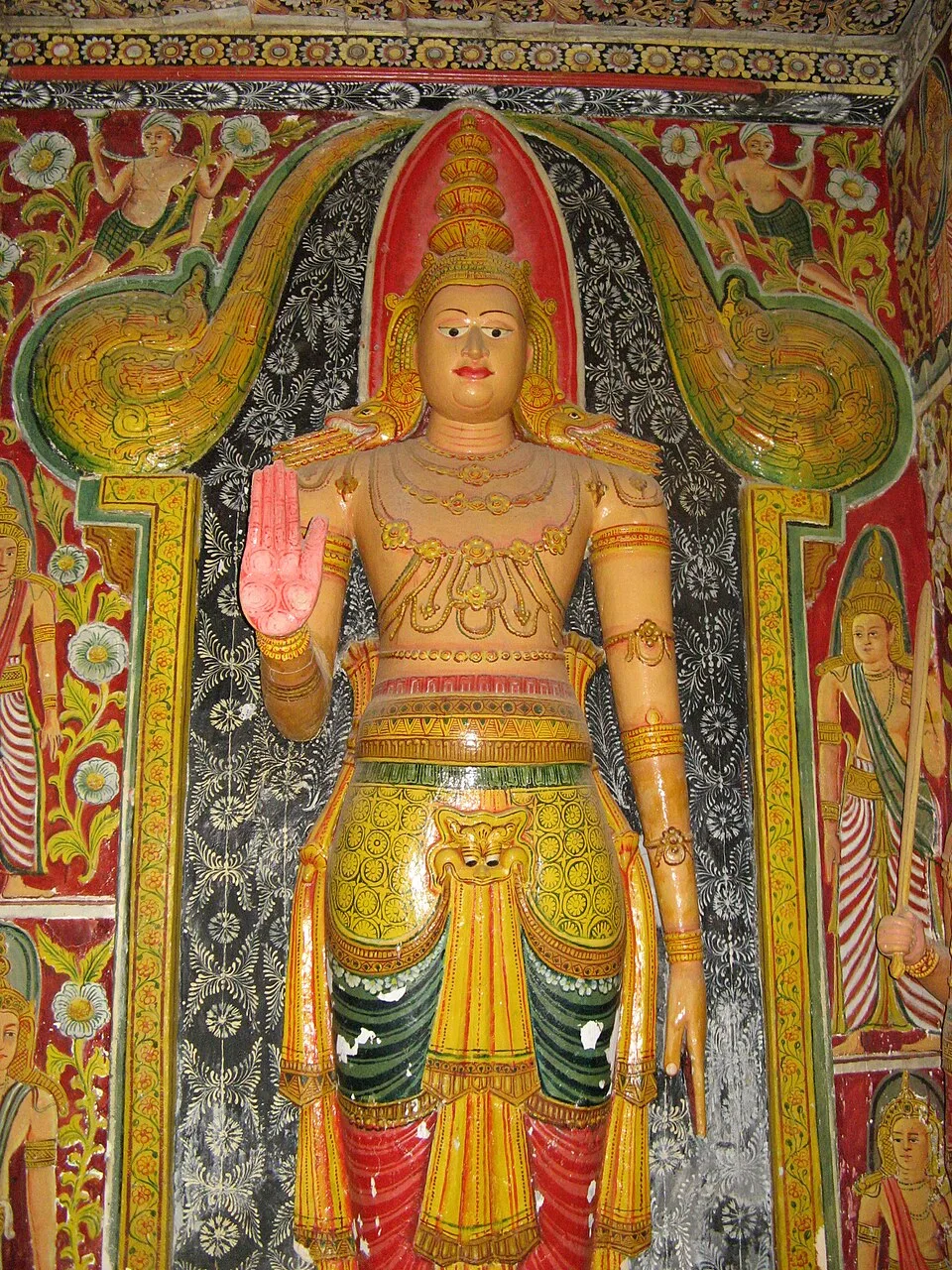
The Purvarama stands at Kataluwa, a village of the Talpe Pattuva, in the Galle district, some eighteen kilometres south of the town, and its image house holds murals long regarded as among the finest of the southern maritime region. They belong to the Southern tradition from which the Transitional Style grew, painted along the ambulatory’s outer wall, the covered path on which the devotee circles the inner shrine, in long horizontal panels meant to be read left to right, following the circuit. The manner is the one the coastal temples made their own after the Kandyan kingdom fell: the single staged scene in place of the older continuous register, a painted architecture that opens into depth, and, most tellingly, the colonial century painted straight into the sacred story. Figures sit on chairs in what the art historians call the European fashion, their feet dangling clear of the ground in the older convention; horse-drawn carriages roll through the scenes; men in buttoned coats, brimmed hats and side whiskers gather at cards and at wine beneath hanging oil lamps, some in Western shoes and jewellery; soldiers shoulder firearms; a ship stands three masts high against a blue-lined sea. Even the guardian set at the threshold is given a gun in his hand. Devotional narrative and the world outside the temple door share one surface, and few paintings anywhere set the two so frankly side by side, which is much of why Kataluwa is counted among the most eloquent things the tradition made as it turned towards the modern age. Above the entrance the image house carries a British royal crest and a painted head of Queen Victoria, and with them an inscribed date of 1886; its walls are the work of two named craftsmen of the Sittara tradition, Kadolgalle Maha Siththara and Podda Siththara, a rare record on a southern wall, where the painter more often went unnamed.
One panel, two readings
The disputed panel runs some nine or ten scenes along the outer ambulatory wall. In the volume on Kataluwa in the series ‘Paintings of Sri Lanka’ (1990), Nandana Chutiwongs, Leelananda Prematilleke and P.L. Prematilleke read it as the story of Patachara, the great Theri, the nun who, having survived every calamity that could fall on a woman, became the counsellor of women in grief; on their reading she is the nun herself, ‘dressed as a nun’ in their words, sailing with her five hundred followers, shown here as five, to be received on a far shore across the seas. It is the reading that has stood in the literature, and it has the ease of a familiar name attached to a hard image.
Asoka de Zoysa has proposed that the familiar name does not fit. His case rests first on the texts: the Patachara story as told in the thirteenth-century Saddharma Ratnavaliya of Ven. Dharmasena closes with the nun contemplating impermanence as she washes her feet, and then attaining the highest wisdom, and it carries no episode of a missionary voyage with five hundred nuns to another land, so the identification, he argues, has no literary source behind it. His second ground is the painting itself. Several of the robed figures wear the upper robe over one shoulder only, the form the essay calls Ekamsika, which he holds was never worn by nuns; their hands are taken by the boatmen as they step aboard and step ashore, a familiarity unlikely for an ordained Bhikkhuni; and where they move through public space, boarding, landing and out on the alms round, they keep both shoulders covered, the form called Ubhayamsika. Reading that robe-code against the nineteenth-century quarrel over how a monk should dress in public, the Parupana Vadaya, he reinterprets the scene as an ecclesiastical event rather than a canonical tale: the arrival home by ship of the monks of the newly founded Kalyanivamsa Nikaya, returning from a higher-ordination voyage to Ramanna, the region of Pegu, or Bago, in lower Burma, with Kataluwa serving as the fraternity’s first headquarters before it moved to the Sailabimbarama at Dodanduwa. He goes further and names the men he believes the boat carries, among them Ven. Kataluve Gunaratanatissa, who was twice refused recognition of his ordination at home on the ground of his caste and sought an uncontested one abroad, and Ven. Attudave Dhammarakkhita, drawing the account from the Sinhala history of the fraternity, the Kalyanisasana Vamsaya compiled by Ven. Polvatte Sri Buddhadatta in 1935.
The two readings sit unreconciled, and each is a position with a name on it. Chutiwongs and her colleagues give the panel to a woman of the canon; de Zoysa gives it to a company of monks and a founding voyage, and reads the wall, after Erwin Panofsky’s method, as a coded claim about which fraternity built the temple rather than as plain narration. The panel is the same; what a viewer is told to see in it is not.
The question of the date
The dating divides the scholarship as sharply as the subject does. Bandaranayake, working from style, places the murals in the 1890s, close to the 1886 inscribed on the image house itself. Working instead from the ecclesiastical history his reading uncovers, the founding of the Kalyanivamsa fraternity and the voyage to Burma that its members made in the first years of the century, de Zoysa dates the wall to the early nineteenth century. The two arguments proceed from different evidence, one from the look of the painting and one from the events it may record, and they have not been brought together; the honest position is to hold the murals to the early nineteenth century and to attribute any firmer year to the scholar who proposes it.
The queen beneath the arch
A separate colonial presence has drawn its own attention. Painted figures that read as Queen Victoria appear at Kataluwa under the makara torana, the arched surround given elsewhere to Maitreya or the Bodhisattva, and at a scatter of other southern and western temples. Vajira Nalinda Jayathilaka has gathered these images and read in them a slow political change, from a crowned and dominant figure set above the doorway to, after about 1880 and the rising of the Buddhist revival, a smaller worshipper subordinate to the Buddha, indigenised in complexion and at length painted out altogether. The identification of the figure as Victoria, and the political reading built upon it, are Jayathilaka’s, and he rests them substantially on oral tradition rather than on any documented commission, so both are best carried as his interpretation and held lightly. The queen, in any case, is a late repainting on a much older Buddhist programme; she is one element worked into the wall, not the wall’s subject, and the shrine she sits within was giving its space to the Bodhisattva long before her face was set there.
Sources
- de Zoysa, Asoka, Vajira Nalinda Jayathilaka, and Ganga Rajinee Dissanayaka. Evolving Traditions of the Buddhist Image House, Part I. Samkathana Research Team, University of Kelaniya. https://www.kln.ac.lk/units/samkathana/
- de Zoysa, Asoka, and Vajira Nalinda Jayathilaka. Buddhist Image Houses. Samkathana Research Team, University of Kelaniya. https://www.kln.ac.lk/units/samkathana/
- Chutiwongs, Nandana, Leelananda Prematilleke, and P.L. Prematilleke. Paintings of Sri Lanka: Kataluwa. Series ‘Paintings of Sri Lanka’. Central Cultural Fund, 1990. https://search.worldcat.org/search?q=Paintings+of+Sri+Lanka+Kataluwa+Chutiwongs
- Bandaranayake, Senake. The Rock and Wall Paintings of Sri Lanka. Colombo: Lake House Bookshop, 1986. https://search.worldcat.org/search?q=Rock+and+Wall+Paintings+of+Sri+Lanka+Bandaranayake
How to cite this profile
Malaka Talwatte, “Kataluwa Purvarama,” Malaka Talwatte: Sri Lankan Art and Ceylon Antiquaria, https://malakatalwatte.pages.dev/artists/kataluwa-purwarama/.
Quote and cite freely with attribution; please do not republish a whole essay, or a photograph, without permission.