Contemporary · Artist
Koralegedara Pushpakumara
On the beams of the Ambekka shrine near Kandy there is a knot, cut into the timber by woodcarvers centuries ago, and Koralegedara Pushpakumara takes that same knot and lays it across a field of barbed wire. He was raised among carvers, and the ornament he grew up watching becomes, in his hands, a way of holding a country’s grief in place: the decorative motif and the instrument of confinement pressed into one surface, so that an inheritance and an injury are made to share a frame. To see why a painter should bring temple carving to the memory of war, you have to begin in a carpenter’s house in the hills.
He was born in 1968 in the hill-country district of Kandy, into a family of carpenters. The craft was in the house before the art was, and his first attraction was to woodwork and carving rather than to paint; the celebrated timber carving of the Gadaladeniya and Ambekka temples near his home became an early and lasting source. That vernacular of the chisel, kept at the margins of the fine-art academy, is what he would later carry into the gallery. He took his BFA in painting and sculpture from the Institute of Aesthetic Studies at the University of Kelaniya in 1997, and went on to study archaeology and the history of art at the same institution, a training that shows in the way he reads objects as carriers of the past.
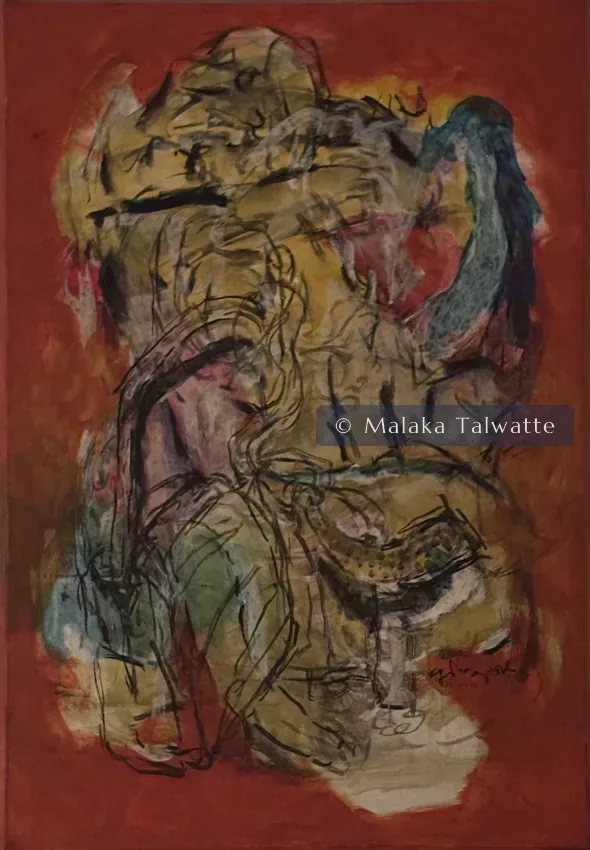
He belongs to the generation that changed Sri Lankan art from within. He exhibited with the No Order Group in the 1990s and stands among the early artists of the ‘90s Trend, the politically charged movement that answered the civil war with performance, installation and a new directness; in 2000 he became a founding member of the Theertha International Artists’ Collective, the institution that has housed much of that work ever since. He is a painter first, though he moves freely into printmaking, sculpture, installation and conceptual practice, and he has worked for decades as a set and production designer for theatre and film alongside the studio.
The paintings are where the knot does its work. They turn on the memory of the war and on the way a society disposes of what it would rather forget, and the ‘Goodwill Hardware’ series, first shown at the Red Dot Gallery in Colombo in 2009 and later at the Colombo Art Biennale, is where that argument is clearest: the everyday materials of the hardware shop, wire, blades and fastenings, are set against the ornamental language of the temple, until the tools of restraint acquire the weight of iconography. The point beneath is plain: he refuses the quiet erasure of suffering from public memory, and he uses the oldest craft of his region to resist it. His work has travelled to group exhibitions and artists’ workshops in India, Sweden, Pakistan and the Netherlands.
The carver’s son who once studied the beams of a Kandyan devalaya now cuts his own marks into the harder timber of recent history, and the knot still holds.
Sources
- Ocula, artist profile.
How to cite this profile
Malaka Talwatte, “Koralegedara Pushpakumara,” Malaka Talwatte: Sri Lankan Art and Ceylon Antiquaria, https://malakatalwatte.pages.dev/artists/koralegedara-pushpakumara/.
Quote and cite freely with attribution; please do not republish a whole essay, or a photograph, without permission.