Classical · Site
Kuttam Pokuna
Two bathing ponds lie side by side in the Abhayagiri monastery at Anuradhapura, cut in dressed granite and fed by a hidden system of channels, and they are admired as much for how the water reached them as for the stone that holds it. The Kuttam Pokuna, the twin ponds, were made for the monks, and the classical mason gave a plain sanitary work the finish of architecture: long flights of cut steps descending into each pool, the two set end to end, the smaller some twenty-eight metres long and the larger forty, both fifteen and a half metres wide and four and a half deep; the water was drawn from a distance, run through a silt-trap to settle it clean, and let into the ponds through a carved spout, the overflow led off to water the rice fields below.
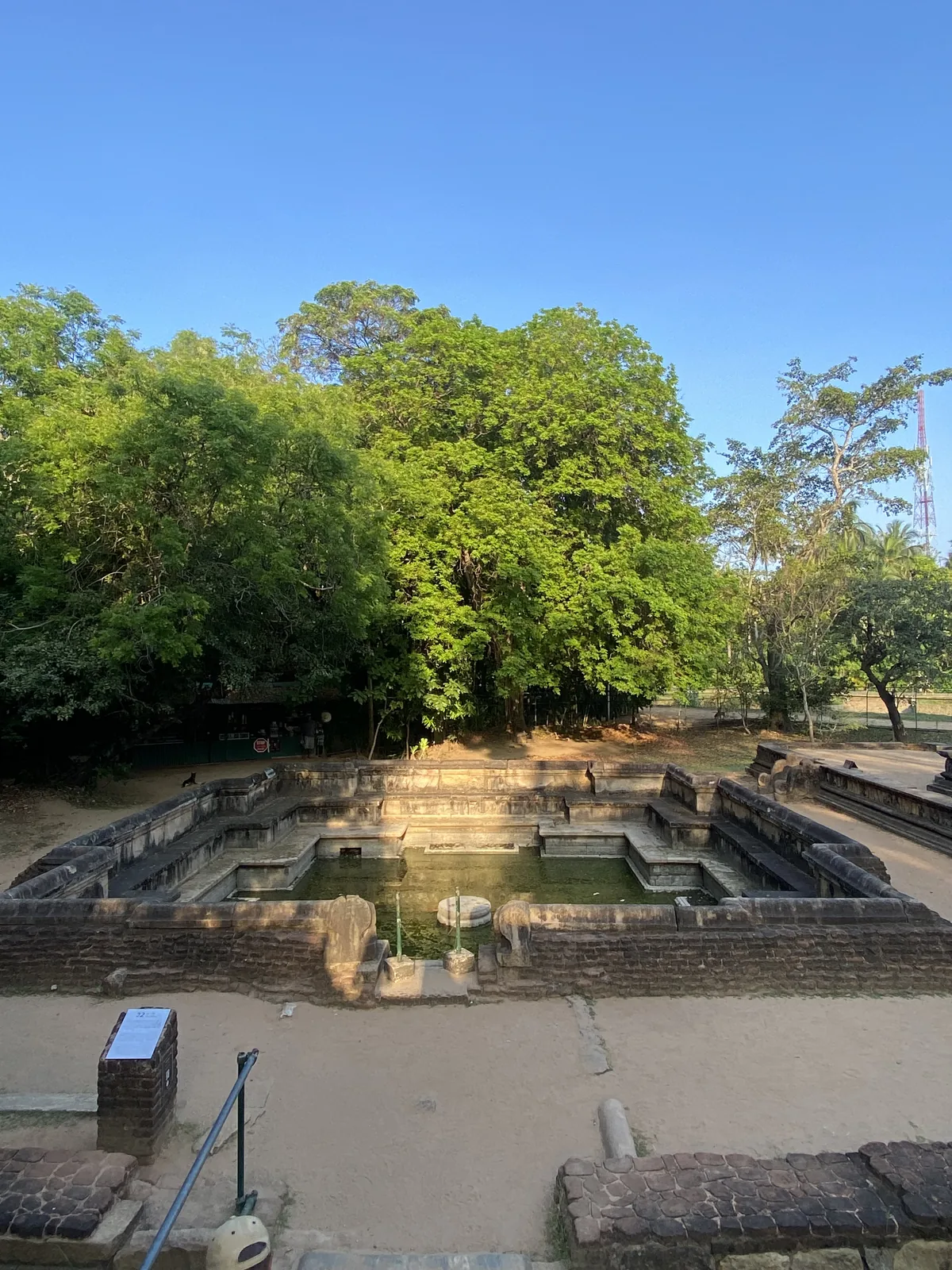
The art of the place gathers at the head of the smaller pond. There, under a makara arch, stands a stone stele carved with a five-hooded naga, the cobra-king who is the guardian of water, set where the water enters as though he brought it; pots of plenty, the punkalasa, are cut on the entry steps, the same wish for abundance the guardstones carry at a temple stair. The whole is granite, squared and laid without mortar, the steps meeting the water in clean tiers.
When the ponds were cut is not fixed. They are given by some to King Aggabodhi in the late sixth or early seventh century and by others, on the style of the carving, to the eighth or the ninth; the honest span is that range. The engineers and masons who ran the water and cut the naga are unknown, as all of them are, and the Kuttam Pokuna stands as the classical island’s proof that a thing made to be useful could be made beautiful, the sanitation of a monastery raised to the level of its shrines.
Sources
- Bandaranayake, Senake. Sinhalese Monastic Architecture. Leiden: Brill, 1974.
- Department of Archaeology / Central Cultural Fund, Anuradhapura.
- UNESCO World Heritage Centre. ‘Sacred City of Anuradhapura’ (inscribed 1982).
How to cite this profile
Malaka Talwatte, “Kuttam Pokuna,” Malaka Talwatte: Sri Lankan Art and Ceylon Antiquaria, https://malakatalwatte.pages.dev/artists/kuttam-pokuna/.
Quote and cite freely with attribution; please do not republish a whole essay, or a photograph, without permission.