Classical · Site
The Lankatilaka Image House
Between two walls of brick seventeen metres high, roofless now to the sky, a colossal Buddha stands headless at the end of a long corridor, and the ruin of the Lankatilaka is among the most imposing things Polonnaruwa keeps. It is a gedige, a vaulted image-house of brick, raised by Parakramabahu I in the twelfth century as the great shrine of his Alahana Pirivena monastery, and though its brick vault has fallen the two towering side walls still stand, so the visitor walks up the aisle between them to the figure at the end as the worshipper once did.
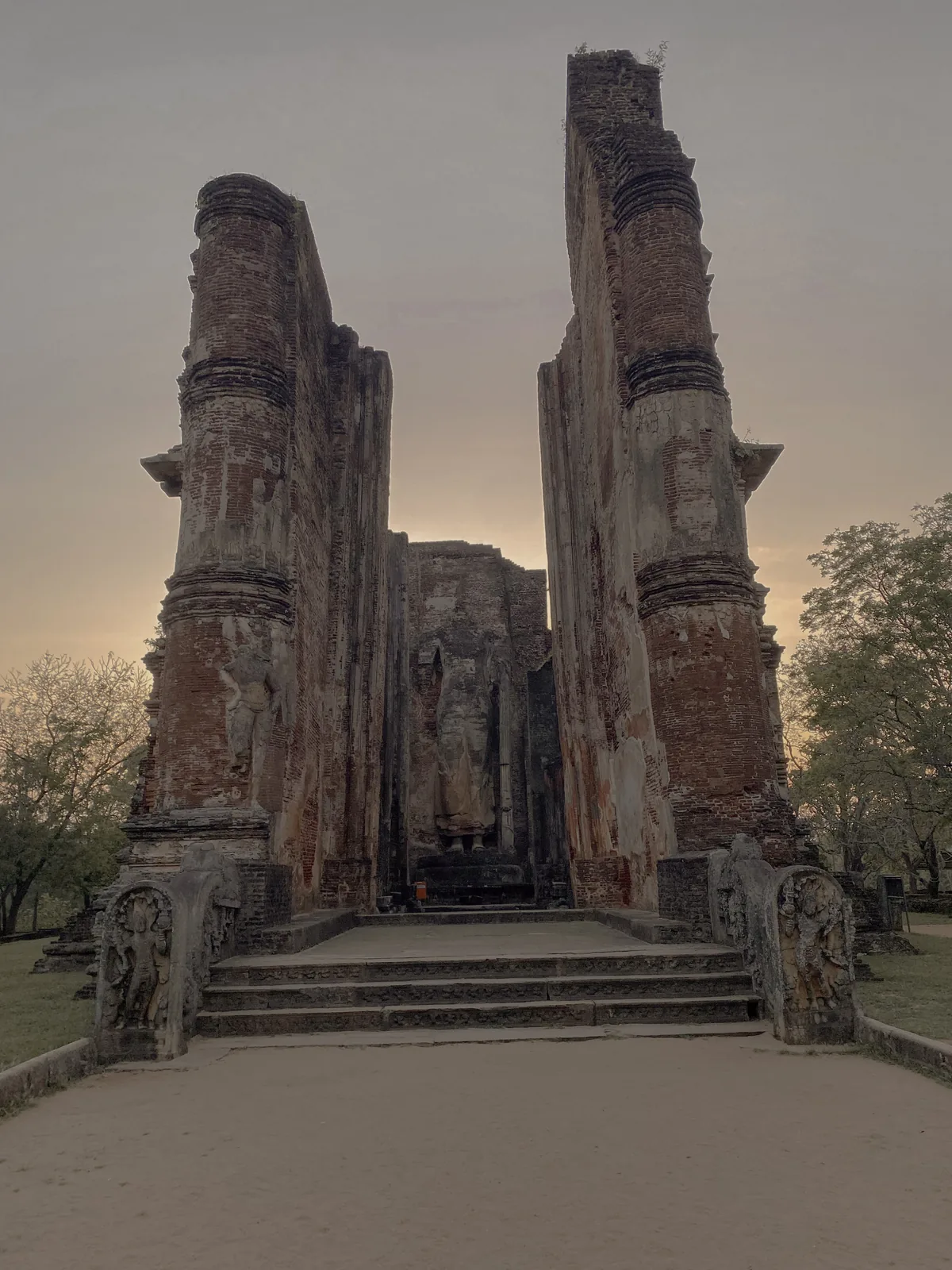
The Buddha is built, not carved, of brick and stucco, and it rose once to some thirteen metres; the head and shoulders are gone and the great standing body remains, filling the space between the walls. The walls themselves are the other wonder. On the outside they are worked in tier upon tier of pilastered niches, false storeys climbing the brick, so the image-house presents itself as a many-storeyed mansion, the storeyed-palace form the Polonnaruwa builders liked, all of it in moulded and cut brick rather than stone.
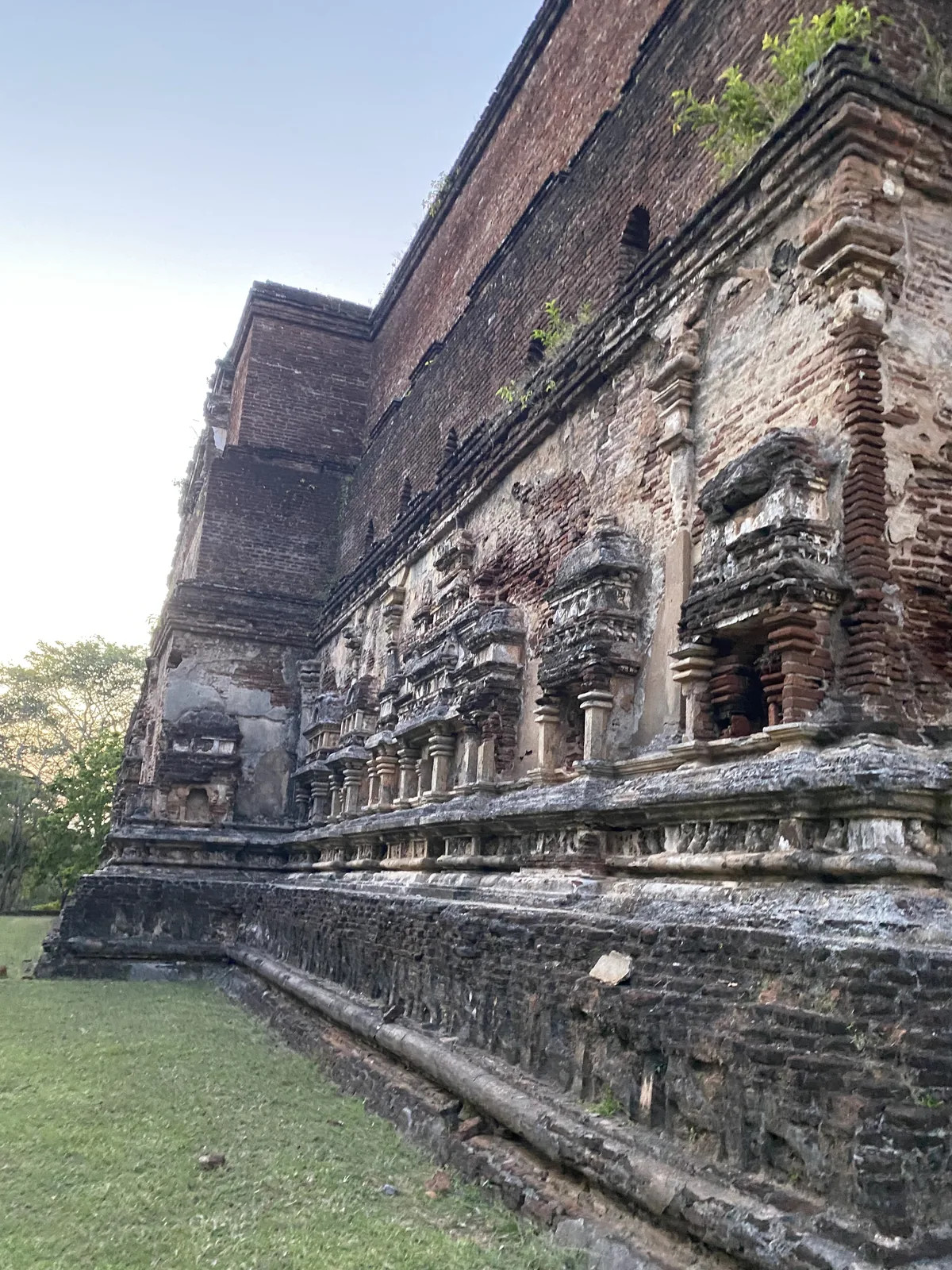
The vault that once closed it was built as the Sinhalese built their vaults, in corbelled brick, each course stepped a little further in than the one below until the two sides met, for the island’s masons kept to the corbel rather than the true arch. The same building holds at Polonnaruwa in the Thuparama gedige, smaller and luckier, whose brick vault has survived where Lankatilaka’s fell. Tradition has the shrine restored after the troubles of the thirteenth century, under Vijayabahu IV, though the record for that is thin.
Of the builders and the image-makers nothing is known, as nothing is anywhere in the classical age. What Lankatilaka keeps is scale, and the ruin of scale: a Buddha of brick as tall as a house, headless at the end of its roofless hall, and the two great walls that held it, standing open to the weather eight centuries after the roof came down.
Sources
- Bandaranayake, Senake. Sinhalese Monastic Architecture. Leiden: Brill, 1974.
- Paranavitana, Senarath. A Guide to Polonnaruwa. Colombo: Department of Archaeology, 1950.
- Schroeder, Ulrich von. Buddhist Sculptures of Sri Lanka. Hong Kong: Visual Dharma, 1990.
- UNESCO World Heritage Centre. ‘Ancient City of Polonnaruwa’ (inscribed 1982).
How to cite this profile
Malaka Talwatte, “The Lankatilaka Image House,” Malaka Talwatte: Sri Lankan Art and Ceylon Antiquaria, https://malakatalwatte.pages.dev/artists/lankatilaka/.
Quote and cite freely with attribution; please do not republish a whole essay, or a photograph, without permission.