Classical · Site
Lovamahapaya
Between the Sri Maha Bodhi and the Ruwanwelisaya stands a field of stone columns, close-set and bare, and they are the surviving skeleton of one of the wonders of the classical city: the Lovamahapaya, the Brazen Palace, the great assembly-hall of the Mahavihara. It was raised by King Dutugamunu in the second century before Christ as the uposathaghara, the chapter-house where the community of monks gathered for its formal acts, and it took its name from the metal that crowned it, a roof sheathed in bronze tiles that gave the building its brazen gleam.
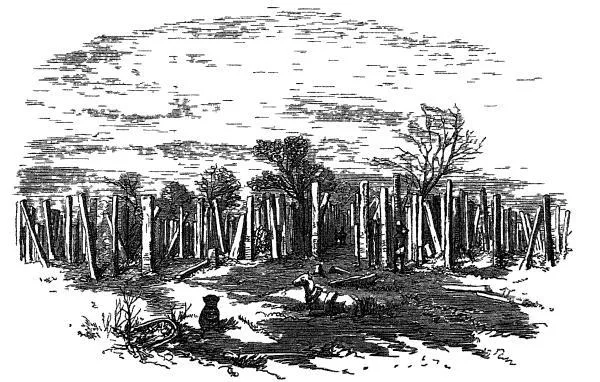

The form was timber above stone, and its scale belongs half to fact and half to the chronicle. The Mahavamsa describes a tower of nine storeys and some nine hundred chambers, its interior rich with ivory and gem-work and a hall of coral and silver, an account to be read as an ideal of magnificence as much as a measured elevation. What is certain is the plan at ground level: a great raised platform carrying a grid of monolithic granite pillars, some sixteen hundred of them in forty rows of forty, on which the many-storeyed wooden building once rested. Bronze roof, timber frame and a stone forest for a foundation, it was among the most ambitious structures the island had attempted.
Timber and fire do not keep. The building burned in the reign of Dutugamunu’s brother Saddhatissa, who rebuilt it on a lesser scale, and it was raised and repaired again by later kings across the centuries. In the turmoil of the third and fourth centuries, when the orthodox Mahavihara fell from royal favour, the hall was even dismantled and its materials carried off to enrich the rival Abhayagiri. The pillars that stand today are not as the first builders set them; they are a later re-erection, crowded closer than the original bays, so that the visitor reads the ground-plan of the vanished tower rather than its true spacing. Even so the field of columns keeps the memory of the whole, and the Lovamahapaya remains one of the Atamasthana, the eight great places of veneration of the sacred city.
Sources
- The Mahavamsa.
- Bandaranayake, Senake. Sinhalese Monastic Architecture: The Viharas of Anuradhapura. Leiden: Brill, 1974.
- Coomaraswamy, Ananda K. Medieval Sinhalese Art. 1908.
- UNESCO World Heritage Centre. ‘Sacred City of Anuradhapura’ (inscribed 1982). https://whc.unesco.org/en/list/200/
- Ponnamperuma, Senani. The Story of Anuradhapura.
How to cite this profile
Malaka Talwatte, “Lovamahapaya,” Malaka Talwatte: Sri Lankan Art and Ceylon Antiquaria, https://malakatalwatte.pages.dev/artists/lovamahapaya/.
Quote and cite freely with attribution; please do not republish a whole essay, or a photograph, without permission.