Modern · Artist
L. T. P. Manjusri
High on a scaffold in a village temple, a young monk copies a fading fresco brushstroke by brushstroke, racing a slower kind of vandalism: the whitewash and the cheap repainting that were erasing the old wall paintings of Ceylon. The monk was L. T. P. Manjusri, and the copying he began in the mid-1930s grew into the work of a lifetime. Across half a century he saved a vanishing art by hand, and out of the saving of it made an art of his own.
The monk and the scholar
He was born Lokukankanamge Thomas Peiris in the coastal village of Alutgama on 28 October 1902, and entered the Buddhist order as a novice at the age of thirteen. The name Manjusri, that of the bodhisattva of wisdom, came to him later and stayed for life, in time becoming his family surname. At the Mangala Pirivena near Alutgama he read Sinhala, Pali and Sanskrit and wrote verse in all three, and he came up there among a remarkable company of young monks of the Buddhist revival: the poet Tibet S. Mahinda, the poet and politician later known as Sagara Palansuriya, and the scholar Walpola Rahula, author of What the Buddha Taught. The languages and the learning stayed with him, and surfaced long afterwards in the journalism of his lay years.
Santiniketan, and the turn to the brush
Painting came to him late, and almost by accident. In 1932, at the age of thirty, he travelled to Bengal to study at Santiniketan, the school Rabindranath Tagore had founded, meaning to read Mahayana philosophy and to learn Chinese so that he could translate Buddhist texts; art formed no part of the plan. There he fell to watching the outdoor painting classes, made friends with Nandalal Bose, the school’s master of painting and one of the founders of Indian modernism, and took up the pen and brush on his own, with Bose’s encouragement. On a vacation home in 1934 he spent twenty-one days tracing the murals of the Sunandarama Vihara near Ambalangoda and a month reproducing them in colour, and it was these copies that caused a stir when, in 1935, they were hung along one wall of a Santiniketan exhibition, with Tagore’s own paintings facing them across the room. Harry Pieris, the Ceylonese painter then teaching at the school, was so struck by them that when Manjusri offered to give them to the academy he insisted instead that they go home to the island, and bought them; that first body of copies is now at the Sapumal Foundation in Colombo. Tagore, questioning the young monk about his purpose, is said to have called him ‘a modern Buddhist priest’. That exhibition, and the friendships it made, turned a scholar-monk into an artist. His years in Bengal left him at home in the language, and he would later turn Tagore’s Gitanjali and the play The Post Office into Sinhala.
As far as Gangtok
In 1937, helped again by Harry Pieris, he set out from Bengal for Tibet, to study its Buddhist art at the source. The politics of the frontier stopped him at Gangtok, in Sikkim, and he never crossed into Tibet itself. There, from a Tibetan master he named as Abbot Uchima, he received the only formal instruction in painting he was ever given, and the months among the Tibetan murals marked him deeply. The firm unbroken contour and the crowded iconographic detail of that tradition entered his own hand, and he painted Tibetan deities and subjects for the rest of his life. In one undated watercolour, Marayuddaya, the Buddha’s victory over the demon Mara, he set a Buddha in the Kandyan manner against a ground of Tibetan gods and cloud, a deliberate joining of the two schools he had studied.
The salvage
He came home to the island in 1937 with his eye changed. He saw the old temple walls with a new attention, and saw at the same time how fast they were going, to whitewash, to clumsy repainting, to plain neglect, and out of that double sight came the work of his life. In 1949, after a photograph taken on board a ship showed him in lay dress and word of it reached home, he gave up his robes altogether and set out as a painter and a journalist, free at last to travel and to copy. He married in 1955, at the age of fifty-three; he and his wife, Mangala, had three children, Kushaan, Manjista and Mandalika, born between 1956 and 1960, who would all become artists. He went the length of the country, setting down on paper what survived on crumbling walls before it could be lost, and he wrote to make the public care, more than a hundred and fifty articles in Sinhala and some fifty-five in English on the frescoes of Sigiriya and the drawn line of the Kandyan temples. As a journalist at Lake House, writing first for Lankadeepa and then for Silumina, Janata, the Observer and the Daily News, he ranged across Sri Lankan and Asian art, the Ajanta caves and Mughal painting, reading the region in a way few of his colleagues could. In 1960 the Arts Council of Ceylon set him and the scholar Siri Gunasinghe to survey the island’s temple paintings, and their report found many on the verge of oblivion; he corresponded, too, with Ananda Coomaraswamy, whose cause of preservation he had taken up. One find of those years stood apart: in 1942, in the Yala jungles at Karambagala, he came upon a fragment of temple fresco reaching back to the second century before Christ, among the oldest survivals of wall-painting on the island and proof that the tradition he was recording ran centuries deeper than Sigiriya itself. The copying kit had nearly cost him his freedom: in the war years he was seized near Yala as a suspected Japanese spy, his maps, binoculars and torch taken for a spy’s tools, until the American intelligence chief in Ceylon, the ornithologist Sidney Dillon Ripley, cleared him and became a lifelong friend and patron; Ripley, later Secretary of the Smithsonian, would help carry his work to America.
The drawn line
His method began and ended with the line. Manjusri held that the essence of the late Kandyan wall paintings lay in their contour, the drawn line that carried the form before any colour was laid over it; these were, he liked to say, drawings to which colour had been added, and it was the line he set out first to preserve. His procedure varied with the wall in front of him: sometimes he pinned a long transparent sheet against the mural and traced it directly, sometimes he reduced the painting with a camera and drew from the reduction, sometimes he made a free sketch. In every case he studied the original minutely and reworked his drawing against it, and where the plaster had decayed he interpreted, and now and then reconstructed, recovering the spirit of the wall as it had first been painted while keeping faith with its weathered condition, its colour and its surviving vitality of line. His copies, people told him, were ‘not flat or dead’, and he thought this close scrutiny was the reason.
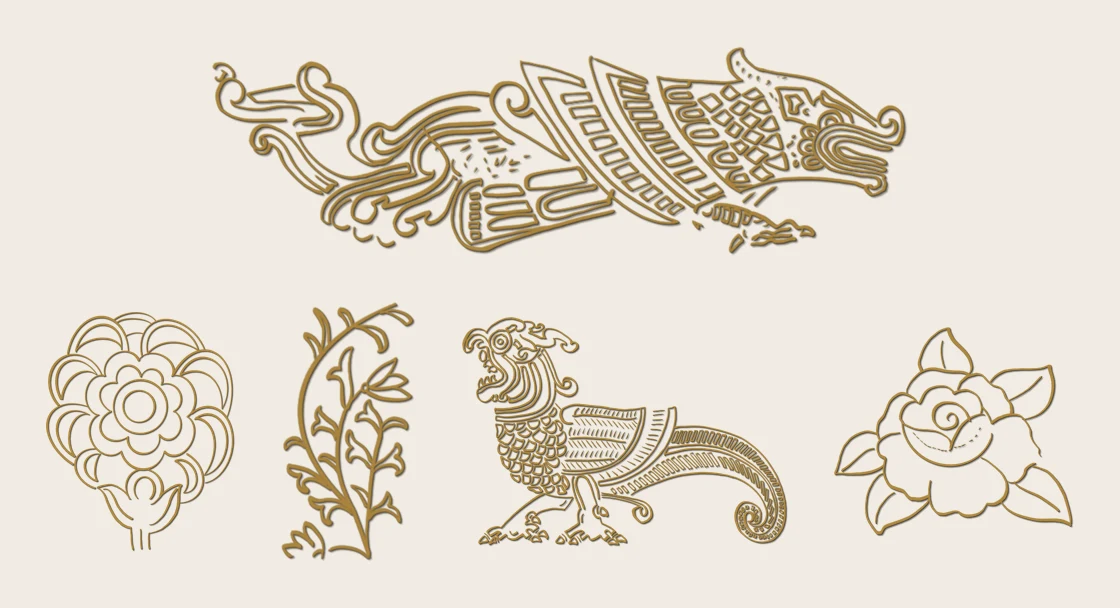
He owned a camera and used it to help the work, but tracing and re-drawing forced a study the shutter could not. The knowledge it yielded, of how a composition was built, how a motif had descended, whose hand had made a particular wall, would otherwise have stayed locked in the plaster. Over the decades he gathered hundreds of line drawings, tracings and colour copies, some cut to the size of a picture frame, others carried on long scrolls, from temples the length and breadth of the country. From that archive he distilled Design Elements from Sri Lankan Temple Paintings, published in 1977 for his seventy-fifth birthday: one hundred and fifty-nine plates of motifs, more than sixty of them given to flowers and floral sprigs alone, the rest to fruit and foliage, birds, beasts and fish, textile and somana patterns, ola-leaf book covers, pillars and roofs, dress, and the figures of kings, devotees, arahats, bodhisattvas and Buddhas. It was the first systematic account of the decorative language of the tradition and, after Coomaraswamy’s Mediaeval Sinhalese Art of 1908, the most substantial book written on it; uncommonly, it was printed in all three of the island’s languages, Sinhala, Tamil and English. Reviewing it in 1980, J. R. Marr regretted only that the motifs and their origins had not yet been studied analytically, and hoped later scholars would take that up.
His own painting
‘I will go on experimenting until I am fully satisfied,’ Manjusri told his friend G. P. Malalasekera in 1947, ‘I hope that will never happen.’ The remark is the truest guide to his own painting, which refuses to hold still across a working life of half a century. His hand is economical and calligraphic, the human figure set down in a few sure strokes. The earliest surviving pieces, made around 1934, are postcard-sized studies of Santiniketan life in pencil, crayon and watercolour. Alongside them run loose impressionist landscapes, palms and huts dissolved into warm ochre and brown, and a stranger group of near-abstract works crowded with hands, fish and animals, close at moments to Cubism; one of these carries the date 1934, which would make him a modernist of surprising precocity and which his cataloguers have found hard to reconcile with the tentative studies around it.
The mature colour works of the 1970s reach a different register altogether. The Metropolitan Museum of Art in New York holds four of his watercolours, all given in 2016 by the American collector Linford Lougheed, who had bought them from the artist, among them Nun and Noble Female Devotee, in which a jewelled laywoman is posed after the celestial dancers of the old Sigiriya paintings against a muted grey wash that suggests the inside of a shrine room. Kitchen Scene, dated 1979, sets four women at their work in an open kitchen of red walls and blue beams, fruit hung from the rafters, one girl astride a coconut scraper, the group set on the warm speckled ground of a temple wall; the museum’s curator of South and Southeast Asian art, John Guy, reads their skirts in the traditional manner, with the saw-tooth tumpal panel and a floral repeat across the field. Lovers, of 1977, binds a man and a woman together under a single translucent shawl, its border embroidered with the sacred goose, the hamsa; Guy takes the motif for the two strands of Manjusri’s own life, the monk and the householder, drawn together in one cloth. Watchers of the late work have caught, in some canvases of these years, an echo of Gustav Klimt’s Vienna, whose galleries he had visited in 1948. His watercolours are held, too, by the New York Public Library and Columbia University, the Columbia sheet a scroll of the Katthahari Jataka copied from the eighteenth-century Kataluwa fresco, bought for the library by the collector Dallas Pratt.
The ’43 Group, and a wider public
The first exhibition of the ’43 Group opened in November 1943 at 525 Darley Road in Maradana, in a shed roofed with sheets of corrugated iron, and it announced the birth of modern art on the island. The war artist John Napper, scathing about the Group when it first exhibited, made one exception and named it: Manjusri, he wrote, was ‘the only man in the group who sees things through his own eyes’. Manjusri was a founder, and one of the harder of them to place; his connection with the Group lasted little more than a year, and he had left it by the time of his first solo exhibition in 1945. His route into it had run through the temple wall: his monographer records that in 1939 and 1940, while still a monk in the community at the Gotami Vihara in Borella, he assisted George Keyt on the murals of the life of the Buddha there, the boldest of the modern movement’s temple commissions, and it was that friendship with Keyt and with Harry Pieris that drew him in. His own path drew a wide public. In 1947 he showed a hundred temple copies and thirty original works at the Ceylon Art Gallery on Green Path, now the National Art Gallery, the exhibition opened by Bishop Lakdasa De Mel and Professor Malalasekera, and then sailed for Europe. London saw him at the Imperial Institute in January 1948, the show opened by the critic Sir Herbert Read, and at the Horniman Museum that April, which bought three of his works; in Vienna the Kunsthistorisches Museum took ten paintings for its collection. He was chosen with George Keyt to represent Ceylon in Steuben Glass’s touring exhibition ‘Asian Artists in Crystal’, his design of the eighth-century bronze Tara, the figure now in the British Museum, engraved by Steuben’s craftsmen on a crystal vase, first shown at the National Gallery of Art in Washington in 1956, at the Metropolitan Museum after, and in Colombo in 1957, where the Prime Minister S.W.R.D. Bandaranaike opened it. At home the shows continued into his last decade, at the Alliance Française in 1970 and the National Art Gallery in 1972, while a travelling exhibition assembled through the Smithsonian Institution carried his work across some eleven American states between 1979 and 1983.
The wall he left behind
When Geoffrey Bawa’s new Parliament rose on its island in the Diyawanna lake at Sri Jayewardenepura Kotte, Manjusri was asked to paint the murals at the entrance to its chamber, and the commission crowned his life. He designed the scheme in the two-dimensional monochromatic line manner of the Degaldoruwa masters he had copied for forty years. Two conch-blowers, a motif he took from the Vijayasundararama at Dambadeniya, usher the visitor in; the four guardian gods believed to protect the island, Saman, Upulvan, Vibhishana and Kataragama, stand to either side; and up the stair run panels following the flight of the messenger bird of the Salalihini Sandeshaya, the fifteenth-century poem of the Kotte court. By 1981 he was too frail to hold the brush, and he set out the whole design for his three children to paint under his eye, so that the wall of a modern parliament came to carry the ancient line in the hand of the family he had trained.
Honours, and the line that runs on
Honours gathered at the end. The Ramon Magsaysay Award, often called Asia’s Nobel Prize, recognised him in 1979, in its trustees’ words, for ‘preserving for the people of Sri Lanka and the world the 2,000-year-old tradition of classical art found in their great Buddhist temples’; too ill to travel to Manila, he sent an acceptance that called himself ‘a painter by accident’ and asked only that the honour might help the work go on. In March 1981 the University of Peradeniya made him an honorary Doctor of Letters, so that the boy who had left the village school without books ended his life as Dr Manjusri. At his death he was at work on three more books: a history of Ceylon art, a history of its temples, and a study of the temple paintings of the seventeenth and eighteenth centuries. He died on 16 June 1982, and was accorded the honours of a national hero: he lay in state at the National Art Gallery, the Prime Minister R. Premadasa led the funeral, and a bronze bust of him was set up there; in 1990 his likeness was set on a national commemorative stamp. He had given the greater part of a long life to paintings that were not his own, copying the walls so that what they held would not be lost, and in the copying he made a body of work that was; the copies themselves became a national record, in some temples the only surviving witness to frescoes that have since gone. His son Kushaan followed him into the craft as a copyist and restorer, his three children painted the Parliament wall in his hand, and in the many Sri Lankan hands that still work in the manner of the Kandyan temples his line runs on.
Sources
- Wanigaratne, Shamil. L. T. P. Manjusri: Artist and Scholar, 1902–1982. Colombo: Perera Hussein, c. 2020.
- Manjusri, L. T. P. Design Elements from Sri Lankan Temple Paintings. Colombo: Archaeological Society of Sri Lanka, 1977.
- The Ramon Magsaysay Award Foundation. ‘Manjusri, L. T. P.’ (1979 laureate, Journalism, Literature and Creative Communication Arts). rmaward.asia.
- The Metropolitan Museum of Art, New York. Works by L. T. P. Manjusri. metmuseum.org.
- Weereratne, Neville. 43 Group: A Chronicle of Fifty Years in the Art of Sri Lanka. Melbourne: Lantana, 1993.
- Weereratne, Neville. ‘Once and Future Artists’. The 43 Group. 43group.org.
- Bandaranayake, Senake, and Albert Dharmasiri. Sri Lankan Painting in the 20th Century. Colombo: National Trust of Sri Lanka, 2009.
- Coomaraswamy, Ananda. Mediaeval Sinhalese Art. 1908.
- Coomaraswamy, Ananda. ‘Open Letter to the Kandyan Chiefs’. Ceylon Observer, 1905.
- Pratt, Dallas. ‘Before the Glory Fades’. Columbia Library Columns, New York, February 1977.
- Tammita-Delgoda, SinhaRaja. George Keyt: The Absence of a Desired Image.
- Manjula, H.A.K.L. ‘L. T. P. Manjusri.’ Lankapradeepa. https://www.lankapradeepa.com/2021/08/ltp-manjusri.html
How to cite this profile
Malaka Talwatte, “L. T. P. Manjusri,” Malaka Talwatte: Sri Lankan Art and Ceylon Antiquaria, https://malakatalwatte.pages.dev/artists/ltp-manjusri/.
Quote and cite freely with attribution; please do not republish a whole essay, or a photograph, without permission.