Classical · Sculpture
Maligawila and Dambegoda
Two colossi stand in the forest of the far south-east, five hundred metres apart and once within one monastery: a standing Buddha of the tallest kind the island cut in free stone, and beside it a crowned Bodhisattva nearly ten metres high, the pair the clearest sign that the Mahayana, with its great compassionate saviours, took hold in Ruhuna far from the capital in the north. Both were thrown down and broken, one in antiquity and both by treasure-hunters within living memory, and both were raised again in our own time from their fragments.
The Buddha at Maligawila is carved not from the living rock, as the great images of the north and the hills are, but fully in the round from a single block of crystalline limestone and set up free-standing in a brick image-house, which makes it a harder thing to have made and, at something over eleven metres, the tallest free-standing ancient stone Buddha on the island. The right hand is raised towards the shoulder in the gesture of blessing, the left gathers the robe, and the robe falls in the same close, finely combed pleats as at Aukana, the Amaravati manner carried the length of the far south. It was found in 1951 lying broken where it had fallen, hurt further by treasure-seekers; a first attempt to raise it failed in 1974, and it was rebuilt and set upright under President Premadasa about 1991, its face and hands and feet mended and its pieces bonded.
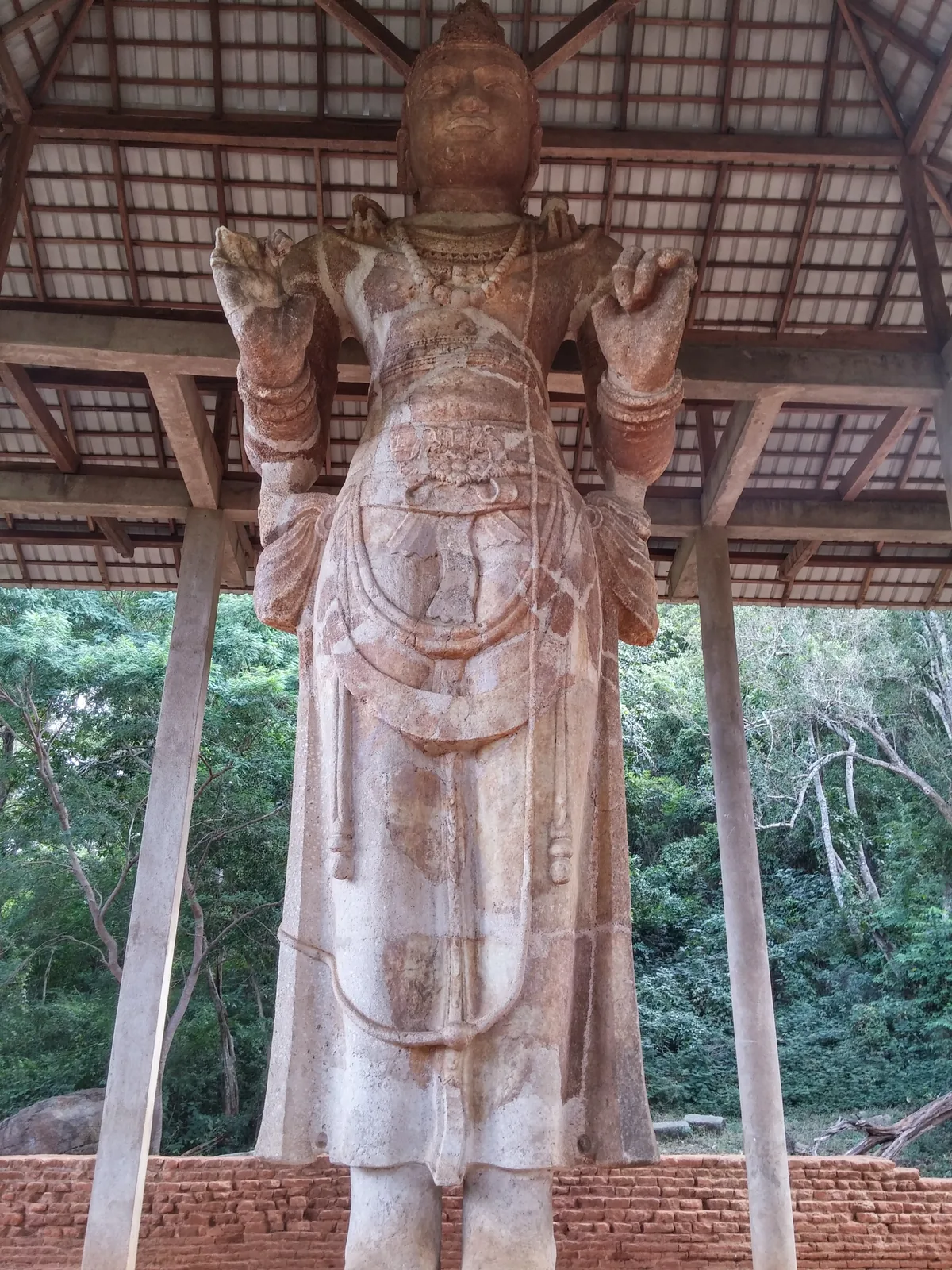
The Bodhisattva a short walk away is the richer carving. Where the Buddha is plain, this figure is crowned and jewelled, a sacred cord across the chest, the two hands raised, and in the crown a small seated Buddha, Amitabha, the sign that names the figure Avalokitesvara, the lord of compassion, though a local tradition calls it Natha and reads it as the future Buddha Maitreya. Nearly ten metres tall and some forty tons, it carries the one piece of its original finish that can still be pointed to: the eyes were set with precious stones, and the empty sockets are where they sat. Treasure-hunters dynamited it into more than a hundred pieces around 1948, and the Department of Archaeology, with German help, put it back together and raised it once more by 1990.
When the two were made is given by tradition to the seventh century and to Aggabodhi, a king of Ruhuna whom the chronicle credits with a great image of the Buddha; the stylistic dating of the Bodhisattva runs later, into the ninth or the tenth century, and the question is best held open. Whether they carried plaster and paint over the stone, as the images of their age generally did, is not recorded of them; the Bodhisattva’s lost gem eyes are the one finish that is sure.
The carvers are unknown, as they are everywhere, and the patron alone is remembered. That two images of this scale, one of them the tallest free-standing Buddha the island ever raised, stood together in the forest of the deep south is the measure of how far the classical art reached beyond its capital, and the labour of setting them up twice, once in stone and once from ruin, is the measure of what they are still held to be worth.
Sources
- Schroeder, Ulrich von. Buddhist Sculptures of Sri Lanka. Hong Kong: Visual Dharma, 1990.
- Dohanian, Diran K. The Mahayana Buddhist Sculpture of Ceylon. New York: Garland, 1977.
- The Culavamsa.
- Department of Archaeology, Sri Lanka.
How to cite this profile
Malaka Talwatte, “Maligawila and Dambegoda,” Malaka Talwatte: Sri Lankan Art and Ceylon Antiquaria, https://malakatalwatte.pages.dev/artists/maligawila/.
Quote and cite freely with attribution; please do not republish a whole essay, or a photograph, without permission.