Classical · Site
Mihintale
The oldest sculpture the island keeps stands on a small stupa at Mihintale. The Kantaka Cetiya carries at each of its four sides a vahalkada, a solid altar-frontispiece built out from the dome in rising tiers of stone, and the carving on these fronts, dwarfs and geese and animals worked in band above band, is reckoned the earliest surviving Sinhalese sculpture in stone, cut about the turn of the first century before and after Christ. Senarath Paranavitana, who excavated the stupa in 1934, called the frontispieces the oldest specimens of the plastic art in the country.
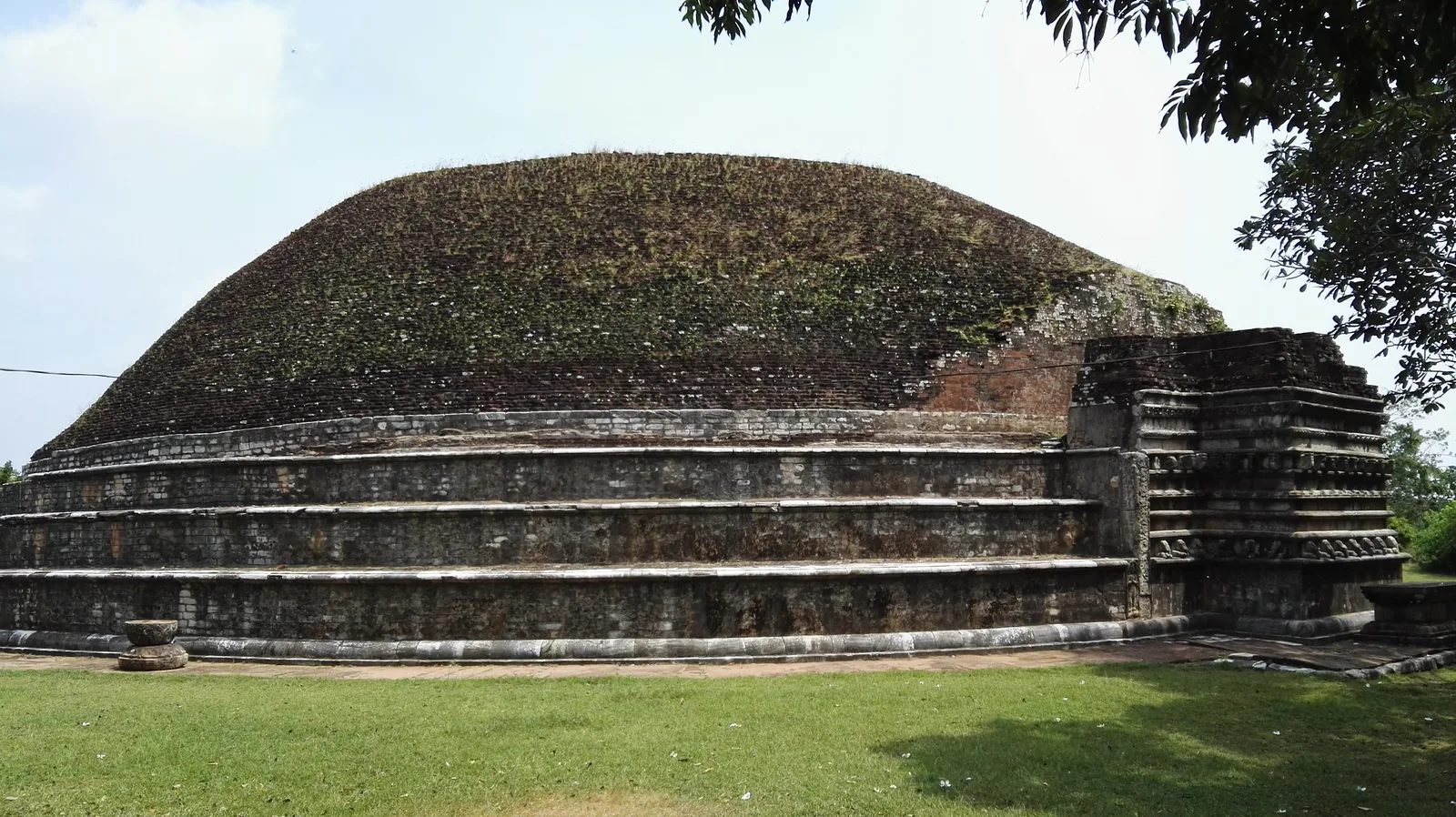
The art of them is in the friezes. A band of gana, the squat dwarf-spirits, runs along the front in a lively, near-comic procession, musicians and tumblers and figures with the heads of horse and bear and monkey among them; a row of sacred geese runs above; and the pilasters at the corners are crowned with the four beasts of the quarters, the elephant to the east, the lion to the north, the horse to the west and the bull to the south. One of the dwarfs carries an elephant’s head, and Paranavitana read it as a very early image of Ganesha, a reading the historian A.L. Basham thought remarkable, since few Indian carvings of the god are older; it is offered as a likelihood rather than a certainty. Traces of old paint have been reported on the fronts, red and yellow on the southern side, so faint now that little can be pressed on them beyond the plain fact that these carvings, like the great images, were once coloured.
The stupa sits on the hill where the island’s whole history of this art begins. At Mihintale, by the tradition the chronicle keeps, the missionary monk Mahinda, sent from the court of the emperor Ashoka, met King Devanampiya Tissa out hunting and turned him and his kingdom to the Buddha, in the third century before Christ; the date is given by tradition rather than fixed by any other record, and the meeting is kept every year at the Poson full moon.
The hill is climbed by a great granite stairway of some eighteen hundred broad steps, cut and laid up the slope, and it carries more carving as it goes: the Naga Pokuna with its five-hooded cobra cut on the rock above the water, the Lion Pond whose bath was fed through the mouth of a rampant lion, and, in the ruined refectory, the two tall inscribed slabs on which King Mahinda IV set out in the tenth century the rules by which the monastery was to be run. At the foot of the hill lie the ruins of a monastic hospital, raised by Sena II in the ninth century, its stone bath cut to immerse a patient in medicinal oils still in place, among the oldest hospital sites known anywhere. The site is the work of many ages, from the third century before Christ to the tenth after it, reign upon reign adding to the hill.
The carvers of the Kantaka fronts left no name, as none of them did, and their work has the more claim on us for being first: the dwarfs and geese and quarter-beasts of Mihintale are the beginning of the long tradition of Sinhalese sculpture that runs from here through Anuradhapura and Polonnaruwa to the temple carvers of Kandy, and it starts, as it goes on, with hands the record does not keep.
Sources
- Paranavitana, Senarath. The Stupa in Ceylon (Memoirs of the Archaeological Survey of Ceylon, Vol. V). 1946.
- Bandaranayake, Senake. Sinhalese Monastic Architecture. Leiden: Brill, 1974.
- Epigraphia Zeylanica.
How to cite this profile
Malaka Talwatte, “Mihintale,” Malaka Talwatte: Sri Lankan Art and Ceylon Antiquaria, https://malakatalwatte.pages.dev/artists/mihintale/.
Quote and cite freely with attribution; please do not republish a whole essay, or a photograph, without permission.