Classical · Minor arts
The minor arts
The great sculpture and painting of the classical island were not the whole of its art. Below the monuments ran a tradition of smaller, portable things, cut, struck and worked in stone and metal and gold, and some of the earliest and the finest of the island’s craft is found in them.
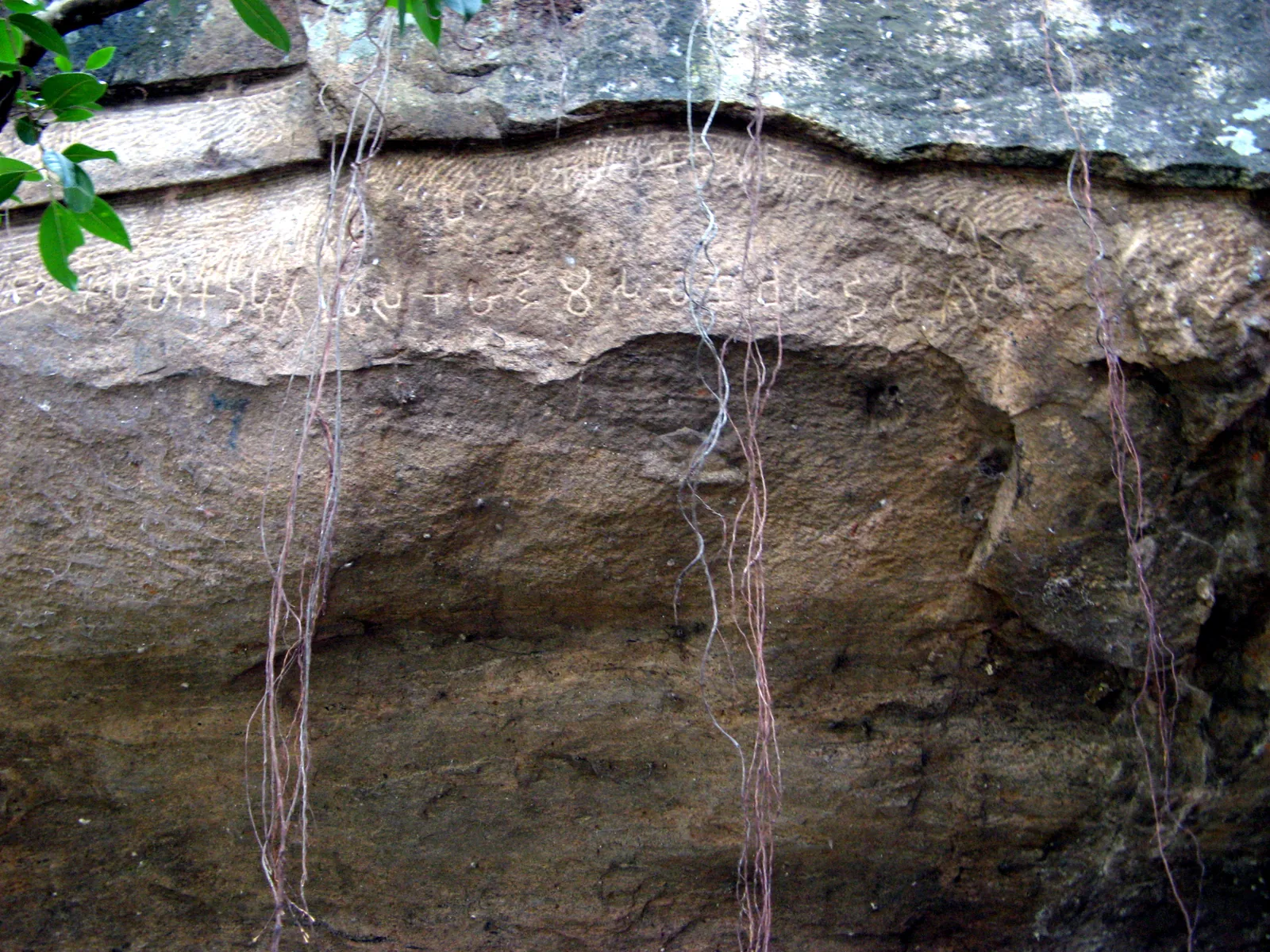
The earliest letters
The oldest art of the island is the art of the letter. From the third century before Christ, lay donors who gave caves to the monks had their gifts recorded in early Brahmi, the script cut in a single line beneath the drip-ledge, the lip cut into the rock brow to throw the rain clear of the shelter. The mason’s ledge and the incised line of letters are one gesture, the earliest writing on the island and its earliest lettering as a made, placed thing. They are found in their hundreds across the dry zone, at Vessagiriya, Mihintale, Rajagala and beyond; at Rajagala and Mihintale two of them name the missionary Mahinda himself.
The letter did not stop being an art when it left the cave. The Brahmi of the drip-ledges grew over the centuries into the rounded Sinhala hand, and by the age of Polonnaruwa it was cut on rock and slab in a fully formed calligraphy, the great stone book of Nissanka Malla and the lesser inscriptions beside it worked in a carved script as considered as the ornament around them.
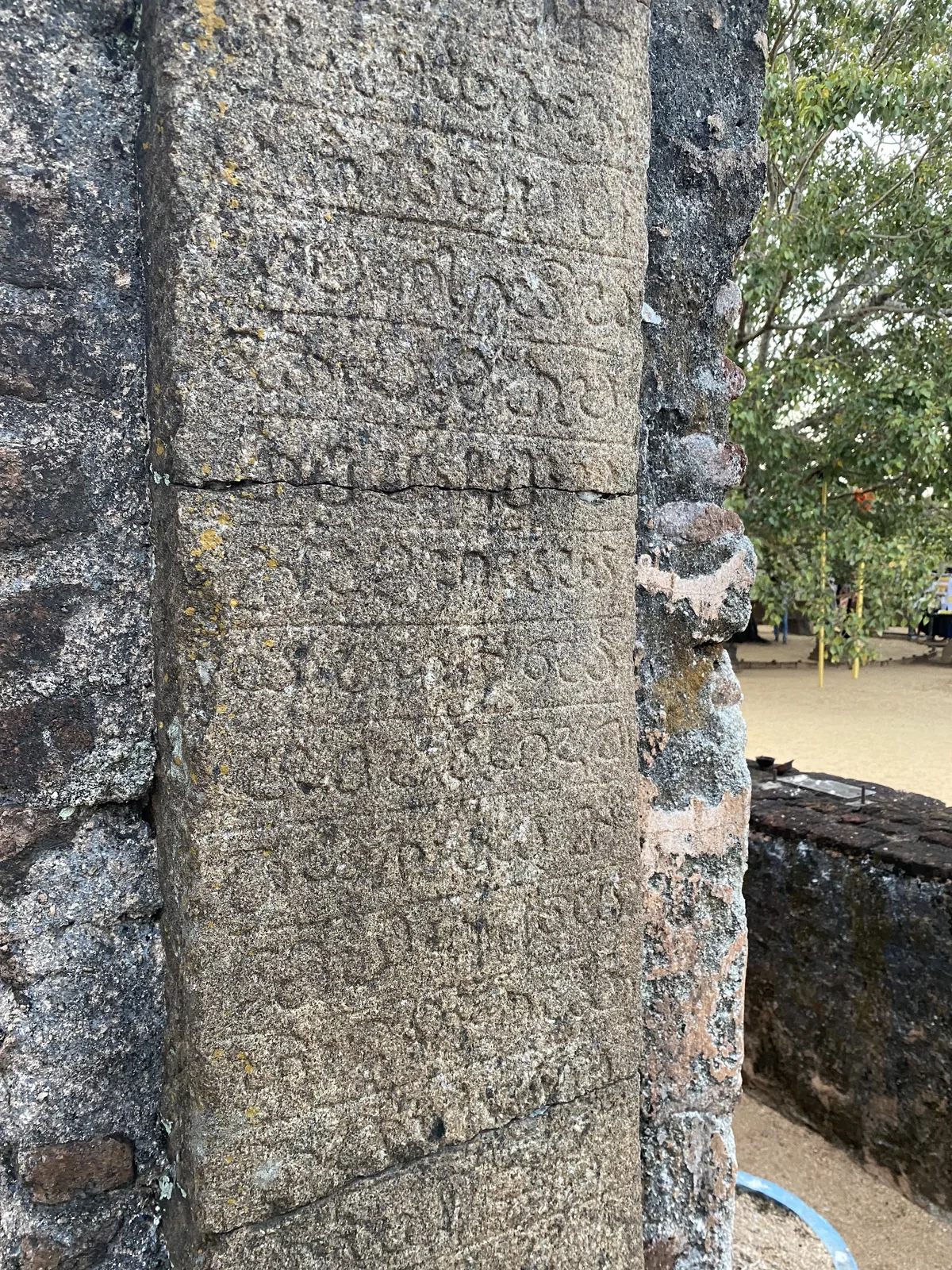
The same hand was kept and copied on the palm leaf, the ola, on which the island wrote its books, and later still it was carried onto the plastered temple wall, where the painters of the image houses set a short inscription beside each scene, a line of the Jataka verse or a caption naming the figure, in a bold cursive close to the letterforms of the manuscripts. It is often the writing, not the picture, that tells one near-identical figure from another, the twenty-four Buddhas of the Suvisi Vivarana known apart by their painted labels alone, and the script is careful enough, and dated often enough, to serve the scholar as a way of dating the paintings themselves.
The coinage
The island struck and cast its own coins, and they carry its iconography in miniature. The early copper Lakshmi plaques show the goddess of fortune on one face and a railed swastika on the other; tree, elephant and swastika recur across the copper issues; and in the Polonnaruwa age the gold kahavanu bears a standing king on one side and a seated king on the other, with a Sanskrit legend read as Sri Lanka Vibhu. The dating and the attribution of many of these are argued, and the classic study, Codrington’s of 1924, is a baseline rather than the last word.
Goldwork and reliquaries
In the relic chambers of the stupas and in buried hoards lies the goldsmith’s and the metalworker’s art. Sheet-gold plaques carry sutra text in fine script, among them the gold leaves of the Perfection of Wisdom from the Jetavana. The relics themselves were housed in miniature reliquaries, stupas in little made of gold, silver, bronze and rock crystal, casket within casket, each reliquary a model of the monument it was buried inside; the crystal was chosen for its purity and its holding of the light, the gold for what gold has always meant. These are the most intimate of the classical arts, made to be sealed away and not seen, and much of what survives is in the national collection at Colombo.
The makers of the letters, the coins and the gold are unknown, as the sculptors and painters are. The donors are named on the caves, the kings on the coins, and the craft itself is anonymous, the common inheritance of the island’s hands.
Sources
- Paranavitana, Senarath. Inscriptions of Ceylon, Vol. I: Early Brahmi Inscriptions, 1970.
- Codrington, H.W. Ceylon Coins and Currency. 1924.
- Coomaraswamy, Ananda K. Mediaeval Sinhalese Art. 1908.
- de Zoysa, Asoka, and Vajira Nalinda Jayathilaka. Buddhist Image Houses.
- Colombo National Museum.
How to cite this profile
Malaka Talwatte, “The minor arts,” Malaka Talwatte: Sri Lankan Art and Ceylon Antiquaria, https://malakatalwatte.pages.dev/artists/minor-arts/.
Quote and cite freely with attribution; please do not republish a whole essay, or a photograph, without permission.