Classical · Sculpture
The Moonstone
Set into the ground at the foot of a flight of temple steps, where a worshipper would pause and cross it going in, the sandakada pahana is the most purely Sinhalese of the island’s carved forms, a half-moon of granite worked in concentric bands that has no true parallel in India. The finest of them, at the building called Mahasena’s Palace in the Abhayagiri monastery at Anuradhapura, keeps its carving crisp after eleven centuries: an outer ring of flame, then a procession of four animals, the elephant, the horse, the lion and the bull, following one another nose to tail; then a band of looping creeper, the liyavela; then a file of sacred geese, each with a sprig in its beak; and at the centre a half-opened lotus.
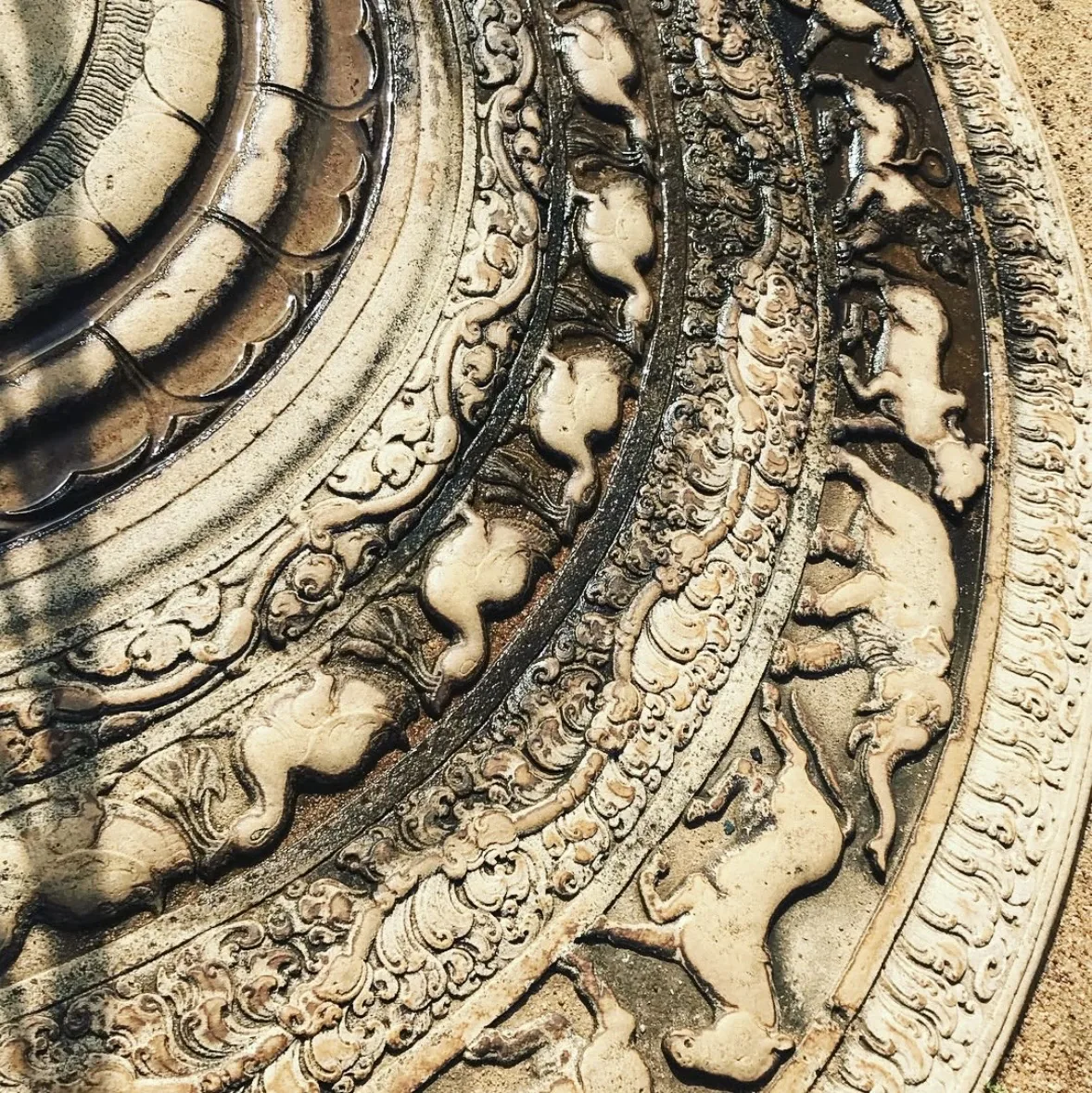
What the bands mean is the oldest argument in the study of Sinhalese art. Senarath Paranavitana, in a paper of 1954 that has shaped every account since, read the moonstone as the whole Buddhist round of birth and death laid out for the foot to cross on the way into the sacred: the outer flames the fires of desire, the four animals the perils of existence, the creeper the grip of craving, the geese the wisdom that sifts good from bad as the sacred goose was said to divide milk from water, and the lotus at the heart the stillness of nirvana into which the worshipper symbolically steps. The reading is beautiful, and it is contested. D.T. Devendra set it aside, taking the moonstone for a decorated threshold whose animals were ornament before they were doctrine; G. Senadheera read the motifs as an aesthetic order rather than a sermon; and the matching of a given animal to a given peril shifts from one writer to the next, so the broad sense of a passage from the world towards release is safer ground than any fixed table of meanings.
The form changed when the capital moved. In the moonstones of Polonnaruwa the bull is gone from the animal band, and often the lion with it, the beasts separated into their own rings. Paranavitana explained the missing bull by the rising Hindu feeling of the age, the bull being Nandi, the mount of Shiva, and no longer a thing to be trodden underfoot; the reading is widely repeated, though it leaves the vanished lion unaccounted for, and that gap is the standing weakness in it. The best of the Polonnaruwa moonstones, at the northern stair of the Vatadage, shows the change at its most assured, a little cooler and more ordered than the crowded half-moons of the older capital.
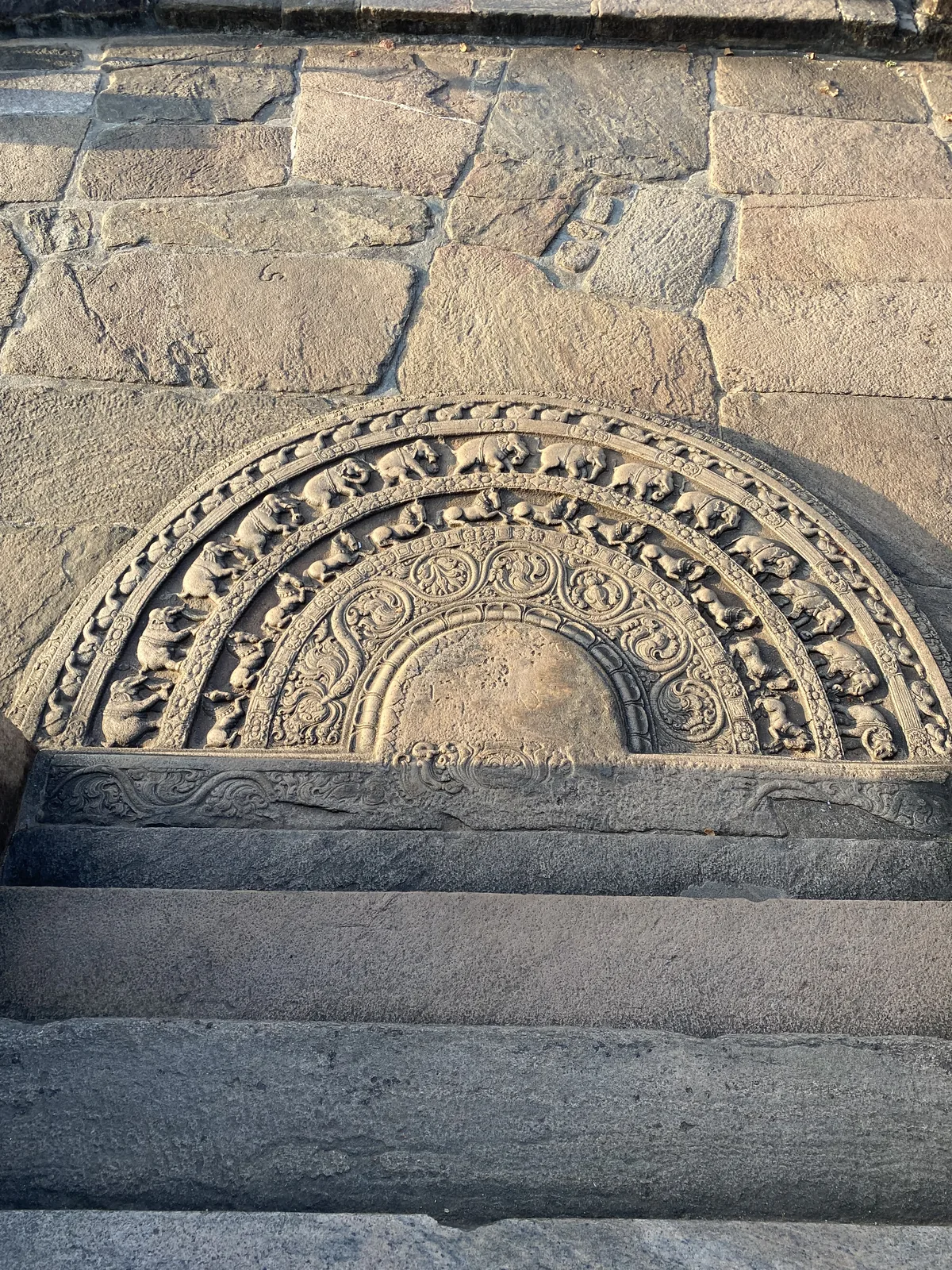
The moonstones were cut in granite, in low relief of great delicacy, at the height of Anuradhapura carving in the eighth to tenth centuries. No trace of paint is recorded on them, and they are shown as they have always been seen, as pure worked stone. Of the hands that cut them nothing survives, as nothing survives of any classical carver of the island; the sandakada pahana is the achievement of a tradition rather than of a name, and it stays the one form by which Sinhalese stonework is known anywhere in the world.
Sources
- Paranavitana, Senarath. ‘The Significance of the Sinhalese Moonstone’. Artibus Asiae 17 (1954), pp. 197–231.
- Devendra, D.T. ‘Moonstone Motifs’. Journal of the Ceylon Branch of the Royal Asiatic Society (1965).
- Coomaraswamy, Ananda K. Mediaeval Sinhalese Art. Broad Campden: Essex House Press, 1908.
- Bandaranayake, Senake. Sinhalese Monastic Architecture. Leiden: Brill, 1974.
How to cite this profile
Malaka Talwatte, “The Moonstone,” Malaka Talwatte: Sri Lankan Art and Ceylon Antiquaria, https://malakatalwatte.pages.dev/artists/moonstone/.
Quote and cite freely with attribution; please do not republish a whole essay, or a photograph, without permission.