Classical · Site
The Nelum Pokuna
The monks of Polonnaruwa bathed in a stone flower. The Nelum Pokuna, the lotus pond, is a bathing pool cut from granite in the shape of an opened lotus, its rim and its descending courses worked as rings of stone petals that step down and inward, ring within ring, to a raised stamen at the centre. Sculpture and plumbing are one thing here: the pool holds water, and it holds a form, and the form is a flower.
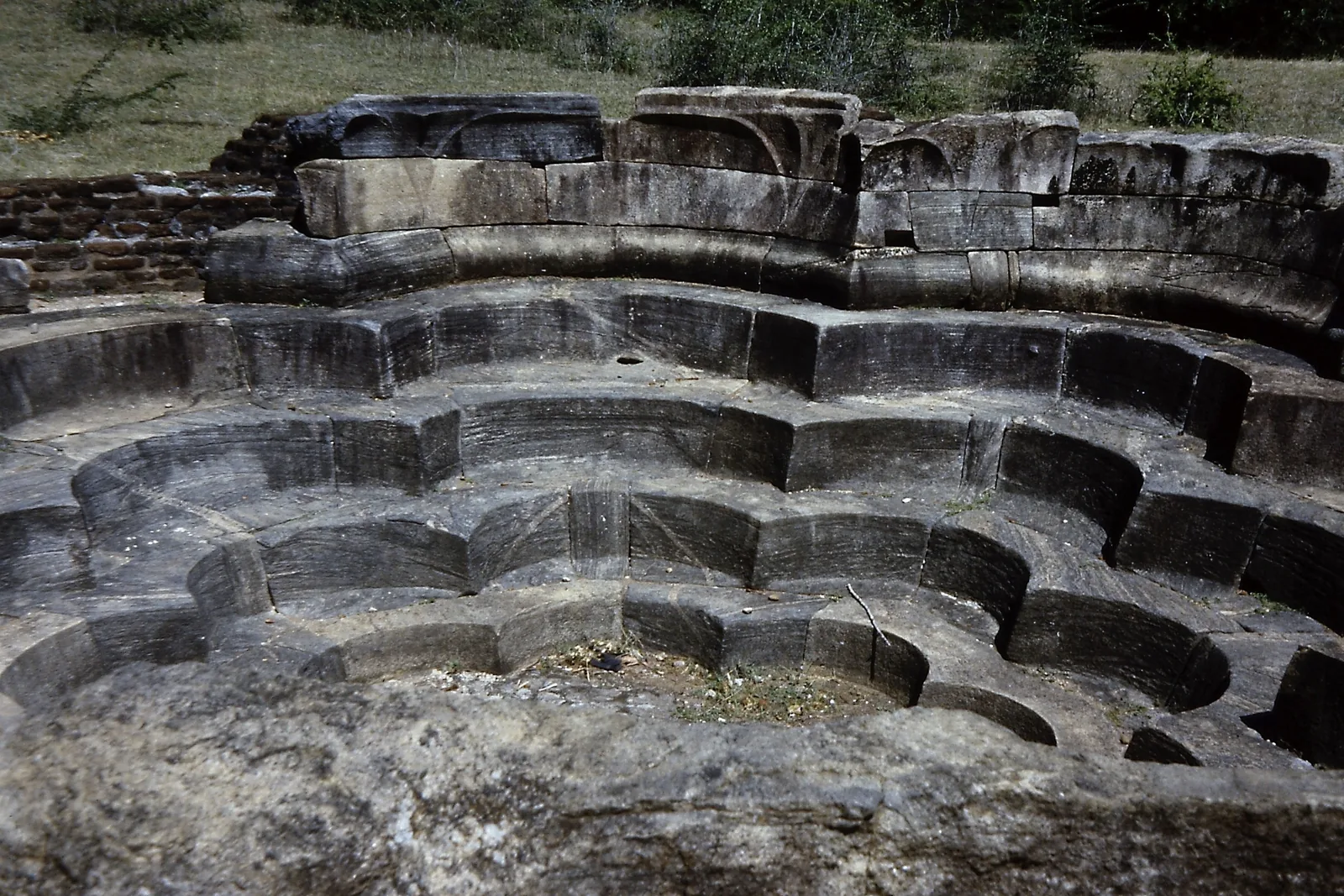
Five tiers of petals, eight to each ring, diminish as they fall towards the middle, so the bather went down into the pool as into the heart of a lotus, the flower that in Buddhist thought stands for purity rising unstained from the water. It is a small pool, a little over seven metres across and less than a metre and a half deep on the figures the Archaeological Commissioner recorded, and the way it was filled is no longer known. It was cut, on the majority reading, for Parakramabahu I in the twelfth century, among the stone bathing ponds the Mahavamsa says he made for the monks of his monastery; the chronicle’s ponds and this one are matched by inference rather than by any inscription on the stone.
The art of it is the turning of a practical thing into an image without spoiling either. A bath is a bath, but a bath cut as a lotus tells the monk who steps into it what the water is for, and does so in worked granite that has kept its petalled edge for eight hundred years. The mason who set it out is unknown, as they all are; the king who wished it is named, and the flower he had cut in stone is among the most quietly perfect things the classical island made.
Sources
- The Mahavamsa.
- Bandaranayake, Senake. Sinhalese Monastic Architecture. Leiden: Brill, 1974.
- Archaeological Survey of Ceylon / Department of Archaeology. Annual Reports.
- UNESCO World Heritage Centre. ‘Ancient City of Polonnaruwa’ (inscribed 1982).
How to cite this profile
Malaka Talwatte, “The Nelum Pokuna,” Malaka Talwatte: Sri Lankan Art and Ceylon Antiquaria, https://malakatalwatte.pages.dev/artists/nelum-pokuna/.
Quote and cite freely with attribution; please do not republish a whole essay, or a photograph, without permission.