Contemporary · Artist
Pala Pothupitiye
A British admiralty chart of Ceylon lies on the table, its coastline inked long ago by men who had come to rule the island, and Pala Pothupitiye takes a blade to it. He cuts, he layers, he turns the whole of South Asia on its head, until the map that once told the country what it was begins instead to answer to him. To understand why a Sri Lankan artist should spend a career reworking the surveys of empire, you have to go back to a carpenter’s house in the deep south, and to a boy who was taught that what his family made was not art.
He was born in Deniyaya in 1972, into a line of craftsmen and ritual performers. His father, Somaweera, carved the ornate costumes and objects used in healing ceremonies, work that the fine-art world admired at a distance and kept outside its walls. The boy grew up inside that contradiction, surrounded by making of real skill and beauty, and taught by the wider culture that it ranked somewhere below the painting hung in a gallery. The art-and-craft divide, and the questions of caste and status his work would later draw out of it, became the subject he returned to for the rest of his life.
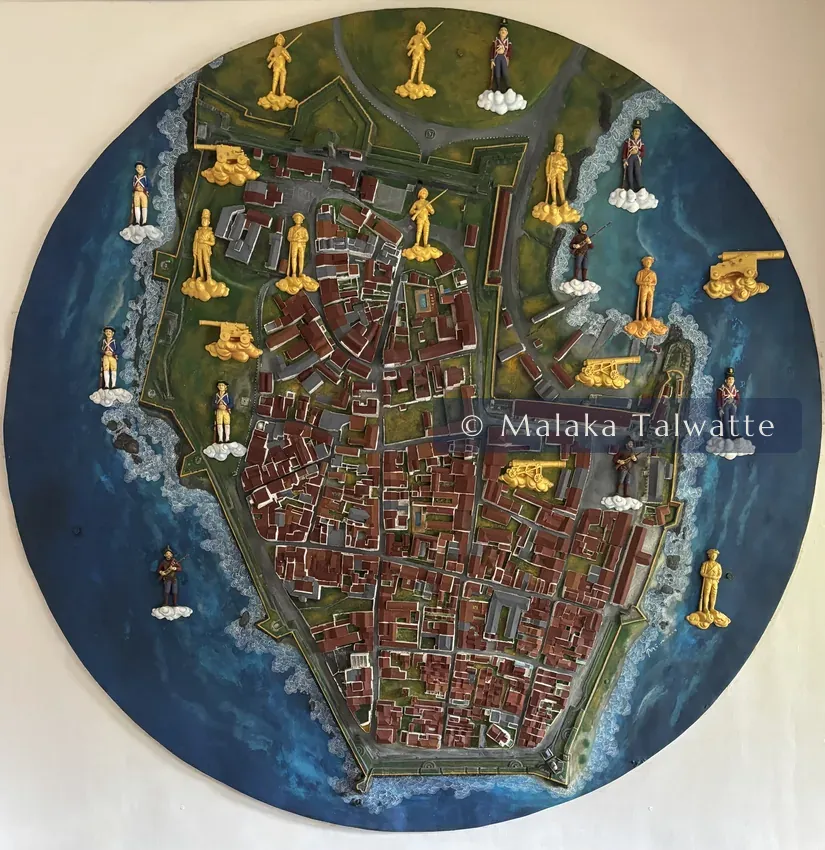
He carried the craft into the academy rather than leaving it at the door, taking a Bachelor of Fine Arts in sculpture at the University of the Visual and Performing Arts in Colombo, and coming up with the generation the critics named the ‘90s Trend, the artists who turned Sri Lankan art toward the war, the politics and the memory of their own decade. Among the earliest members of the Theertha Artists’ Collective, formed in 2000, he helped build the room in which that argument could be held.
The maps came later, and with them the method that would give the old contradiction its form. The colonial chart, the government survey, Ptolemy’s ancient rendering of the island: he treats each as an instrument of possession and hands it back altered, cut through with the very craft traditions the surveyors never counted as knowledge. His inversions of South Asia, and the works that graft one era’s map onto another’s, take up Eurocentrism, the memory of the thirty-year war, and the question of who holds the power to name a place. The tools he was once taught to rank below art became the means by which he redraws the map itself.
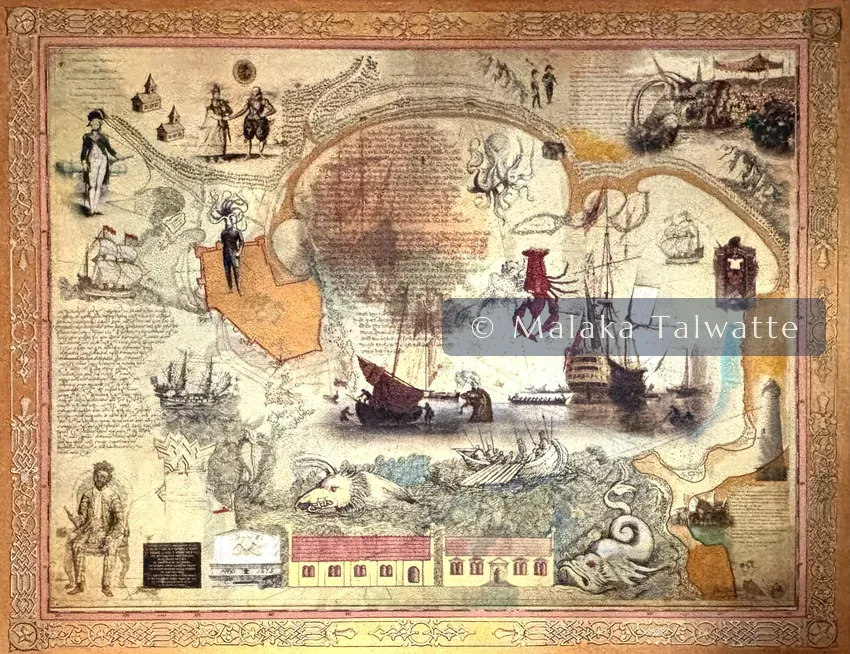
The world beyond Colombo has taken the point. He was selected for the Fukuoka Triennial in Japan in 2005, and has since shown at the Colombo Art Biennale, the inaugural Karachi Biennale in 2017 and the Museu d’Art Contemporani de Barcelona in 2019; his work is held by the Queensland Art Gallery in Australia, and he has exhibited with the Saskia Fernando Gallery in Colombo, where he showed a solo body of new work in 2011.
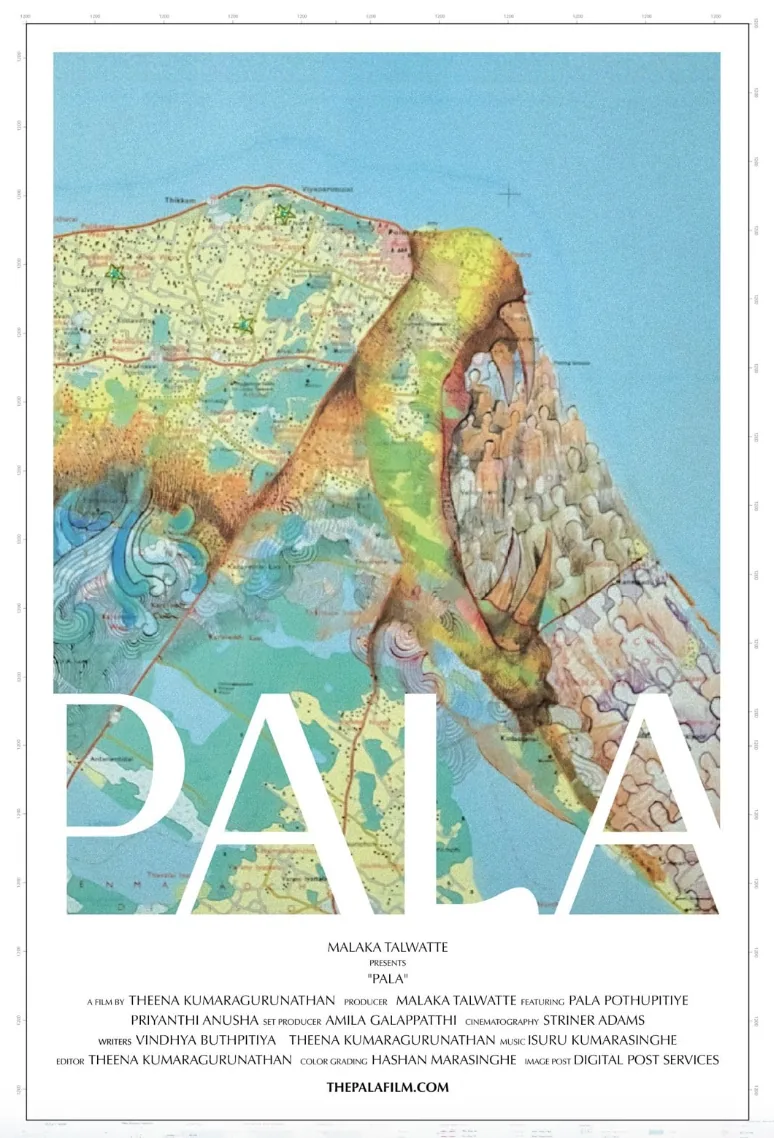
In 2023 he became the subject of a feature documentary, Pala, directed by Theena Kumaragurunathan and produced by Malaka Talwatte. Rather than survey the work from the outside, the film takes the form of a cinematic thovil, the healing ritual of the southern craftsmen he was born among, and returns him to the tradition the galleries once kept at their door: across ninety minutes it moves through sound, movement and image the way the ceremony does, so that the art and the inheritance behind it are held in a single frame. It has since screened internationally, including at the Institute of Contemporary Arts in London.
The boy who watched his father carve the objects the galleries would not admit now sits at a table with a colonial map and a blade. The inheritance he was once taught to hide has become the work he is known for, and the means by which he redraws the lines that others once drew for him.
Sources
- Pothupitiye, Pala. ‘Profile’ (artist’s website). https://palaart.com/profile/
- Scroll.in. ‘Why Pala Pothupitiye’s redrawn maps are gaining ardent admirers in India’. https://scroll.in/magazine/836055/why-a-sri-lankan-artists-redrawn-maps-are-gaining-ardent-admirers-in-india
How to cite this profile
Malaka Talwatte, “Pala Pothupitiye,” Malaka Talwatte: Sri Lankan Art and Ceylon Antiquaria, https://malakatalwatte.pages.dev/artists/pala-pothupitiye/.
Quote and cite freely with attribution; please do not republish a whole essay, or a photograph, without permission.