Pre-modern · Artist
Philippus Baldaeus
Philippus Baldaeus, born at Delft in 1632 and orphaned young, studied theology at Groningen and Leiden, took orders as a minister of the Dutch Reformed Church, and sailed for Batavia in 1654. After Colombo fell to the Company in 1656 he was posted to Ceylon, served as an army chaplain through Mannar and Jaffna, and rose to Chief Predikant of Jaffna in 1658; he learned Tamil, founded some thirty churches and schools, and was sent home in 1665 after a quarrel with the government. He died at Geervliet about 1672, in his fortieth year.
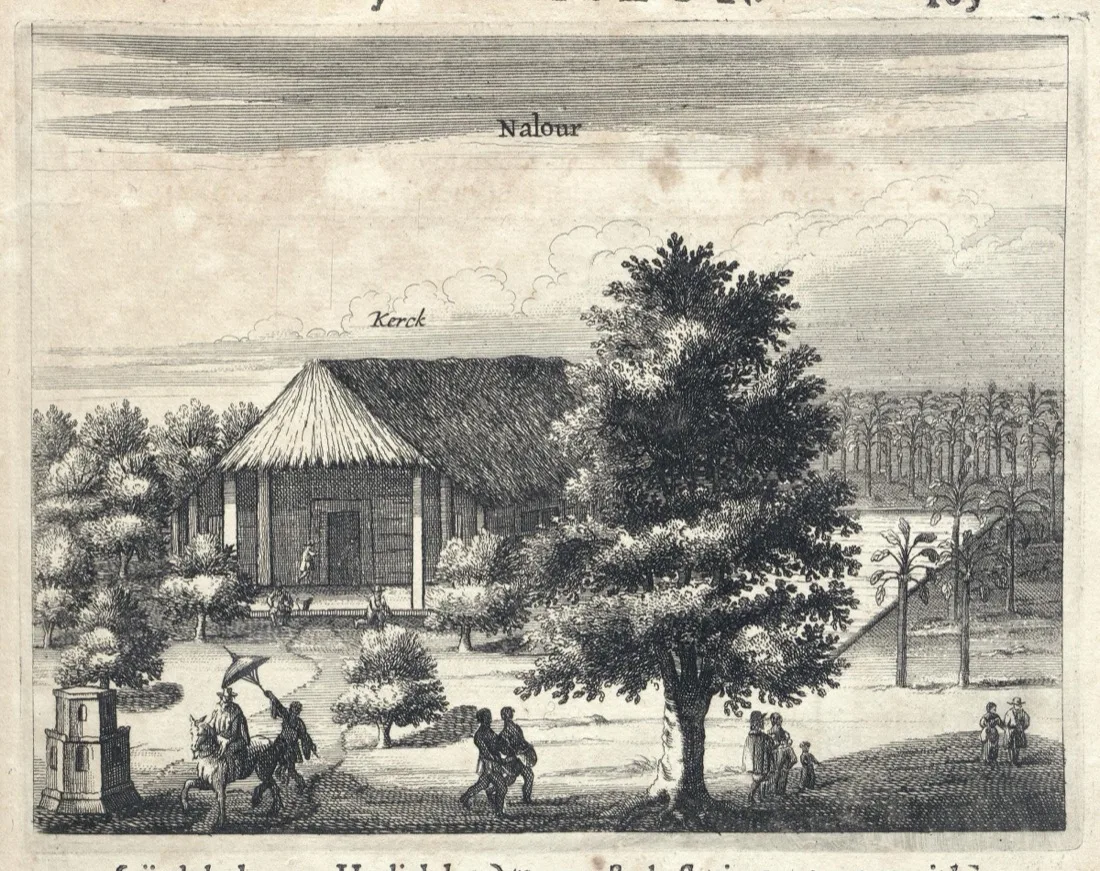
His folio ‘Beschryving van het machtige Eyland Ceylon’, printed at Amsterdam in 1672 just after his death, appeared in three parts, carrying his portrait, many double-folio plates and text engravings: historical events, maps, plans, and views of towns, ports and forts, together with religious and ethnographic subjects. It became one of the most famous illustrated accounts of the island, and its plates were copied for a hundred years.
What raises the folio above a mere gathering of prospects is the double nature of its picture-making. Much of what it shows Baldaeus had stood before himself, the churches he raised across the Jaffna commandement, the funeral rites and household customs of the Tamil north, and those plates hold the steadiness of a witness. The celebrated set on the Hindu gods rests on other ground, for there he drew on Abraham Rogerius, whose ‘Open-Deure tot het verborgen Heydendom’ of 1651 had first opened Tamil worship to Dutch readers, so that the deities come to the page as much inherited from an earlier book as observed at any temple. To turn his Ceylon is to follow two hands at once, the minister recording what lay before him and the compiler assembling what others had already engraved, and the plainness of the cutting, worked in the dense, unsoftened manner of the Dutch travel folio, holds both together as a single documentary whole.
Sources
- Baldaeus, Philippus. Naauwkeurige beschryvinge van Malabar en Choromandel, der zelver aangrenzende ryken, en het machtige eyland Ceylon. Amsterdam, 1672. English translation, A True and Exact Description of the Great Island of Ceylon.
- de Silva, R.K., and W.G.M. Beumer. Illustrations and Views of Dutch Ceylon 1602–1796. London and Leiden: E.J. Brill, 1988.
How to cite this profile
Malaka Talwatte, “Philippus Baldaeus,” Malaka Talwatte: Sri Lankan Art and Ceylon Antiquaria, https://malakatalwatte.pages.dev/artists/philippus-baldaeus/.
Quote and cite freely with attribution; please do not republish a whole essay, or a photograph, without permission.