Classical · Site
The Polonnaruwa stupas
When the kings of Polonnaruwa raised their great stupas, they built to the memory of Anuradhapura. Two of them stand best today, at the two ends of preservation: Rankoth Vehera, the largest, a mountain of bare brick, and Kiri Vehera, the smallest of the great ones, which alone has kept its white skin.
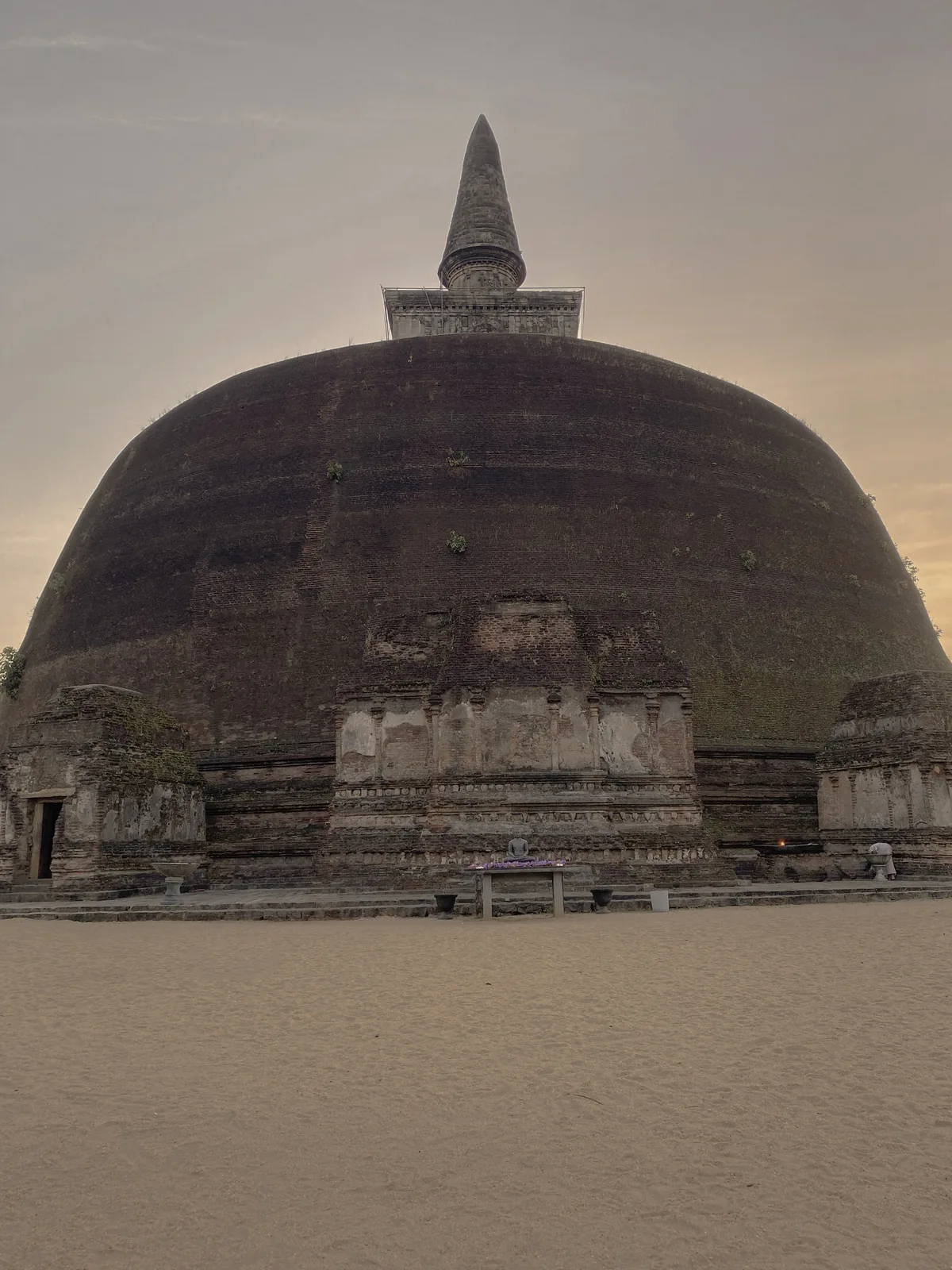
Rankoth Vehera
Rankoth Vehera is the largest stupa at Polonnaruwa, a brick dome swelling in the old bubble form, and Nissanka Malla, who built it and gave it its name, the golden pinnacle, made it deliberately after the Ruwanwelisaya of Anuradhapura, the Polonnaruwa answer to the great dagaba of the older capital. Round its base stand the four frontispieces and the ring of small shrines of a stupa of the first rank. Its size is given variously, the dome now standing above thirty metres and reckoned once at fifty and more, its base running some hundred and seventy metres round; the figures shift from source to source, and the safe word is that it is the greatest of the city’s stupas.
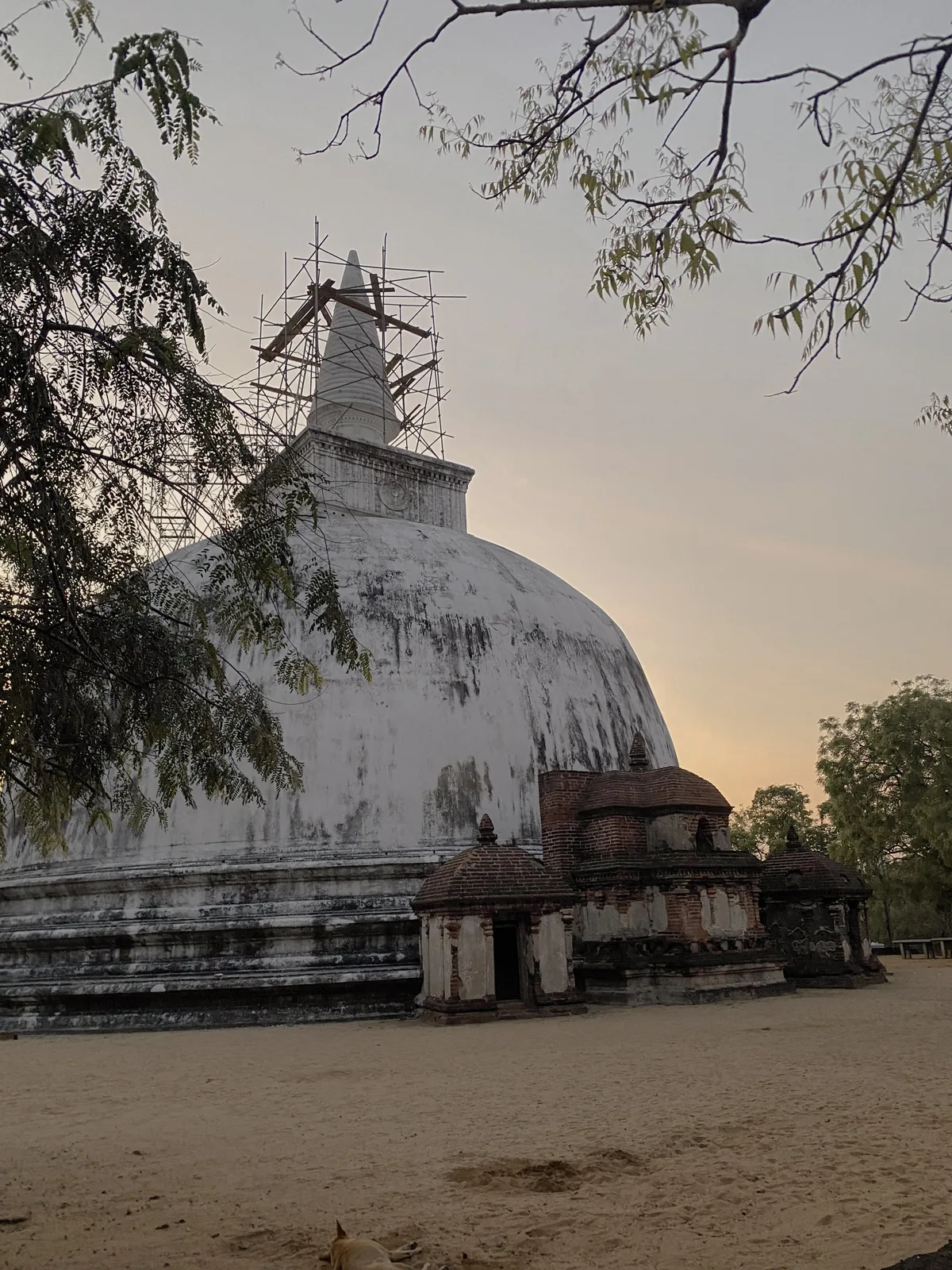
Kiri Vehera
Kiri Vehera is the counter to it, not the largest but the best kept, the one stupa at Polonnaruwa that still wears the white lime plaster of its own age, the chunam skin that gives it its name, the milk stupa. To stand before it is to see what the others have lost, the smooth white dome as it was meant to be seen, where Rankoth and the rest show their bare brick. It is given to the twelfth century and, by tradition, to Queen Subhadra, a consort of Parakramabahu, though whether she built it or it was built for her is not certainly known.
Between the two, the bare brick colossus and the small white-skinned dome, the Polonnaruwa stupa can be read both ways at once, as the great form stripped to its core and as the same form kept whole. Their builders are unknown, as the stupa-builders always are; the kings and the queen are named, and the domes are what they left.
Sources
- Paranavitana, Senarath. A Guide to Polonnaruwa. Colombo: Department of Archaeology, 1950.
- Bandaranayake, Senake. Sinhalese Monastic Architecture. Leiden: Brill, 1974.
- Wickramagamage, Chandra. Heritage of Rajarata. 2004.
- UNESCO World Heritage Centre. ‘Ancient City of Polonnaruwa’ (inscribed 1982).
How to cite this profile
Malaka Talwatte, “The Polonnaruwa stupas,” Malaka Talwatte: Sri Lankan Art and Ceylon Antiquaria, https://malakatalwatte.pages.dev/artists/polonnaruwa-stupas/.
Quote and cite freely with attribution; please do not republish a whole essay, or a photograph, without permission.