Classical · Site
The Polonnaruwa Vatadage
A vatadage was built to put a roof over a stupa, and to do it in stone: a circular house of brick and carved granite raised in rings around a small dagoba, with a Buddha seated at each of the four entrances and a forest of stone columns that once carried a wooden roof over the whole. The best preserved of them all stands in the Sacred Quadrangle at Polonnaruwa, and though the roof and the upper columns are long gone, what remains carries some of the finest carving on the island.
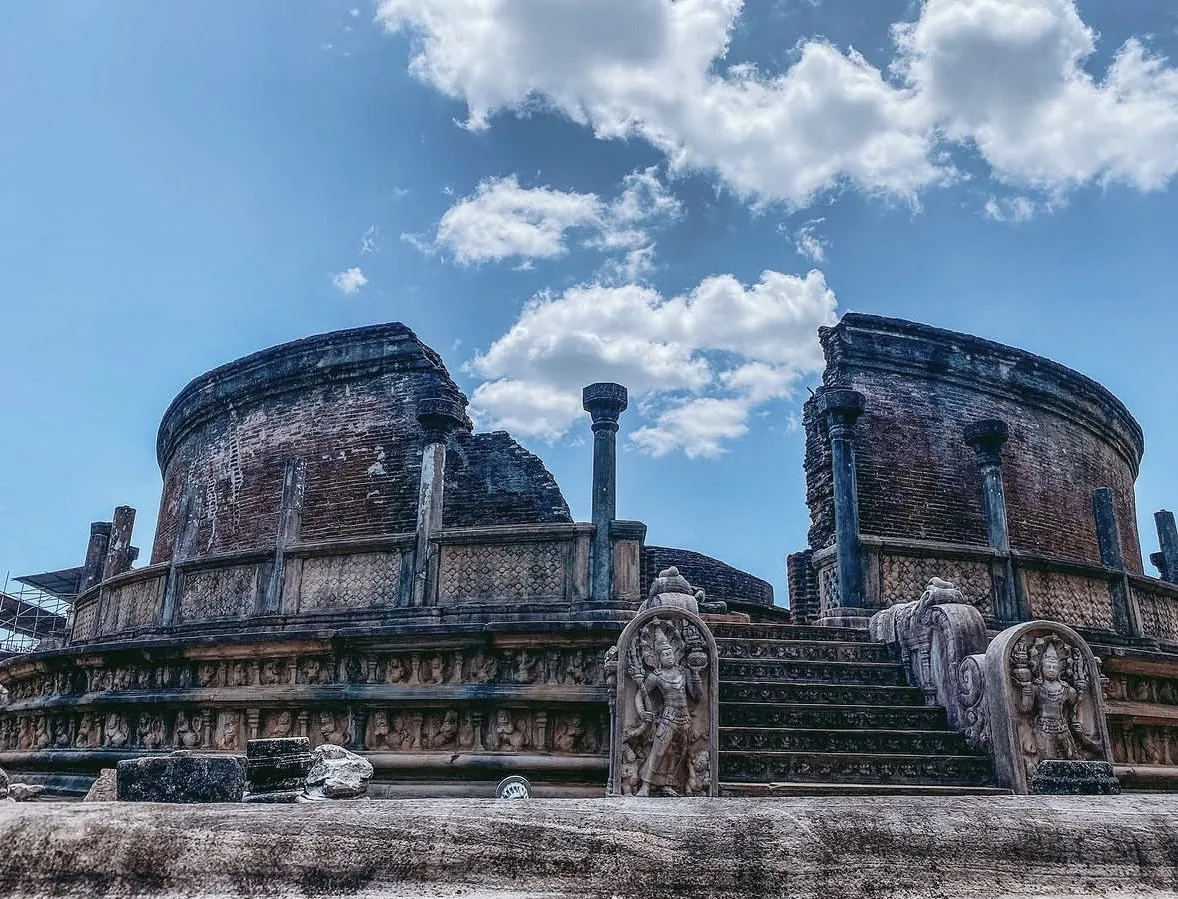
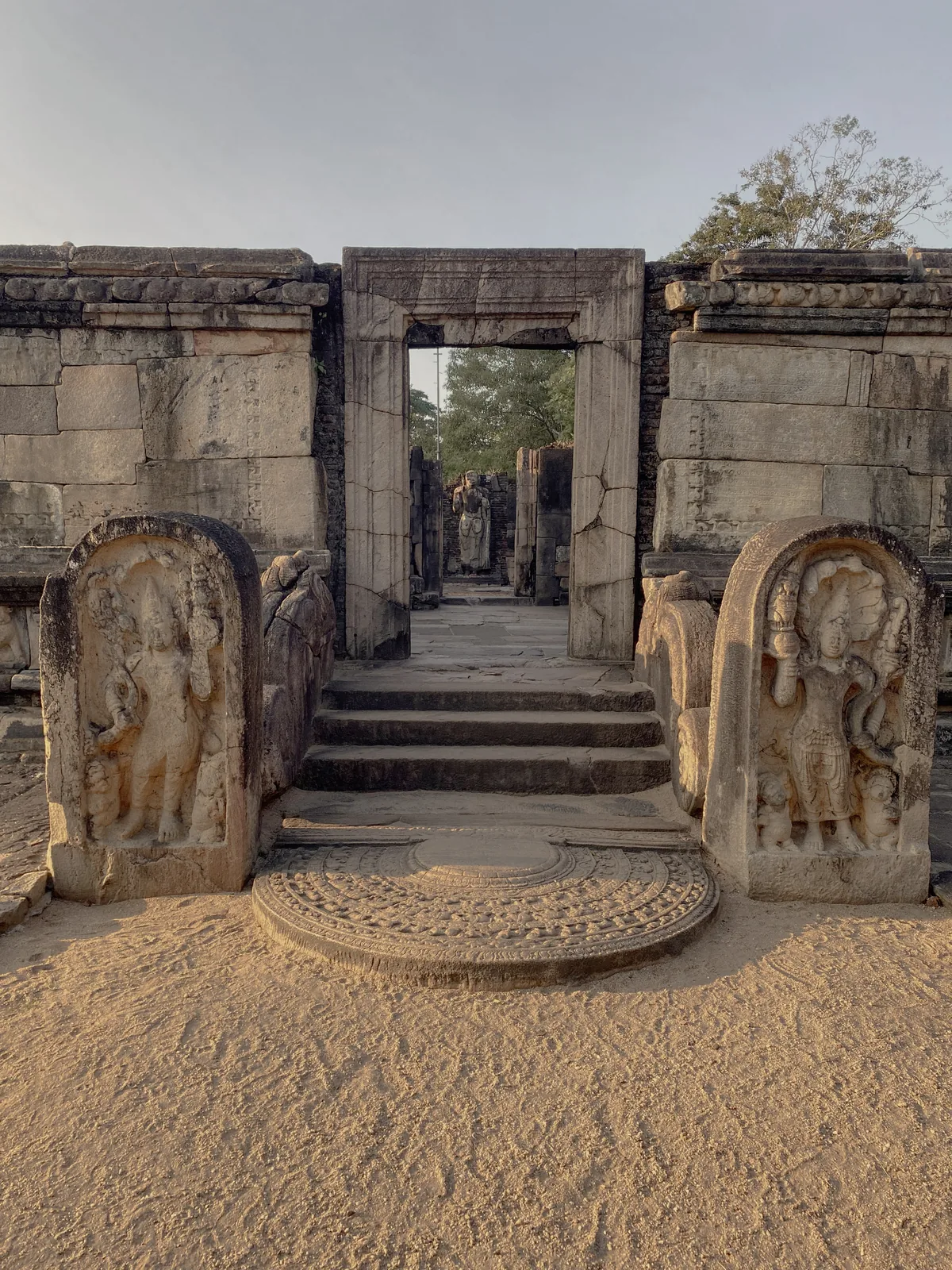
The stone at the northern stair is the reason many come. The moonstone set there is widely held the finest of the Polonnaruwa period, and it shows how the form had changed since Anuradhapura: the bull is gone from the ring of animals, the beasts separated into their own bands, the whole a little more ordered and a little cooler than the crowded half-moons of the older capital. The guardstones are counted among the best on the island, in the company of the great Nagaraja stone at the Ratnaprasada; a low frieze of dwarfs, caught in music and dance, runs round the face of the upper terrace; and a carved stone screen, worked as though it were a timber railing, once closed the platform. The excavator H.C.P. Bell judged the carving here without rival at either Anuradhapura or Polonnaruwa, and little since has argued him down.
Four seated Buddhas face outward from the centre, one to each entrance, cut in grey granite in the posture of meditation, two of them still whole. Who raised the building is not settled. The Culavamsa records that Parakramabahu I built a circular stone shrine for the Tooth Relic, and Bell took the Vatadage for that shrine; a stone inscription on the building, though, has Nissanka Malla claim it as his own, the ‘Ratnagiri’ vatadage raised by his general, and Nissanka Malla was a king much given to claiming other men’s work in stone. The reconciling view, argued by A.M. Hocart and followed by Wilhelm Geiger and H.W. Codrington, gives the building to Parakramabahu I and the embellishment and the inscription to Nissanka Malla, which leaves the first raising of it open and the later adorning of it more or less sure.
The columns are usually thought to have held a wooden roof, on the evidence of nails and tiles turned up in the digging, though the want of a central support has kept the question of how it was covered alive, and reconstructions from a low dome to a conical roof have all been offered. The building belongs to the late twelfth or the early thirteenth century, the last flowering of the old capital before Polonnaruwa was given up to the forest about 1215.
The images and the carving were cut in granite. No trace of original colour is recorded on them, and they are seen as worked stone. Of the carvers nothing is known, as nothing is known of any of them, and the Vatadage stands as the tradition’s parting masterpiece in the round, the point at which the Sinhalese mason’s art of the threshold, the guardian and the sheltered relic was gathered into a single building and brought to its finish.
Sources
- Coomaraswamy, Ananda K. Mediaeval Sinhalese Art. Broad Campden: Essex House Press, 1908.
- Paranavitana, Senarath. Art of the Ancient Sinhalese. Colombo: Lake House, 1971.
- Bandaranayake, Senake. Sinhalese Monastic Architecture. Leiden: Brill, 1974.
- Bell, H.C.P. Archaeological Survey of Ceylon: Annual Reports.
- UNESCO World Heritage Centre. ‘Ancient City of Polonnaruwa’ (inscribed 1982).
How to cite this profile
Malaka Talwatte, “The Polonnaruwa Vatadage,” Malaka Talwatte: Sri Lankan Art and Ceylon Antiquaria, https://malakatalwatte.pages.dev/artists/polonnaruwa-vatadage/.
Quote and cite freely with attribution; please do not republish a whole essay, or a photograph, without permission.