Classical · Sculpture
The Potgul Vihara Statue
A bearded man stands carved in the rock at the southern end of Polonnaruwa, holding something across his chest, and the whole interest of the figure is that we cannot say who he is. In a tradition that carved gods and Buddhas by a fixed canon and left the human face all but untouched, this three-and-a-half-metre image is a rarity: a monumental figure that looks like a particular person, grave, heavy-lidded, the shoulders rounded with age, the weight settled on one leg so the body takes a natural, living stance. Paranavitana thought it an image of unusual strength and dignity, and the carving earns the judgement.
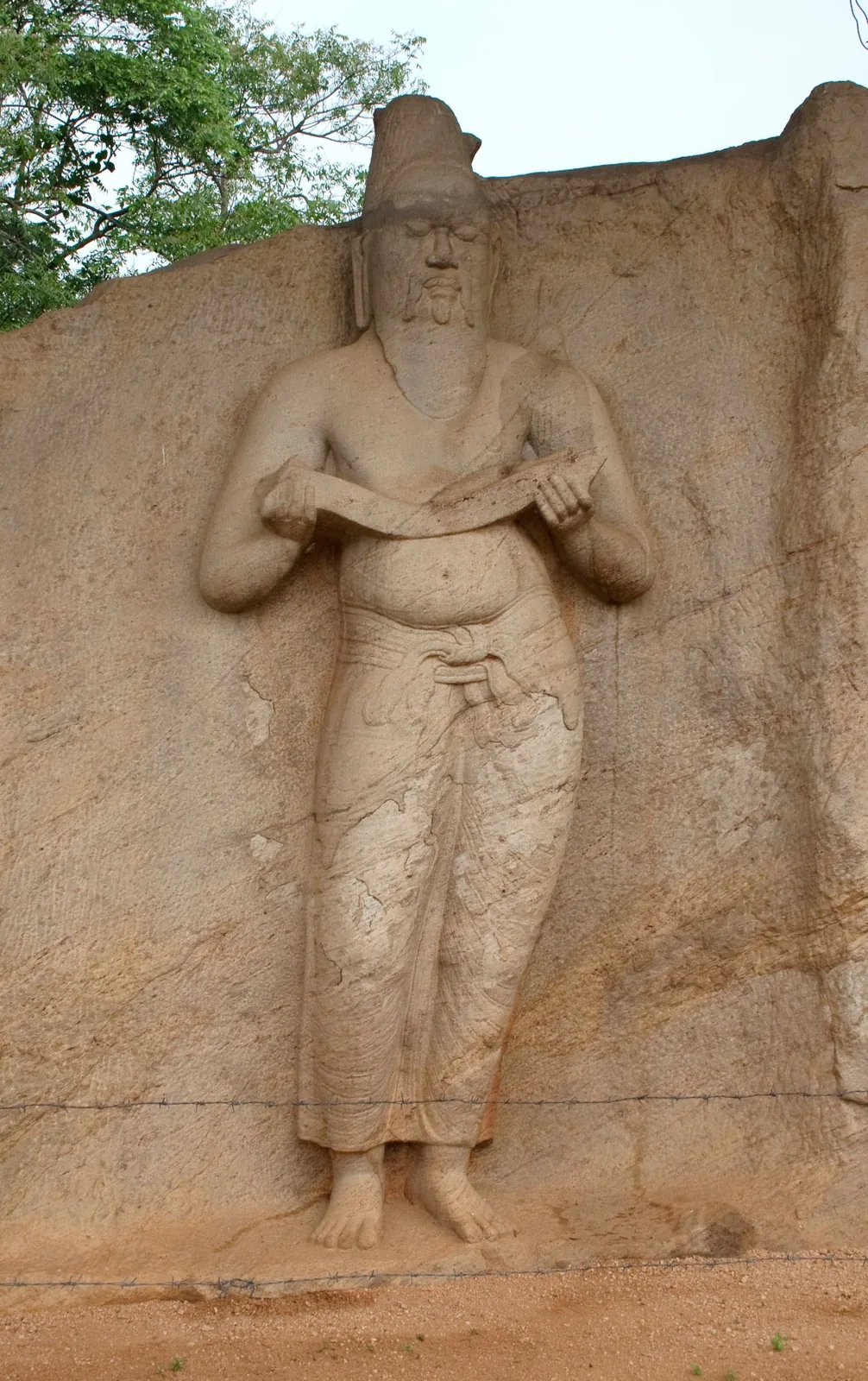
The object he holds is the crux. Some read it as a palm-leaf manuscript, an ola book, which would make him a sage bent over the law; others as a yoke, the yoke of kingship, which would make him a king. The two readings pull the whole identity after them. The popular and long-held view is that the figure is Parakramabahu I, the great king who rebuilt Polonnaruwa, an identification supported by the majesty of the bearing, by drapery close to that of the Gal Vihara Buddhas of his reign, and by cremated remains found nearby that suggest a royal memorial. Against it, Prematilleke and Wickramagamage read a defaced inscription on the rock above as the name of the sage Pulastya, after whom Polonnaruwa was anciently called Pulastipura, and point to the matted hair and the absence of any royal dress.
Even the greatest authority changed his mind. Paranavitana read the figure in 1933 as a sage of the eighth or ninth century, in 1952 as a twelfth-century king holding the yoke of kingship, and later still leaned towards an earlier king, Vijayabahu. The question has never closed, and it is the more interesting for a tradition that so rarely gives us a face to argue over at all.
The figure is cut in high relief on a boulder near the bank of the Parakrama Samudra, the great reservoir Parakramabahu made, and it belongs, on the majority reading, to the twelfth century. Whoever he is, and whoever carved him, the record is silent on both; the Potgul Vihara statue keeps its book or its yoke against its chest and its name to itself, the one near-portrait the classical age has left us and the one it will not let us read.
Sources
- Paranavitana, Senarath. ‘The Statue near Potgul-Vehera at Polonnaruva’. Artibus Asiae 15 (1952): 209–217.
- von Schroeder, Ulrich. Buddhist Sculptures of Sri Lanka. Hong Kong: Visual Dharma, 1990.
- Coomaraswamy, Ananda K. Mediaeval Sinhalese Art. Broad Campden: Essex House Press, 1908.
How to cite this profile
Malaka Talwatte, “The Potgul Vihara Statue,” Malaka Talwatte: Sri Lankan Art and Ceylon Antiquaria, https://malakatalwatte.pages.dev/artists/potgul-vihara/.
Quote and cite freely with attribution; please do not republish a whole essay, or a photograph, without permission.